

Appendix 1. Aide memoire for diving deaths in Tasmania
Deceased
|
Important requirements |
Notes | |
|
The body to remain in clothing or dive suit. The body will be transported directly to the Royal Hobart Hospital (RHH) (preferred) or nearest hospital, weather conditions permitting. |
The body may need to be extracted by land or air transport and may need to be taken to another hospital on route for testing to occur, depending on duration since the death. Other venues for initial assessment include: Launceston General Hospital (LGH), North West Regional Hospital (NWRH), Mersey Community Hospital (MCH), West Coast District Hospital (WCDH), King Island District Hospital (KIDH), and Flinders Island Multipurpose Centre (FIMC). |
The Coroner’s Associate is to ensure appropriate transportation of the body in keeping with time critical body analysis requirements. |
|
If Forensic Services do not attend the location, they will attend the Mortuary for photographs after the CT etc. has been done. |
This step is dependent on ad-vice from the Forensic Pathologist/Coroner as to the value of Mortuary photographs to their exam/investigation. | |
|
The body is to be transported to an appropriate hospital for CT scan or erect CXR within three hours at best (maximum of eight hours) of death. |
If body is unable to be trans-ported in this time, the Coroners Associate will liaise with the RHH Hyperbaric Consultant/Registrar as to any alternatives. |
The RHH hyperbaric Consultant/Registrar will make the arrangements at the alternative venue. The Coroner's Associate will organise the transport. |
|
The Mortuary Ambulance or other transport will deliver the body to the RHH or other venue within considered time constraints. |
The RHH Hyperbaric Consult-ant/Registrar will provide advanced notice of the body arriving for CT scanning/CXR to the respective hospital through the Executive Director of Medical Services (EDMS) or Tasmanian Coordinator for Ochre Medical Services, Queenstown/KI/FI. |
Once these tests have been completed, the Police Officer will accompany the body to the Mortuary for admission. The usual process of body delivery to the RHH will then occur, should the body require an urgent CT scan outside RHH. |
Equipment
|
Important requirements |
Notes | |
|
Secure the diving equipment with video +/- photo documentation. |
Body worn camera (BWC) to be activated and to remain on during the incident. |
Specifically – mask, snorkel, wet suit, fins, weight belt/pouches, BCD, catch bag, scuba apparatus, hookah/surface supply apparatus, and dive watch/computer. (Please refer to Dive Incident Inventory form). |
|
If there is SCUBA in use – seal the equipment with the valves closed: to turn off the gas canister/cylinder count and record the number of rotations of the valve taken to seal the SCUBA tank/gas canister/cylinder. For Rebreather equipment, the two-way cock in the mouth piece needs to be turned to 'atmosphere' (to capture the gas inside the canisters and hoses) and taped in position. Tape all moveable parts in the position they were in for the dive, apart from the above (to be taped in the new position). |
The items need to be left in their current state (i.e. not to be disassembled, or if disassembled to not be reassembled) to be investigated by the Technicians of the RHH Department of Diving and Hyperbaric Medicine (DDHM) as deemed appropriate. |
Southern Marine and Rescue Services (MRS) can dry equipment or assist with wet weighing, if necessary. |
|
All diving and other equipment seized at the scene will be brought to Hobart for assessment and storage at MRS. Boats may be seized if they are relevant to the investigation e.g. Fixed SSBA/Hookah set up on a boat. |
Preference for Dive Squad Supervisor to attend and secure/seize equipment. Issue receipt for any equipment seized. Continuity labels to be attached. |
Forensic Services can have members trained to secure the equipment in the event Dive Supervisor does not attend. Forensic Services may also take the necessary equipment to MRS. |
|
If Forensic Services did not attend scene, MRS can attend on their behalf and photograph equipment. |
If there is a diver from MRS attending, then it will be left to them to secure the equipment in the best way for examination by the DDHM Technicians. Forensic Services can attend MRS prior to the equipment being sent to the RHH DDHM in order to comprehensively photo document all essential equipment. |
Further photographs and the use of drones at the scene can be completed at a later date, if needed. |
|
MRS are to coordinate the inspection of equipment by RHH DDHM Technicians. |
Specifications relating to equipment movement will be outlined in this document and if there is any confusion, advice will be sought from the Dive Squad Supervisor via the Coroners Associate. |
Once any boat assessment is completed it may be considered for conditional release under a Coronial Care and Control Order. |
Appendix 2. Diving Deaths Checklist
|
Item |
Notes |
|
Dive Cylinder / spare |
When in use, the cylinder valve should be fully open & back half turn. When diving, a loose valve is considered ‘open’, hence the term ‘fully open & back half a turn’ = ‘loose’, whereas a tight valve is considered ‘closed’. Be aware some individuals are incorrectly opening valves to the hard stop. This can give a false indication of a closed valve. This can cause a pressure lock when trying to remove the regulator, as the valve is actually open, and system pressurised. Caution is advised. Cylinder valves should be used when fully open, this prevents a narrowed orifice freezing over and allows gas to flow freely. Turn valve off clockwise & note number of full turns. Isolate spare cylinder for air analysis comparison. |
|
1st and 2nd stage regulators |
Check & record pressure gauge. Tape in found position, all adjustment knobs on 2nd stage demand valves. Check for neck strap. |
|
Buoyancy compensator |
Note method of inflation, power inflator (connected to 1st stage regulator), small cylinder or cartridge. Maintain integrity as found. Do not drain contents. Note and record presence or absence and amount of integrated weights if relevant. |
|
Face mask |
If full face mask, check connections, note vent position, note any adjustments or isolation. Do not rinse or wash out mask / oral nasal. |
|
Snorkel |
Do not wash/ rinse. |
|
Swim fins/ boots |
Collect fins, if wearing boots check for weighted soles and release devices. |
|
Dive computer |
Remove from water/ wet area to stop recording. Turn off. Dry and bag. |
|
Wetsuit/ drysuit |
Collect all wetsuit parts worn by deceased for buoyancy assessment. |
|
Weight belt |
Collect weight belt, pocket weights, or weight harness. If deceased, photo in situ. |
|
Deco tables/ docs |
If available, collect full dive plan, decompression & repetitive diving worksheets. |
|
Camera equipment |
Collect recording devices, cameras / video. Check for recordings, memory discs etc. |
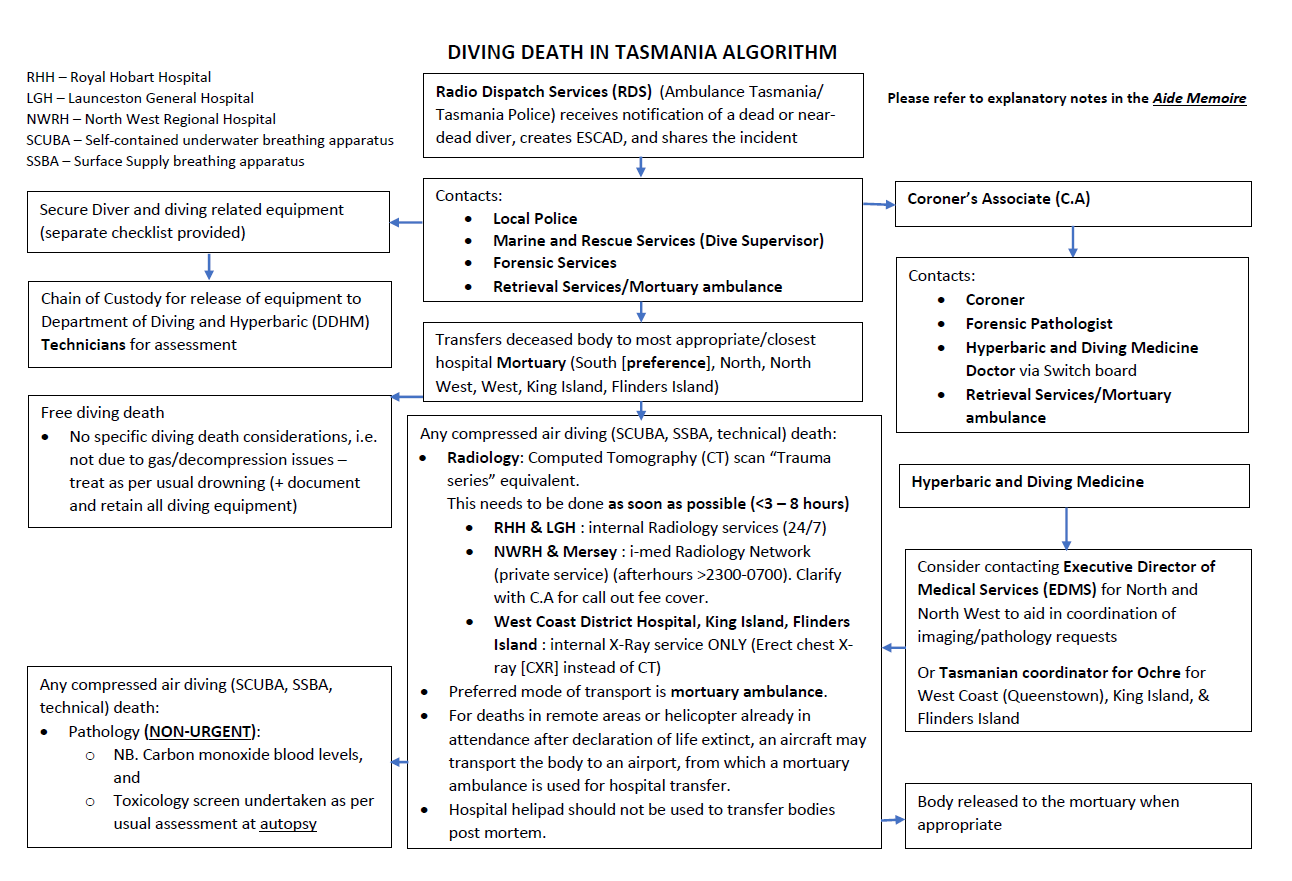
Appendix 3. Diving Death in Tasmania Algorithm