52 - 55


- Super User
- Category: Information
- 1173
Click to download each article. This will download a PDF that is password protected from any changes, these individual article PDFs are not for public distribution and for society members personal use.
Copyright: These articles are the copyright of the authors who grant Diving and Hyperbaric Medicine a non-exclusive licence to publish the article in electronic and other forms.
- Super User
- Category: Information
- 1249
Click to download each article. This will download a PDF that is password protected from any changes, these individual article PDFs are not for public distribution and for society members personal use.
Copyright: These articles are the copyright of the authors who grant Diving and Hyperbaric Medicine a non-exclusive licence to publish the article in electronic and other forms.
- Super User
- Category: Information
- 1005
Click to download each article. This will download a PDF that is password protected from any changes, these individual article PDFs are not for public distribution and for society members personal use.
Copyright: These articles are the copyright of the authors who grant Diving and Hyperbaric Medicine a non-exclusive licence to publish the article in electronic and other forms.
- Super User
- Category: Information
- 328
Click to download each article. This will download a PDF that is password protected from any changes, these individual article PDFs are not for public distribution and for society members personal use.
Copyright: These articles are the copyright of the authors who grant Diving and Hyperbaric Medicine a non-exclusive licence to publish the article in electronic and other forms.
- Super User
- Category: Information
- 18240
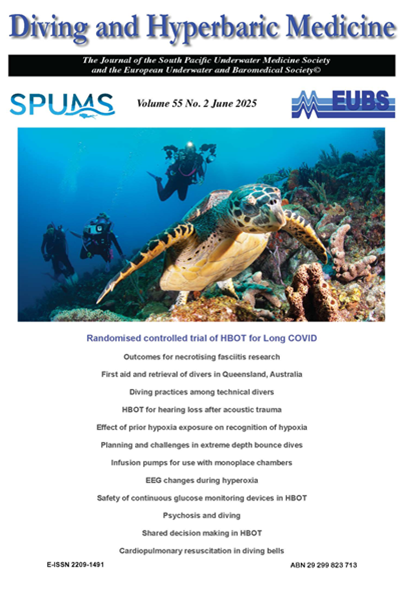
2025 June;55(2)
Diving Hyperb Med. 2025 30 June;55(2):79−90. doi: 10.28920/dhm55.2.79-90. PMID: 40544136.
Oxygen treatment and retrieval pathways of divers with diving-related conditions in Townsville, Australia: a 15-year retrospective review
Denise F Blake1,2,3, Melissa Crowe3, Daniel Lindsay4,5, Richard Turk6, Simon J Mitchell7,8,9, Neal W Pollock10,11
1 Emergency Department, Townsville University Hospital, Townsville, Queensland, Australia
2 Marine Biology and Aquaculture, James Cook University, Townsville, Queensland, Australia
3 College of Healthcare Sciences, James Cook University, Townsville, Queensland, Australia
4 College of Public Health, Medical and Veterinary Sciences, James Cook University, Townsville, Queensland, Australia
5 Population Health Department, QIMR Berghofer Medical Research Institute, Brisbane, Queensland, Australia
6 Hyperbaric Medicine Unit, Townsville University Hospital, Townsville, Queensland, Australia
7 Department of Anaesthesiology, University of Auckland, Auckland, New Zealand
8 Department of Anaesthesia, Auckland City Hospital, Auckland, New Zealand
9 Slark Hyperbaric Unit, North Shore Hospital, Auckland, New Zealand
10 Department of Kinesiology, Faculty of Medicine, Université Laval, Québec, Canada
11 Service de médecine hyperbare, Centre de médecine de plongée du Québec, Levis, Québec, Canada
Corresponding author: Dr Denise F Blake, IMB 23, Emergency Department, 100 Angus Smith Drive, Townsville University Hospital, Douglas, Queensland 4814, Australia
ORCiD: 0000-0002-2811-4195
Keywords
Arterial gas embolism; Decompression sickness; First aid; Oxygen toxicity; Retrieval platform; Scuba diving; Treatment
Abstract
(Blake DF, Crowe M, Lindsay D, Turk R, Mitchell SJ, Pollock NW. Oxygen treatment and retrieval pathways of divers with diving-related conditions in Townsville, Australia: a 15-year retrospective review. Diving and Hyperbaric Medicine. 2025 30 June;55(2):79−90. doi: 10.28920/dhm55.2.79-90. PMID: 40544136.)
Introduction: First aid for injured divers includes oxygen delivery prior to definitive care. Delay to specialist assessment and/or hyperbaric oxygen treatment (HBOT) may be due to dive site remoteness and limited access to facilities. Townsville has the only hyperbaric facility along the Great Barrier Reef. Analysis of oxygen therapy and retrieval pathways of divers treated in Townsville may assist with establishing future education strategies and resource allocation.
Methods: Data were retrospectively collected on divers assessed at the Townsville hyperbaric medicine unit from November 2003 through December 2018. Demographics, dive incident location, oxygen treatment, retrieval platform and pathway, and initial disease grade were reviewed. Data are presented as frequencies and percentages.
Results: A total of 306 cases were included (184 males). Divers typically received oxygen therapy (87%, 267/305 known) prior to specialist review. The non-rebreather mask was the most frequently used (44%, 28/63) followed by in-water recompression (24%, 15/63). While 34% of the divers were retrieved from the scene (n = 104), only 11 (11%, 11/104) were retrieved directly to Townsville. Most divers initially classified as severe were retrieved from the scene (82%, 27/33), only two directly to Townsville. Fifteen cases had three retrieval legs (5%, 15/306).
Conclusions: Most injured divers received oxygen first aid and were transported to Townsville for definitive care with a variable number of retrieval stages. Continuing education of retrieval physicians should address knowledge of diving related injuries and highlight cases that may benefit from expedited transfer.
Copyright: This article is the copyright of the authors who grant Diving and Hyperbaric Medicine a non-exclusive licence to publish the article in electronic and other forms.
Publication Type: Original article
Diving Hyperb Med. 2025 30 June;55(2):91−103. doi: 10.28920/dhm55.2.91-103. PMID: 40544137.
Core outcome set for research in necrotising soft tissue infection patients: an international, multidisciplinary, modified Delphi consensus study
Bridget Devaney1,2,3, Jonathan PC Wackett4, Nicola Ma5, Amanda Nguyen5, Vikash Yogaraj5, Morten Hedetoft6,7, Ole Hyldegaard6,7,8, Aidan Burrell1,9, Biswadev Mitra2,10
1 Department of Intensive Care and Hyperbaric Medicine, Alfred Health, Melbourne, Australia
2 Emergency and Trauma Centre, Alfred Health, Melbourne, Australia
3 Department of Epidemiology and Preventive Medicine, Monash University, Melbourne, Australia
4 Department of Medicine, Alfred Health, Melbourne, Australia
5 Monash University, Melbourne, Australia
6 Department of Anaesthesia, Centre of Head and Orthopaedics, Rigshospitalet, Copenhagen, Denmark
7 University of Copenhagen, Copenhagen, Denmark
8 Hyperbaric Unit, Rigshospitalet, Copenhagen, Denmark
9 Australian and New Zealand Intensive Care Research Centre, Monash University, Melbourne, Australia
10 School of Public Health and Preventive Medicine, Monash University, Melbourne, Australia
Corresponding author: Dr Bridget Devaney Department of Intensive Care and Hyperbaric Medicine, Alfred Health, 55 Commercial Road, Melbourne, VIC 3004, Australia
ORCiD: 0000-0001-6521-418X
Keywords
Gas gangrene; Hyperbaric oxygen treatment; Hyperbaric research; Intensive care medicine; Necrotising infections
Abstract
(Devaney B, Wackett JPC, Ma N, Nguyen A, Yogaraj V, Hedetoft M, Hyldegaard O, Burrell A, Mitra B. Core outcome set for research in necrotising soft tissue infection patients: an international, multidisciplinary, modified delphi consensus study. Diving and Hyperbaric Medicine. 2025 30 June;55(2):91−103. doi: 10.28920/dhm55.2.91-103. PMID: 40544137.)
Introduction: Necrotising soft tissue infections (NSTI) are serious infections associated with considerable morbidity and mortality. Heterogeneity of outcome reporting in the NSTI literature precludes the synthesis of high-quality evidence. There is substantial interest in studying the efficacy of hyperbaric oxygen treatment as an adjunctive treatment in NSTI. The aim of this study was to develop a set of core outcome measures for future trials evaluating interventions for NSTI.
Methods: A modified Delphi consensus method was used to conduct a three-round survey of a diverse panel of clinicians and researchers with expertise in NSTI, and patients with lived experience of NSTI. Participants rated the preliminary list of outcomes using a 9-point scale from 1 (least important) to 9 (most critical). The a priori definition of consensus required outcomes to be rated critical (score ≥ 7) by ≥ 70% of participants, and not important (score ≤ 3) by ≤ 15% of participants. After meeting consensus, outcomes were removed from subsequent rounds. Outcomes that did not meet consensus were included in subsequent rounds.
Results: Ninety-eight participants from 14 countries registered and 86%, 69% and 57% responded for each round, respectively. Outcome measures quantifying five core areas achieved consensus: Death, surgical procedures of debridements and amputations, functional outcome among survivors, measures of sepsis, including septic shock and organ dysfunction and resource use measured through length of hospital and intensive care unit stay.
Conclusions: This initial core set of outcome measures will be evaluated and optimised and can harmonise outcome measurements for investigations among patients with NSTI.
Copyright: This article is the copyright of the authors who grant Diving and Hyperbaric Medicine a non-exclusive licence to publish the article in electronic and other forms.
Publication Type: Original article
Diving Hyperb Med. 2025 30 June;55(2):104−113. doi: 10.28920/dhm55.2.104-113. PMID: 40544138.
Effect of normobaric and hyperbaric hyperoxia treatment on symptoms and cognitive capacities in Long COVID patients: a randomised placebo-controlled, prospective, double-blind trial
Leen D’hoore1, Peter Germonpré1,2, Bert Rinia1, Leonard Caeyers1, Nancy Stevens1, Costantino Balestra2,3,4
1 Centre for Hyperbaric Oxygen Therapy, Queen Astrid Military Hospital, Brussels, Belgium
2 DAN Europe Research Division, Roseto, Italy and Brussels, Belgium
3 Environmental, Occupational, Aging (Integrative) Physiology Laboratory, Haute Ecole Bruxelles-Brabant (HE2B), Brussels, Belgium
4 Motor Sciences Department, Physical Activity Teaching Unit, Université Libre de Bruxelles (ULB), Brussels, Belgium
Corresponding author: Dr Peter Germonpré, Queen Astrid Military Hospital, Bruynstraat 1, B-1120 Brussels, Belgium
ORCiD: 0000-0003-2481-7376
Keywords
COVID-19; Hyperbaric oxygen; Randomised controlled trial; SARS-CoV-2
Abstract
(D’hoore L, Germonpré P, Rinia B, Caeyers L, Stevens N, Balestra C. Effect of normobaric and hyperbaric hyperoxia treatment on symptoms and cognitive capacities in Long COVID patients: a randomised placebo-controlled, prospective, double-blind trial. Diving and Hyperbaric Medicine. 2025 30 June;55(2):104−113. doi: 10.28920/dhm55.2.104-113. PMID: 40544138.)
Introduction: Long COVID syndrome is a major health issue. Multiple treatments have been proposed but efficacy is inadequately investigated. Hyperbaric oxygen therapy (HBOT) has been promoted based on a small number of publications. As there is potential for a placebo effect and the financial cost of HBOT is high, we sought to investigate the effects of HBOT in Long COVID in a randomised trial.
Methods: We randomised 101 patients into four treatment groups, receiving 10 sessions of oxygen ‘treatment’ inside a pressure chamber, according to one of four modalities: A – 100% oxygen at 253 kPa (2.5 atmospheres absolute); B – 40% oxygen at 253 kPa; C – 100% oxygen at 101.3 kPa (1 atmosphere absolute); D – 21% oxygen at 101.3 kPa. Groups B and C thus received a similar effective oxygen dose of 101.3 kPa. Quality of life symptom scores (Visual Analogue Scale; EQ-5D-5L, C19-YRSm), a 6-minute walking test and five neurocognitive tests were administered before and after the treatment series. At three months post-treatment, a telephone questionnaire probed for lasting effects.
Results: All groups were comparable with regards to demographics, Long COVID symptoms and severity. After treatment, there were no significant differences in subjective symptoms, functional scores, and cognitive performance between any groups. The response to treatment was highly variable, with some patients in even the ‘placebo’ group D reporting a significant improvement in their well-being. This was not reflected in any objective outcome scores. No subgroups of patients responded better to any of the treatments.
Conclusions: There was no significant effect from different doses of oxygen in a hyperbaric chamber. It is possible that the very modest improvements reported in other studies were due to a placebo effect. Claims that HBOT has a significant effect on Long COVID need further investigation before indiscriminately prescribing or promoting HBOT.
Copyright: This article is the copyright of the authors who grant Diving and Hyperbaric Medicine a non-exclusive licence to publish the article in electronic and other forms.
Publication Type: Original article
Diving Hyperb Med. 2025 30 June;55(2):114−125. doi: 10.28920/dhm55.2.114-125. PMID: 40544139.
Diving practices in technical divers’ community and behaviour towards self-reported unusual symptoms
Emmanuel Gouin1,2, David PM Monnot3,4, Thierry Michot5, François Guerrero1, Jean-Éric Blatteau6
1 Univ Brest, Laboratory ORPHY EA 4324, Brest, France
2 Divers Alert Network, Durham, NC, United States
3 Department of Kinesiology, Université Laval, Québec, QC, Canada
4 CISSS Chaudière-Appalaches (CHAU-Hôtel-Dieu de Lévis), Hyperbaric Medicine Unit, Emergency Department, Lévis, QC, Canada
5 Univ Brest, Laboratory LABERS UR 3149, Brest, France
6 Military Teaching Hospital Sainte-Anne, Department of Hyperbaric Medicine and Diving Expertise, Toulon, France
Corresponding author: Dr Emmanuel Gouin, Laboratoire ORPHY, EA 4324, Université de Bretagne Occidentale, 6 Av. Le Gorgeu – 29200 BREST, France
ORCiD: 0000-0003-3691-5870
Keywords
Decompression illness; Diving incidents; Epidemiology; Helium; Health status; Mixed gas; Survey
Abstract
(Gouin E, Monnot DPM, Michot T, Guerrero F, Blatteau J-É. Diving practices in technical divers’ community and behaviour towards self-reported unusual symptoms. Diving and Hyperbaric Medicine. 2025 30 June;55(2):114−125. doi: 10.28920/dhm55.2.114-125. PMID: 40544139.)
Introduction: The use of gas mixtures containing helium for deep recreational diving is increasingly common, involving complex logistics and decision-making compromises. The characteristics and inherent risks of this practice remain poorly documented. This study aims to provide an epidemiological inventory of practices and diving-related incidents within the technical diving community.
Methods: An international online survey was disseminated on social networks targeting certified trimix divers. It collected demographic data, diving experience, and dive management practices, along with self-reported unusual symptoms, treatments, and outcomes following trimix dives.
Results: A total of 558 questionnaires were analysed, predominantly from males (92%), mostly over 46 years old (61%), with high certification levels and recreational diving purposes. Forty-two percent reported one or more medical risk factors related to diving. Rebreather use was prevalent (79% at least occasionally). Decompression was primarily managed using compartmental models (85%) with gradient-factors adjustment. Dive planning varied significantly among individuals. Gas density at depth frequently exceeded the current recommendations. Ten percent had experienced symptoms suggestive of gas toxicity, mainly related to nitrogen narcosis. Thirty-six percent (199/558) reported experiencing, at least once, symptoms of diving-related incidents, with 61% (n = 121/199) expressing certainty. In 48% (120/261) of incidents involving decompression sickness (DCS) or breathing symptoms, no treatment was initiated. Among episodes involving DCS symptoms (n = 254), 42% received normobaric oxygen, and 23% sought medical advice, while 16% were treated with hyperbaric oxygen. Only 2.5% reported probable long-lasting sequelae.
Conclusions: The diversity of practices highlights the lack of robust scientific data supporting them. The accident rate in mixed-gas diving may be higher than in typical scuba air diving, though mostly of mild severity. Treatment appears to be neglected despite divers’ high knowledge levels. Continued research into decompression and the physiological effects of these dives is essential, along with ongoing awareness and education efforts in diving first aid within this exposed community.
Copyright: This article is the copyright of the authors who grant Diving and Hyperbaric Medicine a non-exclusive licence to publish the article in electronic and other forms.
Publication Type: Original article
Diving Hyperb Med. 2025 30 June;55(2):126−135. doi: 10.28920/dhm55.2.126-135. PMID: 40544140.
Effects of hyperbaric oxygen therapy initiation latency on auditory outcomes following acute acoustic trauma
Maayan Manheim1*, Liel Mogilevsky1*, Amit Geva1, Orli Knoll1, Gil Zehavi2, Ivan Gur3
1 Israel Naval Medical Institute, Israel Defence Force Medical Corps, Haifa, Israel
2 Israeli Defence Forces Navy, Haifa, Israel
3 School of Public Health, Faculty of Social Welfare and Health Sciences, University of Haifa, Israel
* MM and LM contributed equally as first authors
Corresponding author: Dr Ivan Gur, 8 HaAlia Street, Haifa 3109601, Israel
ORCiD: 0000-0001-7702-2599
Keywords
Hearing loss; Hyperbaric research; Treatment delay
Abstract
(Manheim M, Mogilevsky L, Geva A, Knoll O, Zehavi G, Gur I. Effects of hyperbaric oxygen therapy initiation latency on auditory outcomes following acute acoustic trauma. Diving and Hyperbaric Medicine. 2025 30 June;55(2):126−135. doi: 10.28920/dhm55.2.126-135. PMID: 40544140.)
Introduction: Hyperbaric oxygen (HBO) is a potential adjunct treatment to improve hearing following acute acoustic trauma. However, the optimal time frame for HBO initiation has not been elucidated.
Methods: Patients exposed to intense noise as part of active military service that met our audiometric criteria were referred for combined HBO (253 kPa for 80 min, treatment numbers tirated to response) and corticosteroid treatment. The primary outcome was defined as an improvement of at least 10dB in any of the measured high pure tone frequencies (3, 4, 6 or 8 kHz). Additional outcomes included the absolute change in high pure tone (3, 4, 6 and 8 kHz) summation (HPTS), relative change in HPTS compared to baseline (rHPTS) and the proportion of patients returned to auditory combat readiness.
Results: Of 129 ears (103 patients) included in the final analysis, 59/67 (88%) of the patients treated within seven days but only 14/25 (56%) of patients treated 21 days or more from exposure met the primary outcome (Bonferroni adjusted P = 0.002). Similarly, HPTS improvement (55 dB vs -5dB), rHPTS improvement (55% vs 3%) and return to combat readiness (32/56 (57%) vs 3/20 (15%)) were significantly (P < 0.001, P < 0.001 and P = 0.017, respectively) more pronounced in patients treated earlier. These results were unchanged despite adjusting to age, degree of initial hearing loss and the mechanism of injury.
Conclusions: Early initiation of HBO following acute acoustic trauma is associated with improved response to therapy. The optimal treatment latency appears to be within seven days from injury, with response rates dropping when treatment is delayed beyond three weeks.
Copyright: This article is the copyright of the authors who grant Diving and Hyperbaric Medicine a non-exclusive licence to publish the article in electronic and other forms.
Publication Type: Original article
Diving Hyperb Med. 2025 30 June;55(2):136−144. doi: 10.28920/dhm55.2.136-144. PMID: 40544141.
An unblinded training exposure to hypoxia enhances subsequent hypoxia awareness
August Allocco1,2, Hanna van Waart1, Charlotte JW Connell3, Nicole YE Wong1,4, Abhi Charukonda4, Nicholas Gant3, Xavier CE Vrijdag1, Simon J Mitchell1,4,5
1 Department of Anaesthesiology, University of Auckland, Auckland, New Zealand
2 Department of Anesthesiology, Yale University, New Haven, CT, USA
3 Department of Exercise Sciences, University of Auckland, Auckland, New Zealand
4 Department of Anaesthesia, Auckland City Hospital, Auckland, New Zealand
5 Slark Hyperbaric Unit, North Shore Hospital, Auckland, New Zealand
Corresponding author: Dr Xavier CE Vrijdag, Department of Anaesthesiology, School of Medicine, University of Auckland, Private bag 92019, Auckland 1142, New Zealand
ORCiD: 0000-0001-5907-6083
Keywords
Aviation; Diving research; Diving Medicine; Rebreathers – closed circuit; Technical diving
Abstract
(Allocco A, van Waart H, Connell CJW, Wong NYE, Charukonda A, Gant N, Vrijdag XCE, Mitchell SJ. An unblinded training exposure to hypoxia enhances subsequent hypoxia awareness. Diving and Hyperbaric Medicine. 2025 30 June;55(2):136−144. doi: 10.28920/dhm55.2.136-144. PMID: 40544141.)
Introduction: Malfunctions and human errors in diving rebreathers can cause hypoxia, hyperoxia, and/or hypercapnia. We evaluated whether a prior unblinded hypoxia experience enhances a diver’s ability to recognise hypoxia and initiate self-rescue.
Methods: Forty participants were randomised to receive either an information leaflet describing hypoxia symptoms or an unblinded hypoxia experience, prior to a blinded hypoxia testing exposure during a virtual reality dive over one month later. The primary outcome was the comparison of the proportion of participants in these two groups who initiated self-rescue before reaching a peripheral oxygen saturation of 70% in the blinded exposure. An individual’s ‘symptom profile’ was assessed by comparing symptoms during the unblinded hypoxia experience and blinded testing exposures.
Results: During the blinded hypoxia testing exposure, 18/20 (90%) participants in the hypoxia experience group performed a self-initiated rescue compared to 6/18 (33%) in the information leaflet group (P < 0.001). Participants in the information leaflet group had lower mean SpO2 (73.4% vs 81.4%, mean difference 8% [95% CI = 2.5–13.5%, P = 0.005]) and lower inhaled oxygen fraction (7.6% vs 9.4%, mean difference 1.8% [95% CI = 0.6−3.1%, P = 0.005]) at self-rescue. The most frequent and severe symptoms were light-headedness and shortness of breath. Of the 20 participants completing both hypoxia exposures, 14 (70%) had a consistent hypoxia symptom profile, which was not related to the ability to recognise hypoxia.
Conclusions: Self-rescue was approximately three times more likely for participants who had previously experienced hypoxia compared to simply receiving information on relevant symptoms. Most participants exhibited a consistent pattern of individual symptoms, which did not result in earlier or improved detection of hypoxia.
Copyright: This article is the copyright of the authors who grant Diving and Hyperbaric Medicine a non-exclusive licence to publish the article in electronic and other forms.
Publication Type: Original article
Diving Hyperb Med. 2025 30 June;55(2):145−153. doi: 10.28920/dhm55.2.145-153. PMID: 40544142.
Comparison of three infusion pumps as an option for intensive care treatments in monoplace hyperbaric chambers
Gerald Schmitz1
1 Centro de Medicina Hiperbarica OHB, Hyperbaric Medical Service, San Jose, Costa Rica
Corresponding author: Gerald Schmitz, Centro de Medicina Hiperbarica OHB, Hyperbaric Medical Service, San Jose, Costa Rica
ORCiD: 0000-0002-1138-8456
Keywords
Drug administration; Fluid administration; Hyperbaric chambers; Hyperbaric oxygen therapy, Intravenous infusions
Abstract
(Schmitz G. Comparison of three infusion pumps as an option for intensive care treatments in monoplace hyperbaric chambers. Diving and Hyperbaric Medicine. 2025 30 June;55(2):145−153. doi: 10.28920/dhm55.2.145-153. PMID: 40544142.)
Introduction: Hyperbaric oxygen therapy (HBOT) is used in critical care for managing certain severe conditions. However, the reliability of infusion pumps under hyperbaric conditions remains a critical concern. This study evaluated the performance of three infusion pump models – the Mindray BeneFusion VP5, Baxter Flo-Gard 6201, and Braun Infusomat Space – under hyperbaric conditions.
Methods: Infusion pumps were modified to deliver flow into an environment pressurised up to 284 kPa. Accuracy of flow delivered into a pressurised monoplace chamber were tested across a range of infusion rates (1–100 mL·h-1), with different absolute chamber pressures during the iso-pressure phase (243–284 kPa) and a range of different pressurisation/decompression rates (6.9–34.5 kPa·min-1).
Results: More than 3.6 million measurements were obtained. At iso-pressure the Mindray BeneFusion VP5 and the Baxter Flo-Gard 6201 under-performed at low infusion rates (< 20 mL·h-1) and over-performed at high infusion rates
(> 20 mL·h-1). Both models exhibited significant under-delivery during pressurisation and over-delivery during decompression. For all conditions the Mindray BeneFusion VP5 demonstrated superior performance. The Braun Infusomat Space was unsuitable for hyperbaric use, failing to maintain performance at pressures above 90 kPa.
Conclusions: The Mindray BeneFusion VP5 outperformed the Baxter Flo-Gard 6201 and Braun Infusomat Space under hyperbaric conditions, offering enhanced reliability for critical care HBOT using monoplace chambers. Clinical protocols should prioritise pumps capable of maintaining flow accuracy during pressure fluctuations. These findings inform best practices for infusion pump use in hyperbaric intensive care, addressing a critical gap in HBOT safety and efficacy.
Copyright: This article is the copyright of the authors who grant Diving and Hyperbaric Medicine a non-exclusive licence to publish the article in electronic and other forms.
Publication Type: Technical report
Diving Hyperb Med. 2025 30 June;55(2):154−163. doi: 10.28920/dhm55.2.154-163. PMID: 40544143.
Electroencephalographic (EEG) changes accompanying normal breathing of concentrated oxygen (hyperoxic ventilation) by healthy adults: a systematic review
Lachlan D Barnes1, Luke E Hallum2, Xavier CE Vrijdag1
1 Department of Anaesthesiology, School of Medicine, University of Auckland, Auckland, New Zealand
2 Department of Mechanical Engineering, University of Auckland, Auckland, New Zealand
Corresponding author: Dr Xavier CE Vrijdag, Department of Anaesthesiology, School of Medicine, University of Auckland, Private Bag 92019, Auckland, New Zealand
ORCiD: 0000-0001-5907-6083
Keywords
Hyperoxia; Electroencephalography; Central nervous system; Hyperbaric oxygen; Diving; Toxicity
Abstract
(Barnes LD, Hallum LE, Vrijdag XCE. Electroencephalographic (EEG) changes accompanying normal breathing of concentrated oxygen (hyperoxic ventilation) by healthy adults: a systematic review. Diving and Hyperbaric Medicine. 2025 30 June;55(2):154−163. doi: 10.28920/dhm55.2.154-163. PMID: 40544143.)
Introduction: Divers often increase their fraction of inspired oxygen (FIO2) to decrease their risk of decompression sickness. However, breathing elevated pressures of oxygen can cause central nervous system oxygen toxicity (CNS-OT). This study aimed to review the literature describing the effect of hyperoxia on the electroencephalogram (EEG), thus exploring the potential for real-time detection of an impending CNS-OT seizure.
Methods: We searched Medline, Embase, Scopus, and Web of Science for articles that reported EEG measures accompanying hyperoxic ventilation (FIO2 = 1.0 ± hyperbaric pressure) in healthy participants. We included peer-reviewed journal articles, books, and government reports with no language or date restrictions. Randomised controlled trials and cross-over studies were included; case reports were excluded. We used the Newcastle-Ottawa scale to evaluate evidence quality.
Results: Our search strategy returned 1,025 unique abstracts; we analysed the full text of 46 articles; 22 articles (16 studies) were included for review. Study cohorts were typically small and comprised of male non-divers. We discovered a variety of EEG analysis methods: studies performed spectral analysis (n = 12), the analysis of sensory-evoked potentials (n = 4), connectivity/complexity analysis (n = 3), source localisation (n = 1), and expert qualitative analyses (n = 4). Studies of severe exposures (long duration at hyperbaric pressure) typically reported qualitative measures, and studies of mild exposures typically reported quantitative measures.
Conclusions: There is a need for a large randomised controlled trial reporting quantitative measures to better understand the effect of hyperoxia on the EEG, thus enabling the development of real-time monitoring of CNS-OT risk.
Copyright: This article is the copyright of the authors who grant Diving and Hyperbaric Medicine a non-exclusive licence to publish the article in electronic and other forms.
Publication Type: Review article
Diving Hyperb Med. 2025 30 June;55(2):154−163. doi: 10.28920/dhm55.2.154-163. PMID: 40544144.
Safety and efficacy of continuous glucose monitoring devices in individuals with diabetes undergoing hyperbaric oxygen therapy: a scoping review
Glen Katsnelson1, Marcus Salvatori2,3,4, George Djaiani2,3,4, Elise Greer3, Jordan Tarshis2,5, Rita Katznelson2,3,4
1 Temerty Faculty of Medicine, University of Toronto, Toronto, Ontario, Canada
2 Department of Anesthesiology and Pain Medicine, University of Toronto, Toronto, Ontario, Canada
3 Hyperbaric Medicine Unit, Toronto General Hospital, Toronto, Ontario, Canada
4 Department of Anesthesia and Pain Management, University Health Network, Toronto, Ontario, Canada
5 Department of Anesthesia, Sunnybrook Health Sciences Centre, Toronto, Ontario, Canada
Corresponding author: Dr Rita Katznelson, Toronto General Hospital, 200 Elizabeth St, Toronto, ON M5G 2C4, Canada
ORCiD: 0000-0003-2992-7435
Keywords
Hyperbaric medicine; Hyperbaric research; Implantable devices
Abstract
(Katsnelson G, Salvatori M, Djaiani G, Greer E, Tarshis J, Katznelson R. Safety and efficacy of continuous glucose monitoring devices in individuals with diabetes undergoing hyperbaric oxygen therapy: a scoping review. Diving and Hyperbaric Medicine. 2025 30 June;55(2):164−172. doi: 10.28920/dhm55.2.164-172. PMID: 40544144.)
Introduction: Continuous glucose monitoring devices (CGMs) have emerged as an effective approach to optimise glycaemic control for individuals living with diabetes mellitus. Despite CGMs offering improved patient satisfaction and quality of life, they have been primarily validated for outpatient and home use. This has posed a challenge for patients and providers who wish to incorporate CGMs into clinical settings such as hyperbaric oxygen therapy (HBOT). Those with advanced diabetes mellitus who have diabetic foot ulcers that are refractory to treatment are among the most prevalent users of HBOT. However, those who prefer to use their CGM during HBOT face uncertainty regarding the accuracy and safety of their device under hyperbaric conditions.
Methods: The product specifications of commonly used CGMs were collated. In addition, a scoping review of the literature was conducted where Medline, Embase, and Scopus were searched for reports that assess the accuracy or safety of CGMs in hyperbaric conditions.
Results: The product specifications of commonly used CGMs by Dexcom, Abbott, Medtronic, and Senseonics demonstrate a maximum validated pressure of approximately 106 kPa (1.06 atmospheres absolute). Our literature search identified five reports, of which four focused on accuracy and one focused on safety of CGMs in hyperbaric conditions. Treatments were conducted in multiplace chambers and cumulatively described 39 participants, of whom 12 have diabetes. Although heterogeneous in nature, the reports generally supported the safety and accuracy of CGMs in hyperbaric conditions.
Conclusions: The safety and accuracy of using CGMs during HBOT warrants further investigation. CGMs have not been validated for repeated exposure to hyperbaric conditions and should not be used in oxygen pressurised monoplace chambers until further safety data is available. We provide practical recommendations for use of CGMs in multiplace chambers.
Copyright: This article is the copyright of the authors who grant Diving and Hyperbaric Medicine a non-exclusive licence to publish the article in electronic and other forms.
Publication Type: Review article
Diving Hyperb Med. 2025 30 June;55(2):173−179. doi: 10.28920/dhm55.2.173-179. PMID: 40544145.
Psychosis and diving
Abraham L Querido1,2, Thijs T Wingelaar2,3
1 Praktijk Querido, Hilversum, the Netherlands
2 Dutch Society of Diving and Hyperbaric Medicine, Bilthoven, the Netherlands
3 Royal Netherlands Navy, Diving Medical Center, Den Helder, the Netherlands
Corresponding author: Dr Abraham L Querido, Praktijk Querido, Veerstraat 25, 1211 HJ Hilversum, the Netherlands
ORCiD: 0009-0001-1988-0832
Keywords
Fitness-to-dive; Mental health; Psychiatry; Schizophrenia; Scuba
Abstract
(Querido AL, Wingelaar TT. Psychosis and scuba diving. Diving and Hyperbaric Medicine. 2025 30 June;55(2):173−179. doi: 10.28920/dhm55.2.173-179. PMID: 40544145.)
Psychotic disorders, characterised by impaired reality testing and a spectrum of symptoms, present significant challenges in assessing fitness for diving. While diving can be a safe and rewarding activity, the unique physiological and environmental stresses of hyperbaric conditions can exacerbate psychotic vulnerability or mimic psychotic symptoms. This article reviews the literature on psychosis and diving, exploring the implications of psychotic disorders, psychotropic medications, and hyperbaric effects. It highlights the critical importance of illness insight, the absence of comorbid conditions, and complete remission in determining diving fitness. Key recommendations include avoiding deep dives, careful evaluation of medication use, and a nuanced differentiation between chronic and transient psychoses. By synthesizing existing evidence, this article aims to guide diving medicine professionals in making informed decisions about psychosis and diving suitability.
Copyright: This article is the copyright of the authors who grant Diving and Hyperbaric Medicine a non-exclusive licence to publish the article in electronic and other forms.
Publication Type: Review article
Diving Hyperb Med. 2025 30 June;55(2):180−185. doi: 10.28920/dhm55.2.180-185. PMID: 40544146.
Shared decision-making when considering hyperbaric oxygen therapy: a systematic review
Joost Rutger Meijering1,2, Nurseda Risvanoglu3, Johanna H Nederhoed1, Rigo Hoencamp2, Robert A van Hulst3, Dirk T Ubbink1
1 Department of Surgery, Amsterdam University Medical Center, Amsterdam, the Netherlands
2 Department of Surgery, Alrijne, Leiderdorp, the Netherlands
3 Department of Anaesthesiology, Amsterdam University Medical Center, Amsterdam, the Netherlands
Corresponding author: Joost R Meijering, Department of Surgery, Amsterdam University Medical Center, Amsterdam, the Netherlands
Keywords
Evidence; Policy; Risk management; Theory-based advice; Treatment sequelae
Abstract
(Meijering JR, Risvanoglu N, Nederhoed JH, Hoencamp R, van Hulst RA, Ubbink DT. Shared decision-making when considering hyperbaric oxygen therapy: a systematic review. Diving and Hyperbaric Medicine. 2025 30 June;55(2):180−185. doi: 10.28920/dhm55.2.180-185. PMID: 40544146.)
Introduction: Hyperbaric oxygen therapy (HBOT) is a treatment modality used for various non-acute medical conditions, ranging from ischaemic diabetic ulcers to late post-radiation damage. Despite its wide application, HBOT is often time-consuming, requires multiple sessions, and can be physically and psychologically challenging for patients, contributing to high drop-out rates. In addition, treatment results can vary significantly. These challenges suggest the need for more patient-centred approaches, such as shared decision-making (SDM), to improve patient engagement, satisfaction, and adherence to treatment. SDM, which involves patients in the decision-making process, could potentially improve outcomes and reduce dropout rates. This systematic review presents currently available evidence on the extent of SDM in patients eligible for HBOT.
Methods: A comprehensive literature search was conducted in the Medline, Embase, TRIP and Cochrane Central databases, from inception up to 29 August 2024, to find all studies with original data on SDM when considering HBOT as a treatment option. Study selection was conducted by two reviewers independently. Desired study outcomes were the application and observed levels of SDM.
Results: The search yielded 988 articles of which 24 appeared eligible. After assessing the inclusion criteria and outcomes in the full text articles, zero remained for inclusion: none reported on patient involvement in the decision-making process regarding HBOT. However, six articles did mention that SDM should be an important element when developing clinical practice guidelines for HBOT.
Conclusions: Despite the obvious need for preference-sensitive decision-making in HBOT, there is no scientific evidence available on this topic. Possibly, physicians and patients consider HBOT as a last-resort or even the only treatment option. Consequently, involving the patient’s preference regarding HBOT in the decision-making process is rarely documented. Hence, more awareness of the need for SDM is advocated when considering HBOT, which should be corroborated by research in this area.
Copyright: This article is the copyright of the authors who grant Diving and Hyperbaric Medicine a non-exclusive licence to publish the article in electronic and other forms.
Publication Type: Review article
Diving Hyperb Med. 2025 30 June;55(2):186−190. doi: 10.28920/dhm55.2.186-190. PMID: 40544147.
Advances in the delivery of cardiopulmonary resuscitation in a diving bell
Graham Johnson1,2,3, Phil Bryson4, Andrew Tabner1,2
1 University Hospitals of Derby and Burton NHS Foundation Trust, Emergency Department, Royal Derby Hospital, United Kingdom
2 School of Medicine, University of Nottingham, Derby Road, Nottingham, United Kingdom
3 Department of Communication and Media, Loughborough University, United Kingdom
4 TAC Healthcare, Wellheads Crescent, Wellheads Industrial Estate, Dyce, Aberdeen, United Kingdom
Corresponding author: Dr Andrew Tabner, University Hospitals of Derby and Burton NHS Foundation Trust, Emergency Department, Royal Derby Hospital, DE22 3NE, United Kingdom
ORCiD: 0000-0003-4191-9024
Keywords
Cardiac arrest; Decompression illness; Diving deaths; Diving incidents; Diving research; Saturation diving
Abstract
(Johnson G, Bryson P, Tabner A. Advances in the delivery of cardiopulmonary resuscitation in a diving bell. Diving and Hyperbaric Medicine. 2025 30 June;55(2):186−190. doi: 10.28920/dhm55.2.186-190. PMID: 40544147.)
This commentary discusses the provision of cardiopulmonary resuscitation to casualties in a diving bell. This single resource consolidates recent advances in the field, published in different medical journals, to support dissemination across the wider diving industry. It summarises the evaluation of techniques for the provision of manual cardiopulmonary resuscitation (CPR) to a seated casualty, including head-to-chest, knee-to-chest, and prone knee-to-chest compression delivery, and concludes that the only safe and potentially effective approach in a diving bell setting without room for a supine casualty is knee-to-chest CPR. The evaluation of a mechanical CPR device is discussed; it is found to be as effective as existing devices and manual CPR in terms of compression efficacy and is well-suited to the setting. The development of a bespoke resuscitation algorithm, together with deviations from accepted advanced life support algorithm principles, is presented. A novel ‘upright CPR’ technique for the provision of CPR to a seated casualty, developed during the algorithm evaluation process, is described. Finally, areas where evidence is still lacking, and research priorities for the future, are discussed; a key area for future work is the development and testing of a defibrillator suited to a diving bell setting, where space constraints, a heliox atmosphere, and the risk of both fire and rescuer injury are ever-present.
Copyright: This article is the copyright of the authors who grant Diving and Hyperbaric Medicine a non-exclusive licence to publish the article in electronic and other forms.
Publication Type: Commentary
Diving Hyperb Med. 2025 30 June;55(2):191−194. doi: 10.28920/dhm55.2.191-194. PMID: 40544148.
Healing fragile bones: a case report on hyperbaric oxygen therapy in pycnodysostosis
Kubra Canarslan-Demir1, Ahmet Kaan Yel2, Gamze Aydın1, Taylan Zaman1
1 Department of Underwater and Hyperbaric Medicine, University of Health Sciences, Gulhane Training and Research Hospital, Ankara, Turkey
2 Department of Aerospace Medicine, Gülhane Faculty of Medicine, University of Health Sciences, Ankara, Turkey
Corresponding author: Dr Kubra Canarslan-Demir, SBÜ-Gülhane Eğitim ve Araştırma Hastanesi, Sualtı Hekimliği ve Hiperbarik Tıp Kliniği, Etlik/Ankara, Turkey
ORCiD: 0000-0001-6911-2375
Keywords
Bone remodeling, Fracture healing, Osteoclast, Pain
Abstract
(Canarslan-Demir K, Yel AK, Aydin G, Zaman T. Healing fragile bones: a case report on hyperbaric oxygen therapy in pycnodysostosis. Diving and Hyperbaric Medicine. 2025 30 June;55(2):191−194. doi: 10.28920/dhm55.2.191-194. PMID: 40544148.)
Pycnodysostosis is a rare lysosomal storage disorder characterised by short stature, craniofacial dysmorphisms, dental anomalies, and increased bone fragility due to osteoclast dysfunction caused by cathepsin K gene mutations. This case report describes a 43-year-old female pycnodysostosis patient with recurrent subtrochanteric fractures and delayed bone healing following multiple surgical interventions, including femoral osteotomy and bone grafting. Despite these efforts, bony union was not achieved. The patient underwent 39 sessions of hyperbaric oxygen therapy (HBOT), administered at 243.2 kPa for 120 minutes daily, five days per week. Post-treatment radiographs revealed significant fracture healing, with improvements continuing one month after therapy. Visual analogue pain scores decreased from 4 to 1, and quality of life (SF-36) improved. HBOT enhances tissue oxygenation, stimulating osteogenesis, neovascularization, and immune responses, while optimising osteoclast function, making it a promising treatment for pycnodysostosis-related fracture complications. Although ideal, a controlled trial of HBOT in this rare disorder is probably unachievable. Nevertheless, this report highlights HBOT as a potentially useful adjunctive treatment for enhancing healing of refractory fractures in pycnodysostosis patients.
Copyright: This article is the copyright of the authors who grant Diving and Hyperbaric Medicine a non-exclusive licence to publish the article in electronic and other forms.
Publication Type: Case report
Diving Hyperb Med. 2025 30 June;55(2):195−198. doi: 10.28920/dhm55.2.195-198. PMID: 40544149.
Gastric barotrauma following submarine escape training
Jan Risberg1,2, Simon Phillips3, Nils Sletteskog4, Ketil Grong5
1 NUI as, Bergen, Norway
2 Norwegian Armed Forces Joint Medical Services, Office of Submarine and Diving Medicine, Bergen, Norway
3 Royal Navy, Institute of Naval Medicine, United Kingdom
4 Department of Surgery, Førde Central Hospital, Norway
5 Department of Clinical Science, Faculty of Medicine, University of Bergen, Norway
Corresponding author: Dr Jan Risberg, Diving Physician, NUI as, Gravdalsveien 245, 5165 Laksevåg, Norway
Keywords
Decompression illness; Decompression sickness; Gastro-intestinal tract; Medical conditions and problems; Morbidity
Abstract
(Risberg J, Phillips S, Sletteskog N, Grong K. Gastric barotrauma following submarine escape training. Diving and Hyperbaric Medicine. 2025 30 June;55(2):195−198. doi: 10.28920/dhm55.2.195-198. PMID: 40544149.)
Seventeen case reports of gastric barotrauma following diving have been published previously. We report the case of a 32-year-old healthy male suffering gastric barotrauma in 1987. The incident happened during a military submarine exercise. The patient escaped the submarine at 150 metres water depth but was entangled for a short time in the escape tower and, likely distressed and in a state of panic, swallowed significant amounts of air. He experienced abdominal pain during ascent. Given the special circumstances of this event, medical personnel primarily expected symptoms to be caused by decompression sickness and initiated therapeutic recompression on site. No improvement occurred during recompression, and he was admitted to hospital. Abdominal X-ray disclosed free abdominal gas which was exsufflated in the emergency room. Emergency abdominal surgery revealed a 9 cm rupture of the lesser gastric curvature which was sutured. Recovery was uneventful. We discuss the proper approach to divers experiencing abdominal pain following ascent.
Copyright: This article is the copyright of the authors who grant Diving and Hyperbaric Medicine a non-exclusive licence to publish the article in electronic and other forms.
Publication Type: Case report
Diving Hyperb Med. 2025 30 June;55(2):199−202. doi: 10.28920/dhm55.2.199-202. PMID: 40544150.
Post-traumatic wound infection after diving caused by Vibrio alginolyticus: a case report
Julia Cebrián-López1, Francisco Jover-Díaz1,2, Ana Infante-Urrios3, Pedro M Piqueras-Vidal4, Victoria Ortiz de la Tabla-Duccasse3
1 Miguel Hernandez University, Alicante, Spain
2 Infectious Diseases Unit. Hospital Clínico Universitario San Juan, Alicante, Spain
3 Microbiology Section. Hospital Clínico Universitario San Juan, Alicante, Spain
4 Orthopedic Surgery Department. Hospital Clínico Universitario San Juan, Alicante, Spain
Corresponding author: Dr Francisco Jover-Díaz, Crta Vlencia S/n, 03550, Alicante, Spain
Keywords
Bacteriology; Diving; Marine; Seawater; Sports medicine
Abstract
(Cebrián-López J, Jover-Díaz F, Infante-Urrios A, Piqueras-Vidal PM, Ortiz de la Tabla-Duccasse V. Post-traumatic wound infection after diving caused by Vibrio alginolyticus: a case report. Diving and Hyperbaric Medicine. 2025 30 June;55(2):199−202. doi: 10.28920/dhm55.2.199-202. PMID: 40544150.)
Vibrio alginolyticus is a facultatively anaerobic, Gram-negative bacillus that is a common component of marine flora. Infections caused by Vibrio alginolyticus are rare and typically occur following exposure to seawater or marine animals. This report details the clinical presentation and follow-up of a 65-year-old immunocompetent male who developed a wound infection due to Vibrio alginolyticus. Advanced diagnostic tools, such as MALDI-TOF mass spectrometry, can enhance the identification of these bacteria. Sport clinicians need to recognise Vibrio infections in seawater-contaminated wounds, as infections may be serious and the therapeutic approach may differ from conventional treatments.
Copyright: This article is the copyright of the authors who grant Diving and Hyperbaric Medicine a non-exclusive licence to publish the article in electronic and other forms.
Publication Type: Case report
Diving Hyperb Med. 2025 30 June;55(2):203−210. doi: 10.28920/dhm55.2.203-210. PMID: 40544151.
Extremely deep bounce dives: planning and physiological challenges based on the experiences of a sample of French-speaking technical divers
Emmanuel Gouin1,2, Emmanuel Dugrenot1,2,3, Bernard Gardette4
1 University of Brest, Laboratory ORPHY EA 4324, Brest, France
2 Divers Alert Network, Durham, NC, USA
3 Joint Department of Biomedical Engineering, The University of North Carolina and North Carolina State University, Chapel Hill, NC, USA
4 Previously of COMEX Scientific Director, Marseille, France
Corresponding author: Dr Emmanuel Gouin, Laboratoire ORPHY, EA 4324, Université de Bretagne Occidentale, 6 Av. Le Gorgeu – 29200 BREST, France
ORCiD: 0000-0003-3691-5870
Keywords
Gas density; Helium; HPNS; Hydrogen; Mixed-gas; Rebreather; Solo diving
Abstract
(Gouin E, Dugrenot E, Gardette B. Extremely deep bounce dives: planning and physiological challenges based on the experiences of a sample of French-speaking technical divers. Diving and Hyperbaric Medicine. 2025 30 June;55(2):203−210. doi: 10.28920/dhm55.2.203-210. PMID: 40544151.)
Introduction: Extreme deep technical diving presents significant physiological challenges. While procedures often blend elements from both recreational and commercial diving, many remain empirical and unvalidated for this purpose. The rise of closed-circuit rebreathers has reduced gas cost and logistical barriers, enabling more divers to reach unprecedented depths. This study, based on the experience of deep divers, explores the limits of extreme-depth diving and the strategies developed to overcome them.
Methods: Eight rebreather divers (one female, seven males) with experience beyond 200 metres depth were interviewed regarding their preparation, planning, and execution of such dives. The dive profiles of their deepest dives were analysed.
Results: All were highly experienced technical divers. The median maximal depth was 227 [209–302] metres, with a median total dive time of 290 [271–395] minutes. The gas density of the trimix mixture, oxygen exposure, and ascent rate consistently exceeded current recommendations. High pressure nervous syndrome did not appear to be a major limiting factor, whereas decompression posed greater challenges. Three divers experienced decompression sickness following their deepest dives, highlighting the uncertainty around decompression procedures.
Conclusions: These dives require rigorous preparation, robust support systems, equipment modifications, and perfect skills to reduce risks, which remain excessively high. Data are lacking to validate current practices. Decompression procedures must be adapted for these demanding mixed-gas dives, which are inevitably prolonged. A dry underwater habitat could improve decompression tolerance. The role of hydrogen as a breathing gas remains uncertain and still needs to be clarified, but some consider it a promising avenue for further exploration.
Copyright: This article is the copyright of the authors who grant Diving and Hyperbaric Medicine a non-exclusive licence to publish the article in electronic and other forms.
Publication Type: World as it is
Diving Hyperb Med. 2025 30 June;55(2):211-212. doi: 10.28920/dhm55.2.211-212. PMID: 40544152.
Challenges in the administration of hyperbaric oxygen therapy (HBOT) for complicated cases in a tertiary care setting
Divya Singh1, Chandrasekhar Mohanty1, Rohit Verma1, Subhranshu Kumar2
1 Department of Marine Medicine, INHS Asvini, Colaba, Mumbai, India
2 Marine Medicine, Maharashtra, India
Address for correspondence: Dr Divya Singh, Junior resident Marine Medicine, INHS Asvini, Colaba Mumbai, India
Keywords
Hyperbaric facilities; Hyperbaric medicine; Hyperbaric medicine; Hyperbaric research; Women; Wounds
Copyright: This article is the copyright of the authors who grant Diving and Hyperbaric Medicine a non-exclusive licence to publish the article in electronic and other forms.
Publication Type: Letter to the Editor