
52 - 55


- Super User
- Category: Information
- 5925
Appendix 1 to Risberg et al. Decompression procedures for transfer under pressure (‘TUP’) diving.
Download a PDF of the supplementary file here.
Extended description of candidate TUP tables
Note: Reference numbers correspond to the reference list in the main paper with the exception of four additional references that are listed at the end of this document.34-37
US Navy (USN)
Revision 7 of the USN Diving Manual9 was published in 2016. The manual includes decompression tables for surface-oriented diving with air and Nitrox as the breathing gas in the bottom phase and air and Oxygen as the breathing gas during decompression (“In water air/O2”). These procedures were developed for in-water rather than closed bell decompression. The diver will breathe compressed air during decompression deeper than 9 msw and oxygen at the 9 and 6 msw decompression stops. After 30 min of oxygen breathing the diver will breathe compressed air for 5 min (“air break”). A contingency procedure allows conversion to air breathing in the event of failure of oxygen delivery. A repetitive dive may take place 0-16h after the first dive (in some cases 18h if no Repetitive Group has been assigned). The tables have been developed based on a publicly available algorithm and parameter set (Thalmann E-L, VVAL7918). The Thalmann E-L algorithm is a neo-Haldanian nine-compartments model with T1/2 5-240 min exponential gas uptake and linear gas elimination. This deterministic model has been validated against a probabilistic model based on more than 3000 carefully monitored experimental dives15. The tables have been developed by the US Navy Experimental Diving Unit (NEDU) and a team of scientists with competency in decompression theory have regularly revised and expanded the decompression tables.
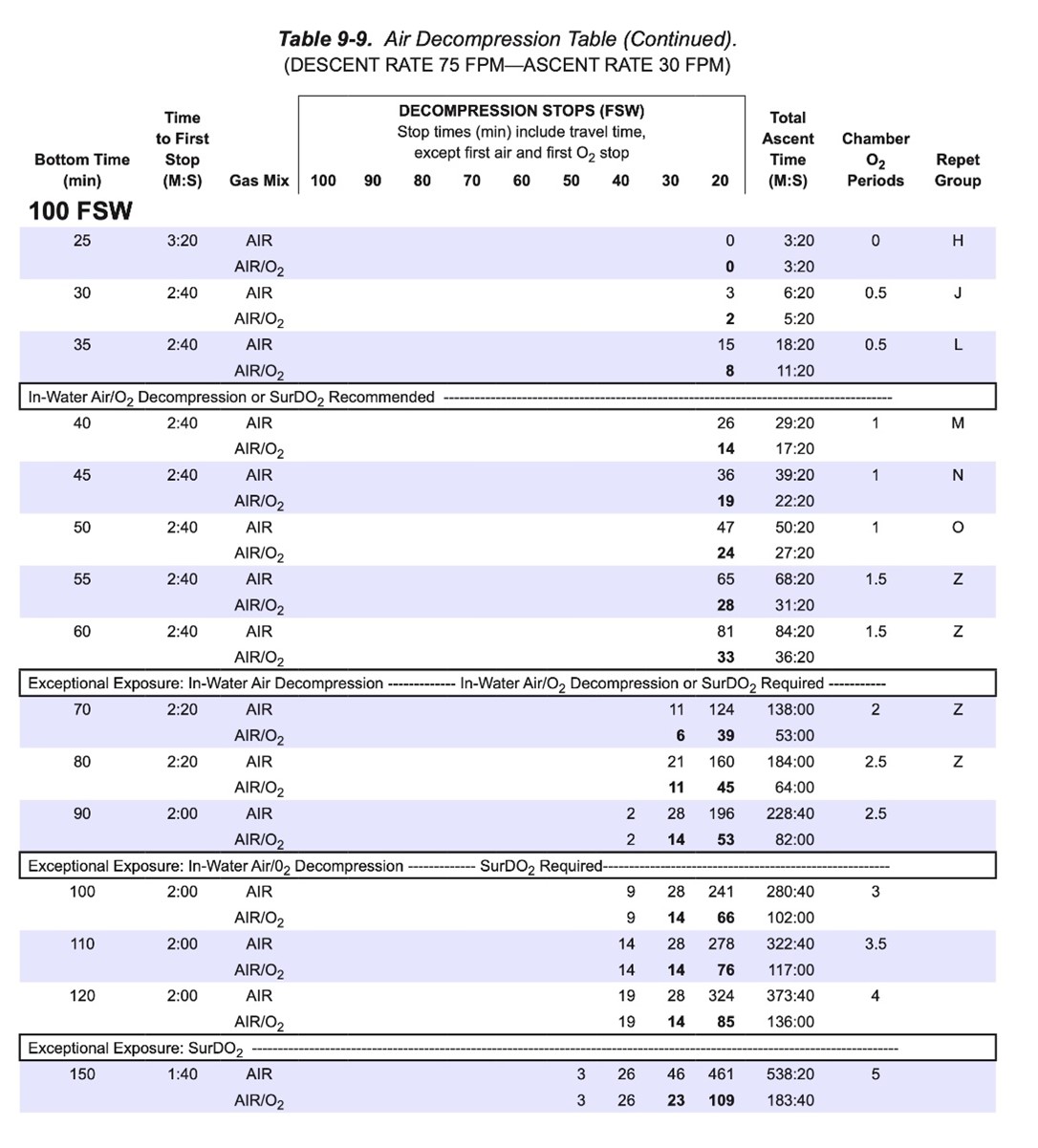
Facsimile from USN Diving Manual Rev 7 of the 100 fsw (30 msw) schedules for air and Air/O2 decompression.
MT92
The French MT 92 tables were originally published in the 1992 revision of the French diving regulations. They included a complete set of air and mixed gas tables, including Air/Standard (standard air table), Air/Oxy/6m (air tables with oxygen stop at 6msw intended for in-water decompression), Air/Oxy/12m (air tables with oxygen stop at 12 msw intended for closed bell /TUP decompression) and Air/Surface decompression. The tables came complete with nitrox, repetitive, altitude, caisson and split-level diving procedures. A contingency procedure allows conversion to air breathing in the event of a failure in oxygen delivery. The decompression for a repetitive dive is calculated based on the sum of the actual bottom time and a residual time-penalty from the preceding dive. The residual time-penalty will depend on the surface interval as well as the depth of the repetitive dive.
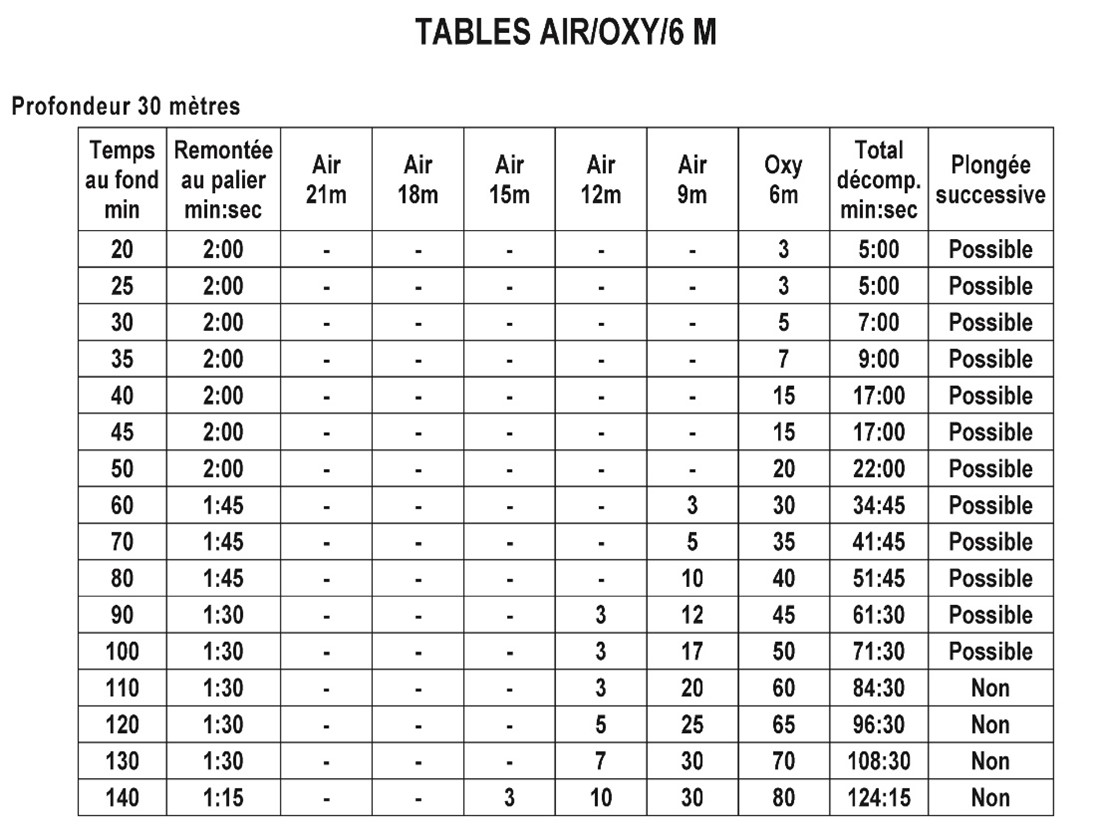
Facsimile of the MT92 “Table 5” (6 msw oxygen) for 30msw table depth.
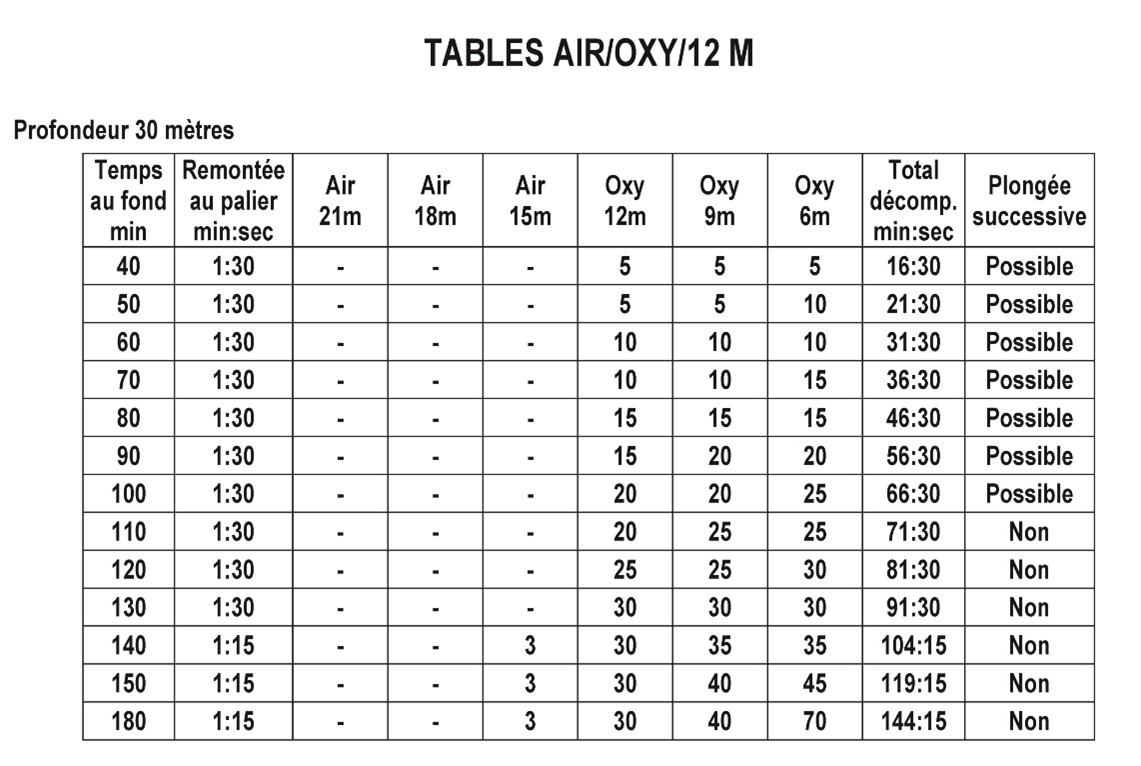
Facsimile of the MT92 “Table 6” (12 msw oxygen) for 30 msw table depth
The latest edition of the French decompression MT 92 tables was published 201211 as an annex to the diving regulations. The French tables hold two decompression procedures that may be applied for TUP-diving. One procedure (Table 5 in the original publication) was developed for open- and closed-bell decompression with Oxygen breathing 12 msw and shallower. The other procedure (Table 4 in the original publication) was developed for in-water decompression with Oxygen breathing at the shallowest 6 msw stop. Oxygen is breathed continuously without air breaks.
The MT 92 tables were initially designed by the French diving company Comex. The Comex database revealed a high DCS incidence in some subgroups of dives decompressing according to the original French 1974 tables34. In 1984 the company developed a new set of tables which was used on Comex worksites between 1986 and 1992 including a large number of air dives from surface to 51 msw on a water pipe installation in Burundi lasting a year. In 1990, these tables were presented to the French Minister of Labor who audited their validation process and reviewed their safety records before they were accepted as official procedures and included in the new diving regulations. The algorithm is a modified perfusion limited model with reduced gradients for compartments with short half times and has been described by Imbert et al.31.
Imbert has reported DCS incidence from this database for dives adhering to the 1974 tables as well as the revised tables developed 198435. From 1976 to 1983 Comex experienced a 0.3% DCS incidence in 64070 dives, but incidence reached 2.1% in the subgroup of the highest PrT index. After table revision DCS incidence was reduced to 0.1% in 33 809 dives completed during 1986-1990. The subgroup with highest PrT reached 0.9% DCS incidence.
DCIEM
The Canadian tables were issued for the first time in 1986 by the Defence and Civil Institute of Environmental Medicine (DCIEM). The latest edition was published in 2009 by Defence R&D Canada10. The tables include procedures for in-water decompression with oxygen breathing. The diver will breathe compressed air at decompression stops 12 msw and deeper, while oxygen is breathed at the shallowest 9 msw stop. A 5 min air break is recommended after 30 min of oxygen breathing. In the event of failure in oxygen provision, the decompression will be changed into a conventional air-decompression procedure. The Canadian tables allow for repetitive diving. The first dive will be awarded a “Repetitive Group”. This Repetitive Group will be converted to a numerical repetitive factor dependent on the surface interval. The equivalent bottom time for a repetitive dive is calculated by multiplying the actual bottom time with the repetitive factor. The principle is similar, but not identical, to the US Navy Diving Manual.
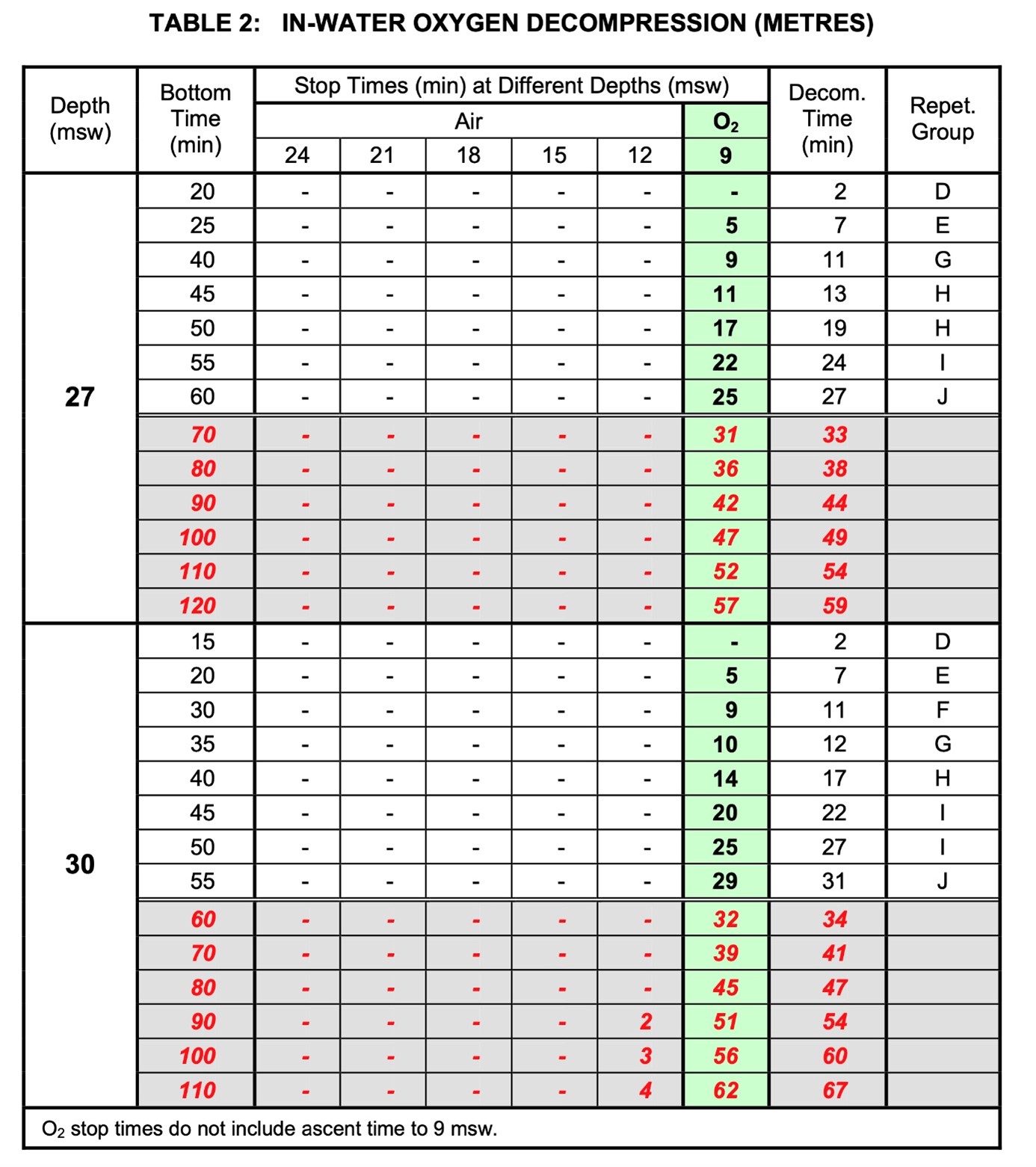
Facsimile from the DCIEM “Table 2” in-water oxygen decompression procedure. 27 and 30 msw table depth
The algorithm has been described in general terms10 and is based on diffusion-limited gas exchange with four serial compartments. The details and parameter set has not been published in public. The Canadian tables have been tested under carefully controlled conditions, including ultrasound surveillance for venous gas embolism. There is no data available to ascertain the extent these tables have been tested using oxygen as the decompression breathing gas.
DCD
The Dutch tables were last time published in 2015 by NDC and are commonly termed the DCD decompression tables12. They are based on an algorithm developed since 1975. The first air decompression tables were published by Vriens Diving and were termed the Vriens-Sterk decompression tables. In 1988, the Netherlands Diving Centre (NDC) asked Sterk to develop the NDC decompression tables, which were published in 1988 and were based on the Vriens-Sterk tables. The 1988 NDC decompression tables were only available in Dutch language. According to the author, the algorithm is a «Neo-Haldanian» sixteen-compartments model with half-times ranging 5-640 min36 (Wouter Sterk, personal communication January 2023), but neither the algorithm nor the parameters have been published in the public domain. The author reported in 1991 that more than 5000 dives completed according to these tables had been registered in a database37. The tables are officially recognized in The Netherlands and are commonly used on the Dutch continental shelf as well as abroad. We have not been able to find data on the use and experience of in-water oxygen decompression. We have included two sets of tables from DCD in our review. The first set are tables designed for wet bell decompression though they can be applied for dry bell decompression as well (Wouter Sterk, personal communication January 2023). The diver breathes oxygen at 9 and 6 msw. A five min air break is recommended after 20 min of oxygen breathing. A new single dive is allowed after a 12 h surface interval. A repetitive dive with air decompression or surface decompression with oxygen is allowed after 2-4 h. These tables have been published in public.
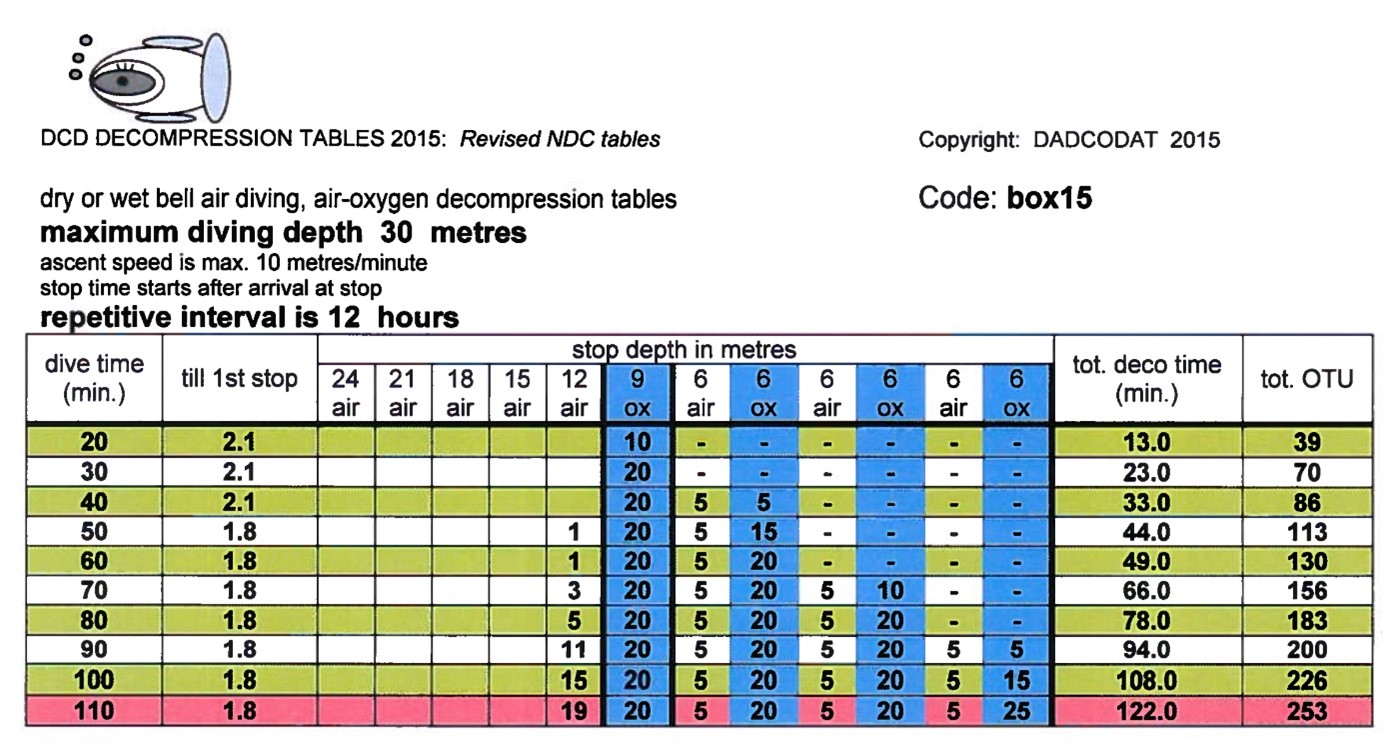
Facsimile from the DCD dry or wet bell decompression procedure. 30 msw table depth. Permission for reproduction Prof Wouter Sterk
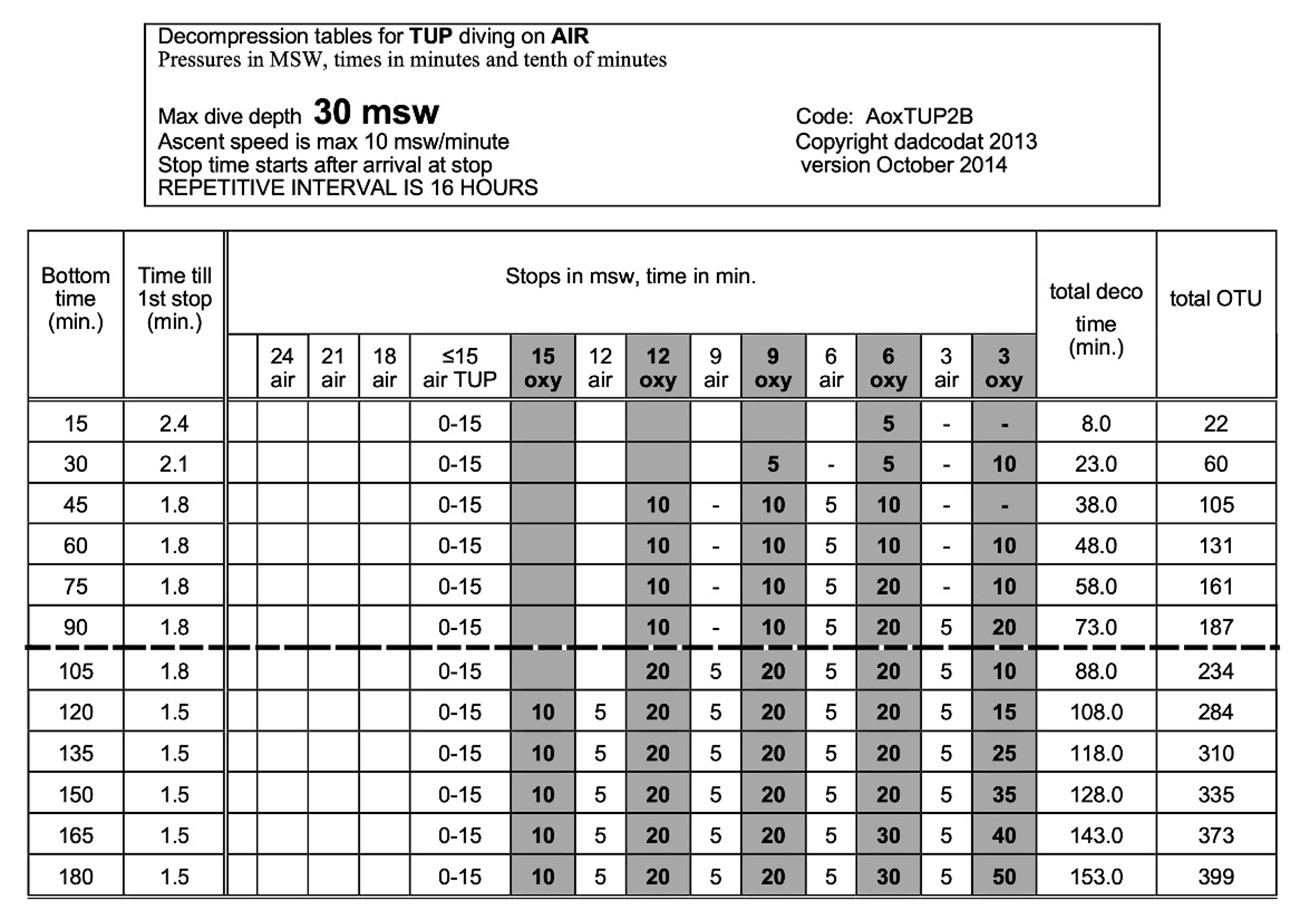
Facsimile from the DCD TUP decomperssion procedure. 30 msw table depth. Permission for reproduction Prof Wouter Sterk
The DCD AoxTUP2B TUP tables (DCD TUP tables) are not published in public but have been developed for the Dutch diving contractor N-Sea by Prof Wouter Sterk. The tables are modification of decompression tables originally developed for caisson work (Wouter Sterk, personal communication, January 2023). The tables range depths from 12 to 51 msw with the diver breathing air as the bottom gas. Compressed air is breathed on decompression stops (3 msw steps) from 24 to 18 msw. The tables are designed to allow the divers 15 min transfer time from the bell to the decompression chamber breathing air. Decompression stops at 15 msw and shallower are planned with oxygen breathing. The shallowest decompression stop is either 6 or 3 msw. A five min air break is planned after every 20 (6 and 9 msw stop) or 10 (15 msw stop) of oxygen breathing. No air break is scheduled during oxygen breathing at 3 msw.
Subsea 7 and Technip
The offshore diving contractors Subsea 7 and Technip submitted their procedures for review. Both companies use MT92 procedures as the basis for their internal procedures. Air breaks have been introduced during oxygen breathing. Random comparisons between the original MT92 tables and the company’s internal procedures disclosed differences in total decompression time in the order of 1-2 min. We consider such differences to be without practical importance and have therefore decided not to use these tables in the comparison.
Additional references
- Imbert JP, Montbarbon S. Use of the Comex diving data base. EUBS Workshop on operational dives and decompression data: collection and analysis; Amsterdam1990.
- Imbert JP. Decompression tables versus decompression procedures: an analysis of decompression sickness using diving data bases. EUBS annual meeting Heraklion, Greece. EUBS; 1991. p. 223–31.
- Sterk W. "SOX" Surface decompression tables in the eastern Scheldt. EUBS annual meeting Rotterdam, The Netherlands. EUBS; 1986. p. 115–23.
- Sterk W. The Netherlands national diving center data base. In: Sterk W, Hamilton RW, editors. EUBS Workshop. Amsterdam, The Netherlands: EUBS; 1990. p. 3–6.
- Super User
- Category: Information
- 295
Meehan, et al. Determining best practice for technical assessment of hookah surface supply diving equipment during diving fatality investigation
Appendix 1. Hookah accident data collection checklist
|
Name of deceased: Age: |
|
Training and experience: |
|
Time and Date of incident: (24hr : yyyy/mm/dd) |
|
Location of incident: |
|
Location of equipment: |
|
Date of inspection of equipment: |
|
Equipment inspected by other agencies: Y N |
|
If above Y, inspected by whom: |
|
Equipment photographed by other agencies: Y N |
|
If above Y, photographed by whom: |
|
Equipment photographed by other agencies: Y N |
|
If above Y, photographed by whom: |
|
Weather Conditions: |
|
Wind Direction at time of incident (if known): |
|
Air Inlet upwind / downwind of compressor unit: |
|
Hookah location at time of incident: Boat Flotation device Land |
|
Surface type compressor was located on (if on land) |
|
Clearance space around compressor (m): |
|
Hookah Brand: |
|
Serial Number: |
|
Description of complete system from air intake to diver(s) regulator(s): |
|
|
General overview of complete hookah system
|
Condition: |
Good |
Fair |
Poor |
Notes/Observations |
|
Air Intake Filter |
|
|
|
|
|
Air Intake
|
|
|
|
|
|
Compressor |
|
|
|
|
|
Linkage between motor and compressor (e.g., belt) |
|
|
|
|
|
Compressor motor |
|
|
|
|
|
Exhaust
|
|
|
|
|
|
Air Reserve Tank including volume |
|
|
|
|
|
Supply Hose
|
|
|
|
|
|
Hose attachments to compressor |
|
|
|
|
|
Regulator and attachment to diver
|
|
|
|
|
|
Harness/Vest |
|
|
|
|
|
Weight belt or vest |
|
|
|
|
|
Compressor Brand / Model No. |
|
Compressor motor type: Petrol Diesel Electric |
|
Engine type: 2 STROKE / 4 STROKE |
|
Fuel level: |
|
Compressed gas output: AIR NITROX |
|
Stated output in litres per minute / cubic feet per minute (CFPM): |
|
Stated line pressure (bar): |
|
Presence of a governor: |
|
Last documented service date: |
|
Inspection / Maintenance Log available: Y N |
|
Owner air test result available: Y N |
|
If Y, results: |
|
Air delivery system: Diaphragm Piston |
|
Pressure relief valve: Functioning? Y / N Setting (bar): |
|
Oil filter: Oil level: |
|
Lubricant type for internal parts (air side): |
|
Condensation drain condition: Water present in drain: Y / N |
|
Site of air hose connections relative to compressor: To reserve tank: Direct connection to compressor: |
|
Length of air intake (m): |
|
Horizontal distance of intake from compressor (m): |
|
Height of intake above compressor (m): |
|
Air intake free of obstructing debris? Y / N |
|
Air intake free of damage? Y / N |
|
Filter present at intake: Condition of filter: |
|
Filter type: Date of last change (if known): |
|
Connection type to compressor: Bayonet? Y / N |
|
Condition of exhaust port: |
|
Distance from air inlet (m): |
Air Reserve Tank
|
Storage Capacity (L): |
|
Integrated into frame of compressor or separate stand-alone unit: |
|
Construction material: Stainless Steel / Aluminium / Other (please specify): |
|
Water trap: Y / N |
|
Particle filter: Y / N Rated to (µm): |
|
Location of particle filter: Between compressor and reserve tank Between reserve tank and diver |
|
Type of particle filter: Macro particle / Carbon filter / Other (e.g. Hopcalite) |
|
Air redundancy? Yes, via surface cylinder Yes, with diver No |
Air Supply Hose
|
No. of hoses: |
|
No. of connections directly to compressor: |
|
Hose brand: |
|
Colour of hose: |
|
Condition of hose: |
|
Any visible damage / scuffs? |
|
Can hose be kinked? |
|
Length of hose (m): Internal Diameter of hose (mm): |
|
Non return valve: Present Absent |
Regulator
|
Hookah specific regulator: Y / N |
|
Modified SCUBA regulator: Y / N |
|
Brand / Model no: |
|
Condition of regulator including mouthpiece and exhalation valves: |
|
Cracking pressure of regulator: |
|
Accessory air supply: Spare Air / Octopus + Cylinder / None |
Harness / Weight Belt
|
Air Test Kit Product: |
|||
| Maximum (ppm) | Recorded (ppm) | Remarks: | |
|
Carbon Dioxide |
PASS / FAIL | ||
|
Carbon Monoxide |
PASS / FAIL | ||
|
Water Vapour |
PASS / FAIL | ||
|
Oil in air |
PASS / FAIL | ||
|
Odour |
PASS / FAIL | ||
|
Oxygen concentration (%) |
|||
|
Tested volume output of the hookah apparatus (l/min) |
|
|
Volume of reserve air tanks (l) |
|
|
(A) Maximum flow at hookah air outlet source |
|
|
(B) Maximum flow (l/min) at delivery point to regulator (1) |
|
|
(C) Maximum flow (l/min) at delivery point to regulator (2) |
|
|
Does (B) + (C) equal measurement (A) or is output flow reduced? |
|
|
Hose configuration: Is there a “Y” or “T” configuration which creates more than one air supply hose from a single outlet at the hookah apparatus? |
|
| Can steal of air be demonstrated if one regulator free flows at a shallow depth? – breathing pressure test | |
|
Driving pressure test: Differential pressure readings between surface and end of air supply hose (psi) |
0m: 5m: 10m: 15m: |
|
Time to depletion of air supply in event of compressor failure or purge of second line. |
|
- Super User
- Category: Information
- 1034
Lippmann et al. Compressed gas diving fatalities in Australian waters 2014 to 2018
Case summaries Scuba and SSBA 2014–2018
SS1: Male, aged 45-50 years, a very experienced diver, treated for depression but otherwise fit and healthy. Was seen to drink several cans of beer before trying to retrieve a craypot using a long air hose attached to a cylinder on the boat. He was submerged, holding a rope to attach to the pot, and a lookout was supposed to be watching his bubbles. Seeing that the diver’s hose was at its maximum length, the boat operator reversed the vessel, believing that the diver was clear. He was struck by the propellor and sustained fatal traumatic head injuries. The autopsy found facial injuries due to propeller, evidence of drowning, blood loss, and toxicology revealed the presence of alcohol (BAL 0.10%) and cannabis, both of which would likely have affected the diver’s judgement.
SC1: Obese and unfit male, aged 40–45 years, with a history of hypertension and 30 previous dives. He became breathless walking the 400 m to the dive site (although a friend carried his equipment) and the dyspnoea increased after swimming a short distance. He removed his hood complaining it was too restrictive. After swimming a bit further underwater, the buddy turned to see the victim with his regulator out and having a seizure. The buddy ditched the victim’s weight belt, brought him to the surface, and towed him to shore, inflating the victim’s BCD and trying to keep his head out of the water. Although untrained, the buddy attempted cardiopulmonary resuscitation (CPR), trying to ventilate the victim’s lungs using a regulator, while a friend went to call for help. Paramedics later arrived and pronounced life extinct. His equipment was found to be in good overall condition and non-contributory, although he was likely overweighted. The autopsy revealed obesity, water in sinuses on CT scan, heavy over-expanded lungs with severe pulmonary oedema. Toxicology revealed evidence of recent cannabis use. It is likely that he became too exhausted, aspirated, and drowned.
SC2: Obese male, aged 30–35 years, with an unreported medical and diving history. He was seen by a bystander gearing up in the car park and the bystander heard him purge his regulator before he descended the relatively long and steep walkway to the beach. Once on the rocks, he told another bystander that he was already exhausted. He was then seen to jump in and descend immediately, indicating that his BCD was not inflated. He was not seen to surface again and was found around 25 minutes later floating under a ledge, unconscious and with his regulator out of his mouth and caught in a crevice. His weights were in place. The rescuers ditched some of his weights, brought him to the surface and towed him to shore. CPR was begun and continued by a bystander (ED nurse). They needed to roll the victim onto his side several times to clear his airway. Ambulance paramedics arrived approximately 30 minutes later, found him to be in asystole and implemented ALS without success. On inspection it was found that his cylinder valve was closed, and the cylinder contained over 200 bar of air. Key autopsy findings included obesity, left ventricular hypertrophy (LVH), pulmonary edema fluid in upper airways and edematous slightly heavy lungs. It is likely that he turned off his valve after checking his gear at the carpark and, in his exhaustion, forgot to open it again before jumping in. With his BCD deflated and being overweighted, he would have sunk quickly and drowned.
SC3: Male, aged 50-55 years, with a history of asthma, heavy smoking and IV drug use. He had some puffs of salbutamol immediately before snorkelling while some friends practiced with scuba in shallow water nearby. He then asked to try the scuba for the first time and donned the equipment. After swimming on the surface for about five minutes, he stood up, took more salbutamol, became dyspnoeic, collapsed, and had a seizure. The friend ditched his weight belt and dragged him to shore with the aid of other nearby divers who then began CPR after some delay. On arrival, ambulance paramedics found him asystolic and implemented advanced life support (ALS). He was hospitalised but never regained consciousness and died one month later. No faults were found with the equipment. No autopsy was conducted. It is likely that he aspirated some water which exacerbated his asthma.
SC4: Male, aged 35–40 years, an experienced diver with history of asthma and amphetamine use. After a sleepless night he set off diving for crayfish. The first dive was with a buddy, but they separated after entry, and he surfaced after 20 minutes, out of gas. He changed tanks, taking one with a known slow leak, and set off diving again, solo. The others became worried when he failed to surface, and called for help, unable to do an underwater search as their tanks were empty. His remains (pelvis and legs only) were found four days later approximately 80 m from the dive site. There was evidence of bites from several different sharks, but it was unknown if these were in inflicted peri- or postmortem. None of his equipment was found. The direct cause of his demise is unknown.
SC5: Male, aged 50–55 years, reportedly fit and healthy, albeit obese. He became certified as an Open Water Diver (OWD) four months earlier and had done a total of seven dives, four of these during training. He and an equally inexperienced buddy were doing their first unsupervised dive from rocks bordering a channel. Before entering, he complained that “none of my watches are reading my tank” but he continued. The buddy swam ahead and could not see the victim when he looked back. On surfacing, he saw the victim surface shortly afterwards, swim to and grab onto nearby rocks, and vomit copious amounts of water. The buddy swam to the victim who was unable to speak and became unconscious.
Bystanders helped to drag him onto rocks and began CPR, despite the continual regurgitation of water. When tested, his equipment was found to be functional, and his cylinder was almost full although the air had a water content of 200 ppm. The autopsy revealed obesity, proximal aortic dissection, heavy lungs, and moderate ischaemic heart disease (IHD). It is likely that he suffered an aortic dissection and subsequently drowned.
SC6: Female, aged 30–35 years, with no significant medical history who was taking no medications. She was certified as an Advanced Open Water Diver (AOWD) and had logged 30 dives. She was diving on a wreck with a maximum depth of 36 msw with a group of four others and a divemaster. While inside the wreck at a depth of about 30 m, there was some surge and the victim appeared to spin in circles and kick out with her fins in a panic, or possibly suffered from a seizure. She spat out her regulator which another diver tried to replace several times but was unable to due to the victim’s clenched teeth. The rescuer then grabbed the victim and did an emergency ascent to the surface. She was brought onto the boat and (compression-only) CPR commenced promptly.
Despite the lack of ventilation, the victim appeared to commence spontaneous breathing for a short time (possibly agonal breaths) and oxygen first aid was provided, but then she appeared to become apnoeic, and compressions were recommenced. When the boat reached the jetty where paramedics were waiting, she was found to be asystolic and ALS was implemented. She was evacuated to a non- tertiary hospital before being transferred to a tertiary hospital with hyperbaric unit after significant delay. She was recompressed, although treatment was shortened as she was too unstable and died soon after. Autopsy revealed a normal heart, heavy lungs, hypoxic brain damage, perforated ear drums. It is unknown why she became unconscious, but it is likely that she aspirated water and ultimately died from drowning.
SC7: Healthy female, aged 20–25 years, was an overseas tourist participating in her first introductory scuba experience with an instructor and two other novices, one a non- swimmer. They entered from a beach where visibility was 0.5 m, although visibility was reportedly up to 4 m further out. She was too buoyant, so the instructor placed a single weight into the victim’s BCD pocket. The non-swimmer aborted the dive due to equalisation problems and the remaining trio encountered another group of divers, resulting in some confusion and reduced visibility. After swimming ahead for what she believed might have been 10 seconds, the instructor turned around and noticed that the victim was missing. In the meantime, some passengers on the boat and nearby snorkellers observed the victim surface and scream for help. She remained on the surface for an estimated 40 seconds before sinking. Neither the lookout of the boat nor the tender driver saw this. The instructor then surfaced before redescending and doing an underwater search without initial success. The victim’s body was eventually found by the instructor approximately one hour later, lying on the bottom with her mask off, regulator out and one fin missing. She was brought to the surface where some in-water rescue breaths were attempted. Airway management was complicated by the presence of froth, regurgitated stomach contents and water. No CPR was attempted due to the delay. The autopsy revealed overinflated oedematous lungs and foam in the upper airways consistent with drowning. The heart was normal (only chest examined at autopsy). Toxicology was negative. There was no imaging. It is likely that she panicked underwater, ascended to the surface but was unable to ditch her weight belt or inflate her BCD and subsequently aspirated water and drowned.
SC8: Severely obese female, aged 50-55 years, with a history of migraine and who was described as unfit. Although she was certified as an OWD for 17 years, it appears that she had done only 11-12 dives over that period. She and her buddy planned to do a drift dive from the shore of a tidal river. There was a slight surface chop and a strong current. The victim entered first and swam 15 m from shore on the surface while the buddy was held up putting on her fins. The victim then called out, pointed down and descended. When the buddy arrived on surface a short time later, she found one of the victim’s fins and saw her on the bottom at a depth of 2 msw, with her demand valve out and a stream of small bubbles coming from her mouth. The buddy called for help and a bystander snorkelled out, dived down, ditched the victim’s belt and brought her to surface. The rescuer then towed the victim to shore and began CPR, rolling her onto her side multiple times to drain water from her mouth. Paramedics arrived 15 minutes later and performed ALS, to no avail. It is likely that she was submerged unconscious for approximately seven minutes. The police found no faults with the equipment. The victim wore a total of around 10 kg of weights and a police reenactment indicated that it would have been unlikely that she could have swum to the surface with only one fin and without dumping weights or inflating her BCD. A CT scan showed probable postmortem decompression artifact. The autopsy revealed obesity; a bitten tongue; over-inflated oedematous lungs; with LVH, mild to moderate focal stenosis of the left anterior descending coronary artery (LAD), patchy fibrosis, and small vessel disease. It appears that the victim lost a fin, was swept into deeper water, panicked, aspirated water, and drowned.
SC9: Female, aged 30–35 years, an overseas tourist who was fit and healthy with no significant medical history. She was certified as an OWD for three years and had logged 13 dives to a maximum depth of 18 msw, albeit none for the previous 13 months. Her first dive of the day was uneventful, and, after a surface interval of 25 minutes, she descended with a group on an instructor-led dive on a wall to 10 msw. The current was too strong, so the instructor changed plans. He saw that the victim was being swept away in the current, but he stayed with the other divers, lost sight of the victim, and surfaced some eight minutes later. In the interim, the victim was seen to surface 50 to 60 m from the boat and scream for help before submerging. A rescuer descended several minutes later and found her on the bottom at 24 msw with her regulator out, mask almost full of water and blood flowing from her mouth. He partially inflated her BCD, brought her to surface, and ditched her scuba unit and her weight belt. She had been unconscious underwater for nine minutes. She was dragged onto the tender and taken to the main boat. CPR was performed by some crew for one hour and 45 minutes until a rescue helicopter arrived and paramedics implemented ALS. One defibrillation shock was delivered without success. Other than a higher than specified ‘cracking pressure’ on the demand valves, the equipment was reported to have been functional and non-contributory. A CT scan showed gas consistent with cerebral arterial gas embolism (CAGE) and postmortem decompression artefact. The history and CT suggested CAGE. The heart was normal. Pulmonary oedema in upper airways and lungs suggested drowning. It is likely that she panicked when being swept away by the current, did a rapid ascent, sustained a CAGE, became unconscious, and subsequently drowned.
SC10: Male, aged 50–55 years, an experienced recreational dive instructor with a history of chronic back pain and depression who had attempted self-harm three months prior. He had also recently been admitted to hospital with chest pain and advised to have further investigation post discharge. He had received a fitness to dive certificate from a doctor with relevant training, although it appears that he had withheld information on his mental health and recent hospital admission. He was participating in a commercial diver training course and had already reportedly completed approximately 12 dives, some of which involved the use of a full-face mask, including practice in clearing it when flooded.
On this occasion, he was undertaking a night dive in a fresh water, low visibility quarry. The divers were required to perform manual tasks, including setting up an underwater work bench with legs. The victim was wearing a full-face mask with communications, drysuit, among other appropriate equipment, but did not have a secondary regulator. The depth was 3.5 m, visibility 0–0.5 m, and the water temperature 13–14°C. He and his buddy were struggling to lift the bench upright on the sloping and slippery dam floor when the buddy lost sight of him. The dive supervisor heard the mask flooding on the communications system and the victim gave a line signal to pull him up urgently. However, when the supervisor tried to pull the diver up, the line was snagged. The buddy was instructed to assist the victim, whom he soon found floating near the bottom, unconscious and with his mask off and by his side but then lost contact with him. The standby diver found the victim disentangled his lifeline which was snagged on the work bench, and the victim was dragged ashore by the supervisor. CPR was commenced within 7 to 8 minutes of the mask flooding and, when an automated external defibrillator (AED) was attached (within 10 minutes of mask flooding) no shock was advised. Ventilations were supplemented with oxygen using a resuscitation mask, and the victim’s airway required repeated clearing of regurgitated stomach contents. Paramedics arrived, found the victim in asystole, implemented ALS which restored a pulse and transported the victim to hospital. He was later declared to be “brain dead” and taken off life support. The autopsy revealed evidence of widespread cerebral hypoxia consistent with clinical brain death, as well as some pre-existing cardiac scarring (focal sub endocardial interstitial fibrosis). Toxicology appeared to be non-contributory, and there was no underlying cardiac or cerebral pathology to indicate a possible cause of loss of consciousness. The cause of death was given as cerebral hypoxaemia secondary to drowning. It is likely that the victim’s mask was accidently dislodged after the lifeline became snagged, and the mask subsequently flooded. He signalled for help before becoming unconscious from drowning, with subsequent cardiac arrest. The investigating coroner made multiple recommendations about the need for accurate and appropriate record keeping, risk assessment, supervision, and equipment redundancy.
SC11: Obese male, aged 65–70 years, with a history of non-insulin-dependent diabetes, hyperlipidaemia, hypertension, prostatic hyperplasia, gout, and an ex-smoker. He was an experienced diver with over 300 dives and described as “competent, confident and cautious”. He was diving for crays with two others, him being on scuba and the others on ‘hookah’. There was a low swell with surface chop and poor visibility and there was a lookout on the boat. The buddies, who mainly had their heads down a hole chasing a crayfish, initially noted the victim to be lying on the bottom watching them. However, on catching the cray after about 10 minutes, the buddies noticed him to be missing. They assumed that he had returned to the boat and would find them again, if desired, by following the hookah hoses, so they continued to dive for another 50 minutes. On boarding the boat and realizing that the victim was missing, the others alerted the emergency services and began a surface search. They soon found him floating face-down approximately 100 m downstream. His weight harness was in place and his BCD was slightly inflated. There was no attempt at CPR as he had been missing for more than 60 min and assumed dead and unresuscitable. On testing, his equipment was found to be working correctly. There was no air remaining in his cylinder although police investigator believed that this likely occurred as a result of his regulator free flowing after he had become unconscious. The autopsy revealed expanded and oedematous lungs, cardiomegaly, LVH and severe IHD. His death was likely the result of a cardiac arrhythmia.
SS2: Male, aged 45–50 years, who was a highly experienced, commercially-trained diver. He and his buddy were collecting scallops using a “hookah” in an area with depths from 8–15 msw and visibility of around 3 m. There were many boats nearby engaged in fishing and diving. A large great white shark (GWS; Carcharodon carcharias) harassed divers in the vicinity a day earlier and they reported this, but the victim and his buddy were unaware of the report. After a while, the divers returned to their boat to count their catch, but hadn’t quite fulfilled the quota, so the victim dived again alone to collect the remainder. When he failed to surface as expected, the buddy snorkelled down along hose and witnessed a large shark (later identified to have likely been a GWS) attacking the victim. She returned to the boat and raised the alarm. Others on nearby boats arrived and pulled in the hose to retrieve the victim’s body. The autopsy showed traumatic injuries to the head, torso and arms, and amputation of both legs at the level of the knees. Death was likely from exsanguination.
SC12: Obese woman, aged 35–40 years, an international tourist with a history of a previously repaired traumatic aortic dissection and on no prescribed medications. She was certified as an AOWD and had logged 30 dives, the last being one year earlier. She was on an instructor- led charter diver with five others. The sea was calm, there was only a slight current and visibility was good. The group descended to 12 msw and, after 10 minutes, the victim signaled that she wanted to surface. The instructor noticed her “panicked eyes” and held onto her to slow her ascent. Once on the surface, the victim complained of dyspnoea. She was taken aboard the tender and brought to the main boat where she was administered oxygen. She became unconscious although initially responded to pain stimulus. After 15 minutes, two doctors who were passengers came to help, an AED was attached (result unreported) and CPR was commenced and continued for 90 minutes until a doctor arrived on a rescue helicopter and declared the victim to be deceased. When tested, no faults were found with her equipment. A CT, several hours postmortem, showed no evidence of CAGE. The autopsy revealed cardiomegaly, LVH, no atheroma of coronary arteries although the left circumflex artery was difficult to dissect. The lungs were congested and oedematous. It is likely that the victim drowned secondary to a cardiac arrhythmia.
SC13: Obese woman, aged 60–65 years, an overseas tourist with no other significant medical history who was diving from a commercial vessel. She entered the water with a buddy but had difficulty descending. There was some current and wind which took them away from the boat and the buddy suggested heading to the boat to get more weight and began swimming ahead. He looked back and saw the victim begin to descend with visible bubbles. He swam towards her and began his descent but could not see the victim, so he surfaced and advised the tender driver of the situation. They returned to the main boat and raised the alarm about a possible missing diver. A surface search was begun and eventually the victim was sighted on the bottom, 95 minutes after she was last seen. A rescuer donned scuba and found the victim on the bottom at 10 msw depth, with her demand valve out but other all other equipment in place. There was 190 bar of air in her tank and her BCD was deflated. The rescuer ditched the victim’s weights and tried to dump air from her BCD, but none came out. He held her demand valve in her mouth and purged it to try to inflate her lungs during ascent. He then brought her to the surface and gave some in-water rescue breaths. She was brought onto the boat where CPR was performed by staff for 45 minutes. A paramedic arrived by helicopter 45 minutes later and continued resuscitation for 20 minutes. An AED indicated no shockable rhythm and no drugs were administered. When tested by the police dive squad, the equipment was generally found to be in “average but serviceable condition and unlikely to have contributed to the case of the accident”.
However, the cylinder was recently out-of-test and found to have a crack in the neck. The air had a high-water content and had a “distinct” odour and taste. The autopsy showed congested and oedematous lungs, areas of myocardial fibrosis and severe IHD. It is likely that the victim died after a cardiac arrhythmia.
SC 14: Obese female, aged 55–60 years, with history of Sjogen’s Disease (treated with hydroxychloroquine) but otherwise apparently healthy. She was a very experienced diver although she had not dived for two years. She went on an instructor-led refresher dive to accompany her inexperienced sister. Some initial buoyancy issues were rectified by the instructor by relocating weights and adjusting her BCD. However, after 29 minutes and at a depth of 8 msw, the instructor noticed a problem, swam to victim who had a glazed look in her eyes. She initially responded to the instructor’s prompts by squeezing his hand, but then became unresponsive. While holding the victim’s regulator in her mouth, the instructor dumped air from her BCD, brought her to surface, inflated her BCD and called for help. The victim was unconscious, cyanotic and froth oozed from her mouth. She was pulled aboard the boat and CPR commenced by staff, assisted by some doctors and a nurse who were also passengers. An AED was attached but no shock was advised. When a rescue helicopter arrived, the doctor pronounced life extinct. The autopsy revealed congested, oedematous lungs, bilateral haemothoraces, and mild to severe IHD. Toxicology indicated a toxic level of hydroxychloroquine. It is possible that she suffered from a cardiac arrhythmia from the combined effects of IHD and hydroxychloroquine toxicity.
SC 15: Obese male, aged 45–50 years, with a history of untreated mild hypertension but believed to be otherwise fit and generally healthy, although taking Nexium. He was certified as an AOWD for 10 years and was an experienced and regular diver. The conditions were favourable with no current, a low swell, and visibility of around seven metres. The victim and his two experienced buddies, all of whom set off with full scuba cylinders, descended and swam along for a while and, on reaching a depth of 13 msw, set out to find crays. After what was reported to have been about 10 minutes, the victim showed a buddy his gauge, which read 20 bar, and signalled that he would return to boat. He then appeared to surface calmly and began a safety stop. The others surfaced some 10 to 15 minutes later and initially assumed that the victim was on the boat but realised that he was not. They found him floating face-down on the surface, unconscious and apnoeic. They were unable to lift him onto the boat for 15 minutes as he was too heavy. In-water “resuscitation” was attempted. A charter boat was nearby, and the victim was loaded onto its tender and CPR started on way to shore. On arrival, CPR was then continued by police and assisted by local doctor and some nurses. CPR had been performed for more than 30 minutes by the time a rescue arrived. The victim was found to be asystolic and ALS was performed for 30 for minutes before the victim was declared deceased. His cylinder was empty, and his equipment was found to be functional when tested. The autopsy showed heavy, congested, and oedematous lungs, cardiomegaly, mild LVH, and moderate to severe IHD. Toxicology found therapeutic levels of pseudoephedrine and quinidine. The presence of quinidine suggests that he might have been treated for cardiac arrhythmia and the pseudoephedrine could have exacerbated this. It is likely that he drowned following a likely cardiac arrhythmia due to IHD, out of air and/or anxiety related to low air situation.
SC16: Obese male, aged 45–50 years, was a very experienced diver with a history of hypercholesterolaemia and chronic back pain (medications unreported). Prior to diving he noticed that his tank valve was leaking but decided to dive anyway as the leak was small. He and a friend went diving for crayfish from an inflatable boat anchored in water 10–15 msw deep. After entry, they dived separately as planned. The friend surfaced several times without seeing the victim. On finishing his dive and boarding the boat, the friend saw the victim on the surface 100 m distant and drove over to him. He was floating on his back, unconscious, froth exuding from his mouth and nose, and with no mask, weight belt or catch bag. The friend ditched the victim’s scuba unit which sank as the BCD was uninflated. He was unable to drag the victim aboard, so he tied the victim to the boat and called the emergency services. A rescue helicopter eventually arrived, and the victim was winched aboard. No resuscitation was attempted. A postmortem CT scan showed no evidence of CAGE. The autopsy revealed froth in upper airways, pulmonary oedema, interstitial fibrosis, cardiomegaly, mild to moderate multivessel IHD, and LVH. It appears that the victim drowned but the cause, including whether he had suffered a cardiac arrhythmia or run out of air, was unclear.
SC17: Obese male, aged 60–65 years, with no significant medical history, taking no medications and described as fit and healthy, other than obesity. He was a very experienced diver, a rebreather instructor, who had logged more than 250 dives. He was diving solo from shore in the early evening in relatively calm conditions. A bystander heard screaming for help and saw the victim in the water, waving a ‘glowstick’. Nearby lifesavers were alerted, and one arrived on a paddleboard shortly afterwards. The victim was initially able to speak to the lifeguard but was dyspnoeic and exhausted. He ditched his own scuba gear to make it easier to get on board. Another lifesaver arrived on a jet ski and the victim was taken to shore but became unconscious enroute. CPR was commenced including the provision of supplemental oxygen (by bag-valve-mask), and an AED was attached but no shock was given. Paramedics arrived, began ALS and transferred the victim to hospital, where he later died. His equipment was found to be functional, and the remaining air met the relevant standards. The autopsy showed obesity, heavy, congested, and oedematous lungs, cardiomegaly, LVH and widely patent coronary arteries. It appears likely that he died as a result of immersion pulmonary oedema (IPO).
SC 18: Male, aged 50–55 years, with an unknown medical history. He was an experienced dive instructor who went diving on a wreck at a depth of 34 msw with three others. The water was calm and warm, visibility good and there was a 0.5 knot current. His first dive required 30 minutes of decompression and, despite being reportedly short of breath afterwards, he dived again after a one-hour surface interval, seemingly solo. He was sighted during the dive, dragging the anchor, and then tying the anchor line to the shot line. After completing their dives, the others became concerned when the victim failed to surface. A large search failed to find him. His scuba unit, mask and board shorts were recovered three days later on the seabed 150 m the from the wreck. The BCD and shorts showed signs of predation by a large shark(s), but it was unclear if this occurred peri- or postmortem. When tested, his cylinder was found to be empty other than 1,200 ml of seawater, although his contents gauge read 10 bar. The demand valves contained some sand and had a slow leak. The BCD had a large tear and would not hold air. The most likely scenarios for this man’s demise are that: (1) he was attacked by a large shark during the dive; or (2) he exhausted his air supply, became unconscious and was later predated upon by a shark(s); (3) he suffered from a medical-related event (including possible DCI) at some point during the dive, became unconscious and was later predated upon by a shark(s).
SC19: Male, aged 30–35 years, with history of a motor vehicle accident and possible subsequent seizure, and under treatment for depression and anxiety (dothiepin, quetiapine). He was a novice diver who had done four dive post OWD certification and was on a dive charter to a reef in 12 msw. The sea was calm and there was no significant current. He was noticed to be very anxious on the surface, unable to descend and panicking, and was coaxed to the back of the boat. While removing his fins in the water, he was seen to have a seizure. The boat operator/divemaster (DM) jumped in, ditched the victim’s weight belt and removed his scuba unit. His head rolled to one side and his face was submerged for several seconds, after which he was heard to make two gasps. The DM dragged the victim onto the transom and checked for a pulse which he was unable to palpate. There was a yellow discharge from his mouth. The DM then gave two rescue breaths and began chest compressions which he continued for a while before dragging the victim onto the main deck. The DM began compression-only CPR for 5 to 10 minutes but stopped to call for help and to try to recall the other divers. Oxygen equipment was available, but he had no time to access it. He then recommenced chest compressions until the divers surfaced after a further 30 minutes. Resuscitation continued during the trip to shore where paramedics continued without success. When the equipment was later tested, the cylinder was empty, likely because of leakage during the time between the incident and testing. The cylinder valve was faulty and leaked, there was also a leak in the first stage regulator, and sand was found in both demand valves, believed to have been there pre-dive. The autopsy revealed aspiration of gastric contents, heavy oedematous lungs, widely patent coronary arteries, and mild LVH. Toxicology revealed quetiapine (therapeutic) and dothiepin (potentially fatal range). It is likely he drowned secondary to a seizure (induced by the toxic effect of dothiepin).
SC20: Obese female, aged 55–60 years, was an overseas tourist with history of hypertension, hypercholesterolaemia, sleep apnoea, spondylolisthesis, anxiety/depression, arthritis, and reflux, and was taking a variety of medications which included amlodipine and celecoxib. She was cleared as fit to dive by her GP and cardiologist prior to travelling. She had certified as an OWD 24 years earlier and had logged 25 dives, including six on this trip on a liveaboard dive vessel. She was on her second dive of day, part of a large group on an organised fish feed. There was a 1 to 1.5 m swell, a current of 0.5 knots and visibility of at least 15 m. The victim entered the water several minutes before her buddies and was initially seen floating on surface. However, when a buddy descended, she saw the victim lying unconscious on the seabed. A swift rescue was performed, and the victim was brought on board the vessel where CPR was commenced, an AED attached, and three shocks delivered. Adrenaline was administered by a passenger who was a doctor, and resuscitation performed for almost an hour, without success. No faults were found with the equipment. Her dive computer profile indicated that the victim became unconscious at a depth of around 3 msw, within 30 to 40 seconds of entry, and sank to the bottom. She was unconscious underwater for six minutes. The operator log showed that CPR began nine minutes after she entered the water, and the first shock was delivered two minutes later.
The autopsy revealed petechial haemorrhages, congested, oedematous albeit not heavy, lungs, and mild to severe IHD. Toxicology showed the presence of amlodipine, celecoxib, and THC. It is likely that she suffered a cardiac arrhythmia soon after entering the water and subsequently drowned.
SC21: Female, aged 60–65 years, who was generally fit and healthy despite some comorbidities. She was an experienced diver who went diving for crayfish at a familiar site with a buddy. It was overcast, there was a low swell, visibility was around 3 m and the depth 10 msw. After about 20 minutes, the buddy turned and saw the victim swimming about one metre behind and one metre above him, and she signalled “OK”. However, shortly afterwards, he felt something brush his leg and, when he turned, he could no longer see his buddy but instead saw a large shark swimming towards the surface. Some nearby fishermen saw thrashing and then saw the victim floating on the surface with a 5.7 m GWS circling her. The buddy surfaced and the fisherman drove their boat between him and the shark to enable him to board his boat. He then drove to the victim and hauled her aboard. She had multiple limb and digit amputations and was obviously deceased. No mention was made whether any of the fishers nearby had been burleying. The autopsy showed amputation of an arm, leg, and various other traumatic injuries. Death resulted from multiple limb amputations.
SC22: Female, aged 40–45 years, was a fit dive instructor with a history of 350 dives. She had mild untreated hypertension and possible obsessive-compulsive disorder. She was taking an OWD student on his second dive of the day (and the course) at a large jetty. It was reported that there was pressure for the diver to complete his training as he had a trip planned in the immediate future. She wore a dry suit and scuba unit and BCD with 8.8 kg of integrated weights, and a knife. It was a cold winter’s day and there was a strong wind, a mild current and a 2 m swell on the seaward side, albeit sheltered in the lee, where the earlier dive took place without incident. The water temperature was 12°C and visibility 5 m. After a surface interval of 51 minutes (during which it is likely that the student became cold), the pair re-entered the water. This dive involved skills checks, and it is likely the student was required to demonstrate mask and regulator removal and replacement. The jetty has protective slabs on the seaward side which provide substantial shelter from incoming waves. However, there is a gap under these slabs and a strong surge can enter through this. The pair strayed onto the seaward side of the jetty and into the rough, surgy water. After a rapid ascent, the student was seen to surface with his mask off and it was clear he was in trouble. The instructor surfaced and attempted to rescue him but became exhausted and failed to inflate her BCD or dry suit, or ditch her weights as suggested by one of the nearby rescuers. Rescue efforts were hampered by the bad conditions. One rescuer valiantly clung to a jetty ladder while holding onto part of the diver’s partly unreeled and entangled SMB line to support her. He was forced to abandon his efforts due to large waves crashing over him. Both divers died at the scene. No problems were found with her equipment when tested and there was 20 bar of air remaining in her cylinder. Her dive computer recorded a maximum depth of 9 msw (indicating that she was subjected to a 2 m swell outside the protection of the jetty) and that there was a very rapid ascent from 7 msw to the surface about 13.5 minutes into the dive. The autopsy showed hyperinflated, oedematous and congested lungs, mild LVH, no IHD; head abrasions, bruising and haematomas, and bruising on an arm, hand and leg. It is likely that she became exhausted and overwhelmed by the rescue efforts and situational stress, failed to act to attain positive buoyancy to save herself, and subsequently drowned.
SC23: Male, aged 35–40 years, who was fit and healthy with no significant medical history and reported to be a reasonable swimmer. He was diving with an experienced instructor on his second dive of the day (and the OWD course) at a large jetty. He was wearing a 7 mm wetsuit with hood and boots, and a scuba unit and BCD with 9 kg of integrated weights. It was a cold winter’s day and there was a strong wind, a mild current and a 2 m swell on the seaward side, albeit sheltered in the lee, where the earlier dive took place without incident. The water temperature was 12°C and visibility 5 m. After a surface interval of 51 minutes (during which it is likely that the student became cold), the pair re-entered the water. This dive involved skills checks and it is likely he was required to demonstrate mask and regulator removal and replacement. The jetty has protective slabs on the seaward side which provide substantial shelter from incoming waves. However, there is a gap under these slabs and a strong surge can enter through this. The pair strayed onto the seaward side of the jetty and into the rough, surgy water. After a rapid ascent, the student was seen to surface with his mask off and it was clear he was in trouble. He was unconscious and cyanotic. The instructor surfaced and attempted to rescue him but she herself became incapacitated. After a delay, some bystanders launched a dinghy and recovered the student. CPR was attempted without success. When paramedics arrived, he was asystolic and resuscitation was discontinued due to the delay prior to recovery. No significant faults were found with his equipment, and he had plenty of air remaining in his cylinder. The autopsy revealed white, frothy sputum in the airways, oedematous and inflated lungs, no significant IHD or LVH, and abrasions to the face and one hand. It is possible that the divers were inadvertently sucked out from the relative shelter under the pier by the surge, causing the victim to panic, aspirate water, and subsequently drown.
SC24: Male, aged 40–45 years, with no significant medical history and “average fitness” was an active and experienced diver who had logged 350 dives. He was a member of a dive club and had met the requirements to fill tanks from the club’s compressor which was reportedly regularly maintained by another club member, an electrical, refrigeration and air conditioning mechanic. One evening, the victim filled several cylinders for his buddy and himself, as well as some of other club members. The victim and his partner went diving from a charter boat using tanks he had filled using the club’s compressor. The first dive was uneventful, the victim and his buddy appeared well during the surface interval and changed tanks before the next dive. They entered into a strong but manageable current and after 10 minutes at a maximum depth of 27 msw, the victim indicated that he was feeling unwell and wished to surface. They ascended slowly, became separated due to the current, but the partner managed to board the boat. The victim was seen to surface briefly and thought to “fiddle” with his BCD before sinking. His body was recovered the following day - his weights in situ, BCD partly inflated, and pressure gauge reportedly indicating at least 80 bars of remaining gas. The buddy suffered from headaches and some amnesia for several days. Gas analyses of the victim’s cylinder indicated 7,636 ppm carbon dioxide (CO2) and 2,366 ppm carbon monoxide (CO). High levels of CO and CO2 were also found in the tank he had used for the earlier dive, as well as in both of his buddy’s tanks (and tanks of other members filled at the same time). The autopsy showed a subarachnoid haemorrhage of unknown origin, heavy, oedematous and hyperinflated lungs, and only mild IHD. Toxicology indicated a carboxyhaemoglobin (COHb) level of 56%. It is likely that the victim drowned as a result of carbon monoxide poisoning. Investigation found multiple faults with dive club compressor.
SC25: Male, aged 60–65 years, with a history of hypertension (perindopril) but otherwise apparently fit and healthy and a regular swimmer and walker. He underwent a fitness-to- dive assessment with a doctor with relevant training, where his blood pressure was recorded as 169/99 but no other potential issues were identified. Two weeks later, he travelled interstate where he had enrolled in an OWD course. He was standing at the shallow end of a swimming pool after just completing the 200 m swim test when he was seen to hold his nose and fall forwards, unconscious. The instructor promptly started CPR with supplemental oxygen provided. An ambulance arrived 10 to 15 minutes later, one defibrillation shock was given, and ALS was performed but was unsuccessful. The autopsy revealed severe pulmonary congestion and oedema, severe triple vessel IHD, myocardial fibrosis on the left ventricle, and mild LVH. He likely died from a cardiac arrhythmia after exerting himself during the swim test.
SC26: Obese male, aged 50–55 years, with history of asthma (salbutamol, fluticasone/salmeterol) and surgical repair of cerebral aneurysm 20 months earlier. He was certified as an OWD six years prior and had completed 40 dives. The victim and his buddy entered the water from a jetty and swam to a nearby channel with a depth of 15 msw.
There was a large swell and they struggled to make headway in the rough conditions. They eventually tried to return to the jetty but continued to struggle, especially the victim. The buddy went ahead to raise help. At one point he looked back and saw the victim crawling onto a rock. A rescuer swam out to help the victim and found him unconscious and being washed against a sheer rock wall, with froth coming from his mouth. He ditched the victim’s weights and tried to inflate his BCD, which he was unable to do as there was no remaining air. He then towed the victim towards shore, at one stage attempting in-water compressions. Paramedics were waiting when the victim was brought ashore, a defibrillator was attached but no resuscitation was attempted. The autopsy showed some froth in mouth and airways, pulmonary oedema, widely patent coronary arteries, and evidence of a previous craniectomy with a cerebral aneurysm clip. It is likely that the victim became exhausted trying to swim in the prevailing conditions, had exhausted his air supply, aspirated water, and drowned.
SC27: Male, aged 60-65 years, was an overseas tourist with a reported history of psoriatic arthritis (codeine/paracetamol, sulfasaline). He was a strong swimmer, had certified as an AOWD four years earlier and had done more than 30 dives, 10 in the past year. He was diving from a commercial vessel, and he had done an earlier dive to 19 msw for 38 minutes without incident. After a surface interval of 57 minutes, he dived again. The water’s surface was choppy, there was a slight current, and visibility was 12 to 15 m. He and two buddies were swimming near the bottom at a depth of around 18 m about 15 minutes into the dive when he was seen to roll over to his side with his regulator out. One buddy inflated the victim’s BCD and the other tried to hold his regulator in place as they ascended. On surfacing, a large amount of water and blood-stained sputum came from his mouth. He was promptly brought onto the tender and back onto the pontoon. CPR was commenced by crew, assisted by some passengers who were nurses. Supplemental oxygen was administered, an AED was attached within 15 minutes of the victim becoming unconscious, and four shocks were given. When a doctor arrived on the rescue helicopter, the victim was found to be asystolic and adrenaline was given, with no response. No faults were found with the equipment or the breathing air. A postmortem CT showed no signs of CAGE. The autopsy showed substantial pulmonary congestion and oedema, cardiomegaly, severe triple vessel IHD, and a large PFO. It is likely he suffered from a cardiac arrhythmia and subsequently drowned.
SC28: Obese male, aged 50–55 years, with a history of hypertension and electrocardiogram changes consistent with LVH. He was certified as an AOWD and was described as “experienced” but had done no dives for more than two years. He, his buddy, and another pair of divers carried their equipment quite a long distance to reach the shore entry point for the dive. He was wearing a steel tank and approximately 12 kg of weights. The conditions were described as “relatively good” with visibility of approximately 7 m but there was a “reasonable surge” over the reef. They descended and did a shallow, short dive before having to surface and crawl over a section of reef. After redescending, they continued to dive at a depth of about 5 msw. After swimming through a small cave, the buddy lost sight of the victim for several minutes. In the meantime, the victim surfaced in distress and was assisted by one of the other divers. At this time, his pressure gauge read 100 bar. They headed towards shore but passed a ‘bommie’ on different sides. The other diver then saw the victim sinking so swam towards him. The original buddy then saw what was happening, swam to and grabbed the victim, inflated his BCD and they rose to the surface. The buddy removed the victim’s mask and noted that he was unconscious with froth coming from his mouth, and he heard what he believed to be agonal gasps. He gave some rescue breaths and continued these as one of the other divers towed the victim to shore where they commenced CPR. Another diver went to call for help and retrieved the buddy’s first aid kit which included a BVM and an AED. The AED was attached (an estimated 20 minutes after unconsciousness) but no shock was advised. Paramedics arrived and implemented ALS without success. No significant faults were found with the equipment. The cylinder was empty as the regulator free-flowed during the rescue. The autopsy showed heavy, congested lungs, cardiomegaly, LVH, moderate to severe IHD, a congested liver and patchy subarachnoid haemorrhage. It is likely that he suffered from a cardiac arrhythmia and drowned.
SC29: Male, aged 45–50 years, apparently fit and healthy with no significant medical history and who was taking no regular medications. He was an experienced diver, but his qualification was not reported. He reportedly had drunk 10 pints of home brew the day before, which was not unusual. After an earlier uneventful dive to check some craypots, he moved his boat and anchored at another site with a depth of 10–13 msw. It was sunny with little wind and visibility was greater than 5 m. While his partner remained on the boat, the victim entered the water to free snagged craypots. He was wearing a two-piece 5 mm wetsuit and a weight belt with 6.8 kg of weights. Shortly afterwards, he surfaced, attached a rope to the boat and to his BCD, and redescended. After 3–4 minutes he was seen to breach the surface, feet first and unconscious. He was dragged onto the boat and CPR commenced by his partner and a friend who came from a boat nearby. He was stabilized by paramedics and transferred to hospital but had suffered an unrecoverable hypoxic brain injury and life support was withdrawn. When tested, it was found that his BCD had a sticky inflator button. There was 120 bar of air remaining in his cylinder. His weight belt was found attached to a craypot. The autopsy showed severe IHD and the lungs had been removed for donation.
One possible scenario is that, while trying to raise the craypot, he was unable to inflate his BCD and so removed his weight belt, tied it to the craypot and subsequently lost control of buoyancy and inverted during an uncontrolled ascent. His mouthpiece was ripped off at some point so he would have lost his air supply. It is likely that he drowned.
SC30: Obese female, aged 65–70 years, who swam and walked daily and was described as “fit and healthy”. However, she had reported occasional palpitations (asymptomatic) five months earlier and had two recent episodes of dyspnoea after exercise. The first occurred after walking and climbing stairs, and the last (which included numbness in her feet) occurring after swimming on the day before her diving incident. She was a certified OWD who had logged 148 dives, albeit with some reported “panic attacks”. She was diving from a boat at a familiar site with a group of friends. The conditions were “very good” with a light breeze, a low swell, and a water temperature of 17°C. She and her buddy were completing what appeared to have been an incident-free dive to 14 msw for 38 minutes. After a normal ascent with a short stop at 6 msw, on surfacing, the victim appeared dazed, dyspnoeic, and made a gurgling sound when trying to speak. She dumped some weights and they started to swim towards the boat, but she soon became unconscious. The others came to assist and began in-water rescue breathing while towing her to the boat. Once on board, after “some moisture” was cleared from the victim’s mouth, CPR was performed during the 30-minute trip to the jetty, where paramedics were waiting. She was asystolic with a clear airway. ALS was commenced and spontaneous circulation returned after 40 minutes (> 1 hr post event). However, she was hemodynamically unstable and died in hospital.
When tested, her equipment was found to be functional and there was 90 bar of air remaining in her cylinder. A postmortem CT showed no signs of CAGE. The autopsy revealed heavy, congested lungs, sub-pleural emphysema, some interstitial fibrosis, mild pulmonary hypertension, LVH, moderate IHD and myocardial contraction bands. It was suggested that she likely suffered a cardiac arrhythmia although another possibility would be IPO.
RB31: Obese male, aged 45–50 years, with no significant medical history. He had been diving for nine years and had been certified to dive with a Closed-Circuit Rebreather (CCR) using air diluent three years earlier. However, his subsequent experience with his CCR was not reported. He was on a dive outing with a group of divers from his club. After an earlier uneventful dive, the victim and his buddy set out for another dive. He was using his CCR (rEVO III) with O2, air diluent and an air bailout and was wearing a drysuit. His buddy was also using a CCR. They descended and explored a cave at a depth of 15 msw, following it into shallower water and into a narrowing fissure. There was a strong current and moderate surge. The buddy signalled that he wanted to surface, and the victim decided to continue exploring the fissure. The buddy returned to the boat and, he and the others became concerned when the victim failed to surface. After an extended search, they eventually saw the victim’s fins breeching the surface and found him with his head and body submerged, mask off and mouthpiece out. He was pulled onto the boat unconscious, apnoeic and cyanotic, there were abrasions on his face and scalp and his tongue and lip appeared to have been bitten. They began CPR and called the emergency services. When paramedics eventually arrived, the victim was declared deceased. When examined, the CCR circuit was flooded, the bailout regulator damaged and its cylinder full of water. There was remaining O2 and diluent air. However, no pre-existing faults were found with the equipment. The victim’s dive computer indicated that he was likely unconscious for more than 70 minutes, initially being pushed through the fissure by the current and surge, then sinking for a period before floating to the surface. The autopsy showed overexpanded and congested lungs, minimal IHD, multiple abrasions on face, scalp and the back of the hands and a large haemotoma in the right temporal region. It is likely that the victim was smashed against the rocks by the surge, his mouthpiece was displaced, and he subsequently drowned.
SC32: Male, aged 60–65 years, with a history of hypertension (perindopril/amlodipine) and hypercholesterolaemia (ezetimibe/simvastatin) but he was fit and ran regularly. He had undergone a diving medical examination with an appropriately trained doctor two months prior to his fatal incident and no issues were found, other than hypertension. He was certified as an AOWD, had subsequently completed additional training including ‘deep’ and ‘nitrox’, and had logged 193 dives. He and his buddy were on a dive charter in what was described as “ideal” conditions. The sea was calm, it was ‘slack water’, water temperature was 19oC and visibility 10 m. A previously experienced drysuit diver, he was trying out a new cold water drysuit with thick undergarments in preparation for an upcoming dive trip to Antarctica. He was using a steel cylinder filled to around 225 bar, attached to a new harness and wings. He was also using a new cold-water regulator and carrying 15 kg of integrated weights. The victim and his buddy swam uneventfully along a wall to a maximum depth of 21 msw and he pointed out various items of interest to his less experienced buddy. After about 35 minutes, when the victim’s gauge reportedly read 40-50 bar, he signalled to ascend. The pair ascended and spent five minutes in shallower water doing what was described as a “rough safety stop”. The victim then inflated his SMB and immediately surfaced without signalling his buddy, who was surprised by this. The buddy surfaced shortly afterwards, and the pair were about 10 m apart as the current was now running. The buddy noted that the victim had changed regulators and saw him roll over to his side before submerging and disappearing. The victim’s body was recovered the following day on seabed at a depth of 14 msw. His drysuit and wings were deflated, and his tank was empty. His BCD waistband was unstrapped but the shoulder straps were clipped. His mask was on but his regulator out. The autopsy showed hyperinflated, congested, and oedematous lungs, some endocardial fibrosis and moderate IHD. It is likely that the victim miscalculated his air usage with his new equipment, ran out of air, was unable to attain positive buoyancy, sank and drowned.
SC33: Obese female, aged 60–65 years, with a history of NIDDM but no longer requiring medication and with no known complications. She was enrolled in a OWD course and underwent a diving medical examination with a doctor with no specialised training.
However, reportedly, the doctor advised her not to dive until she lost weight and increased her fitness but still certified her as fit to dive. She was on her first open water scuba dive.
After donning her equipment and walking 50 m to the shore, she was breathless and complained that her (5 mm full) wetsuit felt too tight. She was wearing a standard scuba unit with a steel tank and carrying 8 kg of weights distributed between her weight belt and BCD. The surface was calm with a low swell, there was no current, the water temperature was 20oC and visibility was around 3 m. The group reached a maximum depth of 7.6 msw and the victim appeared to be relaxed and enjoying the dive. However, 30 minutes into the dive and at a depth of 4 msw, the victim appeared to panic, grabbed the instructor, and spat out her regulator. The instructor held her and immediately purged and replaced the victim’s regulator. The victim was wide-eyed and breathing rapidly and shallowly and clutched her throat before becoming unconscious. The instructor controlled their ascent and towed the victim to shore, 40 m distant, her head being supported out of the water by another diver. The instructor believed that there had been little opportunity for the victim to aspirate water both during the dive and during the rescue. White, frothy sputum which later became blood-stained exuded from the victim’s mouth. On shore, she was placed into the recovery position to clear her airway and was unconscious, apnoeic and pulseless. Lifesavers and a bystander doctor arrived, an AED attached, but no shock was advised. Paramedics arrived, implemented ALS and transferred the victim to a nearby hospital where spontaneous circulation occurred after prolonged asystole. A coronary angiogram was unremarkable.
She was diagnosed with hypoxic ischaemic encephalopathy and her prognosis was poor and she died four days later. Autopsy revealed organising bronchopneumonia and cerebral oedema with ischaemic changes, mildly heavy and congested lungs, some thickening over the LV, mild IHD, and focal LV contraction bands. No faults were found with the equipment or air, of which there was 120 bar remaining. It is likely that this was a fatal case of IPO.
SC34: Male, aged 50–55 years, with no significant medical history was certified as an AOWD and was an experienced and regular diver. He went diving for crayfish with friends. There was a slight chop and low swell, the water temperature was 21oC, and visibility was 15 m. After 15 minutes at a maximum depth of 39 msw, the victim signalled that he was ascending. When his buddy ascended a few minutes later and was at a 5 m stop, he saw the victim on the surface and holding onto the anchor line but noticed that his tank had slipped from his BCD. The buddy aborted his stop and swam to help. The victim was clinging to the line, his eyes were open, but he was not responding. He was still wearing his mask, his regulator was in his mouth, and his BCD was clipped to the anchor line. The buddy unclipped the victim’s BCD from the anchor line, prised his hands from the line, and towed him to the stern of the boat. The victim grabbed the ladder before became becoming unconscious. He was dragged onto the boat and CPR commenced. A rescue team later arrived with a defibrillator and oxygen equipment and continued resuscitation. However, the victim was pronounced dead on arrival at hospital. No faults were found with the equipment, but the cylinder was empty. The dive computer showed a normal ascent to 28 m followed by a fast ascent to the surface with eight minutes of decompression omitted. A CT performed three hours postmortem showed “a massive amount of subcutaneous and intracerebral gas”. The autopsy showed congested lungs and mild IHD. It is likely that the victim ran out of air during the ascent, breath-held during a rapid ascent, and sustained a CAGE.
RB35: Obese male, aged 35–40 years, with a history of hypothyroidism (thyroxin), bipolar depression/anxiety (quetiapine), sleep apnoea, and asthma. He was an experienced diver with cave, technical and CCR certifications although he had only recently received his CCR unit. After leaving a suicide note, he entered the water alone from a jetty at around midnight. He was found by another diver early in the morning. There was a plume of frothy pink sputum from his mouth. No CPR was attempted. No faults were found with the equipment other than closed tank valves. The autopsy showed congested and oedematous lungs and moderate IHD. Death was by asphyxiation.
SC36: Obese male, aged 55–60 years, with no known medical condition. He and two buddies entered the water from a jetty. There was a strong wind, and the sea was very choppy with a swell, causing one of the buddies to abort the dive. The victim and the remaining buddy descended to a depth of 5 msw and swam to a nearby reef. Visibility was 3 m, and the buddy reported that the conditions underwater were more manageable, despite a current. After around 10 minutes, the buddy noticed the victim trying to swim downwards and, seeing a weight on the bottom, presumed it was the victim’s and retrieved it. When he could no longer see the victim, he surfaced and saw him about 10 m away. He swam to his friend with some difficulty due to the chop and current and, on reaching him, found him with his regulator out, dyspnoeic, and somewhat incoherent. The buddy towed the victim towards shore, initially with the victim lying on his back and kicking. However, the victim rolled over, unconscious. The buddy called for help and continued to tow the victim to shore where bystanders began CPR. When the police and an ambulance arrived, he was asystolic, and they were unable to resuscitate him. When tested, the equipment was found to be in good condition. A postmortem CT scan showed no signs of CAGE. The autopsy revealed froth in both bronchi, congested and oedematous lungs, a dilated right ventricle and severe focal IHD. The pathologist reported the cause of death as “unclear” but suggested that this might have been a case of IPO. It might also have been a primary drowning, or secondary to a cardiac arrhythmia.
SS3: Male, aged 70–75 years, with insulin dependent diabetes mellitus but otherwise apparently fit and healthy. He was diving solo from his boat using homemade SSBA while a companion was occupied with other tasks in the galley. When the companion returned to the deck after possibly 20 minutes, she saw the victim face down in the water, unconscious. She dragged him partially aboard, secured him with a rope and called for help. Some fishermen on a nearby vessel responded, dragged the victim fully aboard and began CPR. His pupils were fixed and dilated, and he regurgitated large amounts of water. Rescue police arrived with a defibrillator after possibly one hour and continued CPR until paramedics arrived and declared life extinct. When inspected, the “homemade” ‘hookah’ had one severed intake hose and another partially severed hose from rubbing against the fan belt. It was located in a hatch with poor ventilation. The autopsy showed heavy lungs with evidence of mild emphysema and pulmonary hypertension, cardiomegaly, LV hyperplasia, and moderate to severe IHD. Toxicology revealed COHb of 37%. The death resulted from CO toxicity.
SC37: Severely obese male, aged 65–70 years, was an overseas tourist with a history of post-traumatic stress disorder, hypertension, deep vein thrombosis, back pain, and insomnia. He was a very experienced diver but had not dived for many years. He was with a group who went diving for crayfish. There was a light wind and a low swell, visibility was around 6 m and the depth of the site was 10–15 msw. After about 25 minutes he signalled to his buddy that he was surfacing and did so alone and unobserved. Sometime later, he was seen floating face down with his BCD inflated and weight belt ditched. The lookout was unable to lift the victim into the boat and had to wait for the others to surface before being able to do so. CPR was then commenced and continued for 30 minutes or so, unsuccessfully. At some point the victim’s demand valve was reported to have been free flowing so the cylinder valve was closed. The contents gauge was noted to have read 20 bar. When tested, the equipment was generally functional, although the primary demand valve had a higher than specified breathing resistance and a torn mouthpiece. The contents gauge read 18 bar high. A CT scan performed five hours postmortem showed gas in the cerebral vessels, LV, and liver. The autopsy revealed bruising on the tongue, hypertensive cerebral changes, congested lungs (not inflated), cardiomegaly with dilated ventricles, LVH, myocardial fibrosis, and mild IHD. Death was likely a result of cardiac arrhythmia with secondary CAGE.
SS4: Scarce information on this incident is currently available. Male, aged 30-35 years with an unknown medical and diving history. He and a friend set out on a boat with an SSBA system, planning to catch crayfish. Initially, they both tried diving, but found the compressor unable to supply sufficient air, so the friend aborted the dive and returned to the boat. After around 90 minutes, the friend became concerned and pulled on the hose without a response. He pulled the victim to surface and returned to the boat ramp where CPR was performed without success. Apparently, the compressor’s air intake set up was poor and close to the exhaust and it is likely exhaust fumes were sucked in. Autopsy details are currently unavailable but reportedly toxicology revealed a very high level of COHb.
SC38: Male, aged 60–65 years, with an unreported medical history (although toxicology revealed the presence of clonazepam and nifedipine). Although he became certified as an OWD 15 years earlier, his subsequent experience is unreported. On this occasion, he was diving for abalone from rocks in rough seas. Apparently, there were two divers, but the report includes no mention of a buddy. He surfaced after five minutes and wanted to get out but was unable to exit the water and was washed further out. A friend on the shore threw him a rope and pulled him closer to rocks. The victim then removed his scuba unit and weight belt to climb onto the rocks more easily. However, he became visibly exhausted and panicked before being swamped by a wave and dragged underwater. He floated to the surface unconscious but the friend on the rocks was unable to assist. Police divers recovered his body later that day and his scuba unit several days later. The tank was empty when found (believed likely to have free-flowed). A postmortem CT scan revealed no evidence of CAGE or coronary artery calcification. External examination revealed various abrasions, believed to have occurred during recovery. No internal autopsy was performed. It is likely that the victim aspirated water when swamped by a wave, and subsequently drowned.
- Super User
- Category: Information
- 368
Al Balushi A, Smart D. Safety and performance of intravenous pumps and syringe drivers in hyperbaric environments.
Appendix 1. Literature Search Strategy
|
Name of the Database |
Medline |
|
|
Platform |
OvidSP |
|
|
Database Coverage |
1946 present |
|
|
Date Exported |
12/05/2021 |
|
|
Total Number of Results |
17 |
|
|
Search Strategy |
|
|
|
1 |
risk*.mp. |
2,841,661 |
|
2 |
safety.mp. |
612,587 |
|
3 |
hazard*.mp. |
319,699 |
|
4 |
explod*.mp. |
2,571 |
|
5 |
explosion.mp. |
11,423 |
|
6 |
implod*.mp. |
296 |
|
7 |
implosion.mp. |
493 |
|
8 |
Equipment Safety/ |
10,371 |
|
9 |
Equipment Failure/ |
23,702 |
|
10 |
1 or 2 or 3 or 4 or 5 or 6 or 7 or 8 or 9 |
3,458,106 |
|
11 |
(syringe adj3 driver*).mp. |
195 |
|
12 |
(intravenous adj3 (pump* or infusion*)).mp. |
81,149 |
|
13 |
(pump* adj3 (IV or syringe* or infusion*)).mp. |
13,224 |
|
14 |
Infusion Pumps/ |
5,406 |
|
15 |
Infusions, Intravenous/ |
55,647 |
|
16 |
11 or 12 or 13 or 14 or 15 |
92,869 |
|
17 |
(hyperbaric adj3 chamber*).mp. |
988 |
|
18 |
(hyperbaric adj3 oxygen*).mp. |
14,558 |
|
19 |
HBOT.mp. |
893 |
|
20 |
HBO.mp. |
3,080 |
|
21 |
Hyperbaric Oxygenation/ |
12,078 |
|
22 |
17 or 18 or 19 or 20 or 21 |
15,567 |
|
23 |
10 and 16 and 22 |
23 |
|
25 |
limit 23 to (english language and yr="2006 -Current") |
17 |
|
Name of the Database |
CINAHL |
|
|
Platform |
EbscoHost |
|
|
Database Coverage |
|
|
|
Date Exported |
12/05/2021 |
|
|
Total Number of Results |
1 |
|
|
Search Strategy |
Copy and Paste your search strategy |
|
|
S23 |
S9 AND S15 AND S21 Limit Publication Date: 2006-2021 |
1 |
|
S22 |
S9 AND S15 AND S21 |
2 |
|
S21 |
S16 OR S17 OR S18 OR S19 OR S20 |
3,016 |
|
S20 |
(MH "Hyperbaric Oxygenation") |
2,418 |
|
S19 |
TI HBO OR AB HBO |
431 |
|
S18 |
TI HBOT OR AB HBOT |
290 |
|
S17 |
TI (hyperbaric N3 oxygen*) OR AB (hyperbaric N3 oxygen*) |
1,863 |
|
S16 |
TI (hyperbaric N3 chamber*) OR AB (hyperbaric N3 chamber*) |
141 |
|
S15 |
S10 OR S11 OR S12 OR S13 OR S14 |
17,610 |
|
S14 |
(MH "Infusions, Intravenous") |
11,197 |
|
S13 |
(MH "Infusion Devices") OR (MH "Infusion Pumps") |
2,549 |
|
S12 |
TI (pump* N3 (IV OR syringe* OR infusion*)) OR AB (pump* N3 (IV OR syringe* OR infusion*)) |
1,523 |
|
S11 |
TI (intravenous N3 (pump* OR infusion*)) OR AB (intravenous N3 (pump* OR infusion*)) |
4,837 |
|
S10 |
TI (syringe N3 driver*) OR AB (syringe N3 driver*) |
134 |
|
S9 |
S1 OR S2 OR S3 OR S4 OR S5 OR S6 OR S7 OR S8 |
963,914 |
|
S8 |
TI implosion* OR AB implosion* |
15 |
|
S7 |
TI implode* OR AB implode* |
15 |
|
S6 |
TI explosion* OR AB explosion* |
2,294 |
|
S5 |
TI explode* OR AB explode* |
403 |
|
S4 |
TI hazard* OR AB hazard* |
77,160 |
|
S3 |
TI safety OR AB safety |
191,083 |
|
S2 |
TI risk* OR AB risk* |
768,147 |
|
S1 |
(MH "Equipment Safety") OR (MH "Equipment Reliability") OR (MH "Equipment Failure") |
18,527 |
|
Name of the Database |
Embase |
|
|
Platform |
OvidSP |
|
|
Database Coverage |
|
|
|
Date Exported |
12/05/2021 |
|
|
Total Number of Results |
26 |
|
|
Search Strategy |
Copy and Paste your search strategy |
|
|
1 |
risk*.mp. |
4,285,627 |
|
2 |
safety.mp. |
1,231,253 |
|
3 |
hazard*.mp. |
505,186 |
|
4 |
explod*.mp. |
3,020 |
|
5 |
explosion.mp. |
16,360 |
|
6 |
implod*.mp. |
208 |
|
7 |
implosion.mp. |
322 |
|
8 |
Device Safety/ |
14,106 |
|
9 |
Device Failure/ |
6,182 |
|
10 |
1 or 2 or 3 or 4 or 5 or 6 or 7 or 8 or 9 |
5,389,302 |
|
11 |
(syringe adj3 driver*).mp. |
292 |
|
12 |
(intravenous adj3 (pump* or infusion*)).mp. |
44,875 |
|
13 |
(pump* adj3 (IV or syringe* or infusion*)).mp. |
14,930 |
|
14 |
exp infusion pump/ |
9,934 |
|
15 |
Intravenous Drug Administration/ |
366,284 |
|
16 |
11 or 12 or 13 or 14 or 15 |
405,855 |
|
17 |
(hyperbaric adj3 chamber*).mp. |
1,542 |
|
18 |
(hyperbaric adj3 oxygen*).mp. |
18,263 |
|
19 |
HBOT.mp. |
1,233 |
|
20 |
HBO.mp. |
3,690 |
|
21 |
hyperbaric chamber/ |
541 |
|
22 |
hyperbaric oxygen therapy/ |
3,402 |
|
23 |
17 or 18 or 19 or 20 or 21 or 22 |
19,602 |
|
24 |
10 and 16 and 23 |
41 |
|
26 |
limit 24 to (english language and yr="2006 -Current") |
26 |
|
Name of the Database |
Scopus |
|
|
Platform |
Elsevier |
|
|
Database Coverage |
|
|
|
Date Exported |
12/05/2021 |
|
|
Total Number of Results |
24 |
|
|
Search Strategy |
Copy and Paste your search strategy |
|
|
|
((TITLE-ABS-KEY("risk*")) OR (TITLE-ABS-KEY("safety")) OR (TITLE-ABS-KEY("hazard*")) OR (TITLE-ABS-KEY("explod*")) OR (TITLE-ABS-KEY("explosion")) OR (TITLE-ABS-KEY("implod*")) OR (TITLE-ABS-KEY("implosion")) OR (INDEXTERMS("Equipment Safety")) OR (INDEXTERMS("Equipment Failure"))) AND (((TITLE-ABS-KEY("syringe") W/3 TITLE-ABS-KEY("driver*"))) OR ((TITLE-ABS-KEY("intravenous") W/3 (TITLE-ABS-KEY("pump*") OR TITLE-ABS-KEY("infusion*")))) OR ((TITLE-ABS-KEY("pump*") W/3 (TITLE-ABS-KEY("IV") OR TITLE-ABS-KEY("syringe*") OR TITLE-ABS-KEY("infusion*")))) OR (INDEXTERMS("Infusion Pumps")) OR (INDEXTERMS("Infusions, Intravenous"))) AND (((TITLE-ABS-KEY("hyperbaric") W/3 TITLE-ABS-KEY("chamber*"))) OR ((TITLE-ABS-KEY("hyperbaric") W/3 TITLE-ABS-KEY("oxygen*"))) OR (TITLE-ABS-KEY("HBOT")) OR (TITLE-ABS-KEY("HBO")) OR (INDEXTERMS("Hyperbaric Oxygenation"))) AND ( LIMIT-TO ( LANGUAGE,"English" ) ) AND ( LIMIT-TO ( PUBYEAR,2006-2021) |
24 |
|
Name of the Database |
Web of Science |
|
|
Platform |
Clarivate |
|
|
Database Coverage |
|
|
|
Date Exported |
12/05/2021 |
|
|
Total Number of Results |
13 |
|
|
Search Strategy |
Copy and Paste your search strategy |
|
|
|
TOPIC: ((risk*) OR (safety) OR (hazard*) OR (explod*) OR (explosion) OR (implod*) OR (implosion)) AND ((syringe NEAR/3 driver*) OR (intravenous NEAR/3 (pump* OR infusion*)) OR (pump* NEAR/3 (IV OR syringe* OR infusion*))) AND ((hyperbaric NEAR/3 chamber*) OR (hyperbaric NEAR/3 oxygen*) OR (HBOT) OR (HBO)) |
13 |