52 - 55


- Super User
- Category: Information
- 11004
2023 December;53(4)
Diving Hyperb Med. 2023 December 20;53(4):299−305. doi: 10.28920/dhm53.4.299-305. PMID: 38091588. PMCID: PMC10944666.
Risk assessment of SWEN21 a suggested new dive table for the Swedish armed forces: bubble grades by ultrasonography
Carl Hjelte1,2,3, Oskar Plogmark1,2, Mårten Silvanius2,4, Magnus Ekström1, Oskar Frånberg1,4
1 Lund University, Faculty of Medicine, Department of Clinical Sciences Lund, Respiratory Medicine and Allergology,
Lund, Sweden
2 Swedish Armed Forces Diving and Naval Medicine Center, Swedish Armed Forces, Karlskrona, Sweden
3 Sahlgrenska University Hospital, Anesthesia and Intensive Care, Gothenburg, Sweden
4 Blekinge Institute of Technology, Department of Mathematics and Natural Science, Karlskrona, Sweden
Corresponding author: Dr Carl Hjelte, Kungsladugårdsgatan 113B. 414 76, Gothenburg, Sweden
ORCiD: 0009-0009-5522-8735
carl_hjelte@hotmail
Keywords
Decompression; Decompression illness; Decompression tables; Diving; Echocardiography; Risk; Venous gas emboli
Abstract
(Hjelte C, Plogmark O, Silvanius M, Ekström M, Frånberg O. Risk assessment of SWEN21 a suggested new dive table for the Swedish armed forces: bubble grades by ultrasonography. Diving and Hyperbaric Medicine. 2023 December 20;53(4):299−305. doi: 10.28920/dhm53.4.299-305. PMID: 38091588. PMCID: PMC10944666.)
Introduction: To develop the diving capacity in the Swedish armed forces the current air decompression tables are under revision. A new decompression table named SWEN21 has been created to have a projected risk level of 1% for decompression sickness (DCS) at the no stop limits. The aim of this study was to evaluate the safety of SWEN21 through the measurement of venous gas emboli (VGE) in a dive series.
Methods: A total 154 dives were conducted by 47 divers in a hyperbaric wet chamber. As a proxy for DCS risk serial VGE measurements by echocardiography were conducted and graded according to the Eftedal-Brubakk scale. Measurements were done every 15 minutes for approximately 2 hours after each dive. Peak VGE grades for the different dive profiles were used in a Bayesian approach correlating VGE grade and risk of DCS. Symptoms of DCS were continually monitored.
Results: The median (interquartile range) peak VGE grade after limb flexion for a majority of the time-depth combinations, and of SWEN21 as a whole, was 3 (3–4) with the exception of two decompression profiles which resulted in a grade of 3.5 (3–4) and 4 (4–4) respectively. The estimated risk of DCS in the Bayesian model varied between 4.7–11.1%. Three dives (2%) resulted in DCS. All symptoms resolved with hyperbaric oxygen treatment.
Conclusions: This evaluation of the SWEN21 decompression table, using bubble formation measured with echocardiography, suggests that the risk of DCS may be higher than the projected 1%.
Copyright: This article is the copyright of the authors who grant Diving and Hyperbaric Medicine a non-exclusive licence to publish the article in electronic and other forms.
Publication Type: Original article
Diving Hyperb Med. 2023 December 20;53(4):306−312. doi: 10.28920/dhm53.4.306-312. PMID: 38091589. PMCID: PMC10944662.
Rapture of the deep: gas narcosis may impair decision-making in scuba divers
Pauliina A Ahti1, Jan Wikgren1
1 Centre for Interdisciplinary Brain Research, Department of Psychology, University of Jyväskylä, Finland
Corresponding author: Dr Pauliina A Ahti, Centre for Interdisciplinary Brain Research, Department of Psychology,
University of Jyväskylä, Finland
ORCiD: 000-002-6216-9616
Keywords
Cold; Deep diving; Gases; Nitrogen narcosis; Personality; Psychology; Scientific diving
Abstract
(Ahti PA, Wikgren J. Rapture of the deep: gas narcosis may impair decision-making in scuba divers. Diving and Hyperbaric Medicine. 2023 December 20;53(4):306−312. doi: 10.28920/dhm53.4.306-312. PMID: 38091589. PMCID: PMC10944662.)
Introduction: While gas narcosis is familiar to most divers conducting deep (> 30 metres) dives, its effects are often considered minuscule or subtle at 30 metres. However, previous studies have shown that narcosis may affect divers at depths usually considered safe from its influence, but little knowledge exists on the effects of gas narcosis on higher cognitive functions such as decision-making in relatively shallow water at 30 metres. Impaired decision-making could be a significant safety issue for a multitasking diver.
Methods: We conducted a study exploring the effects of gas narcosis on decision-making in divers breathing compressed air underwater. The divers (n = 22) were evenly divided into 5-metre and 30-metre groups. In the water, we used underwater tablets equipped with the Iowa Gambling Task (IGT), a well-known psychological task used to evaluate impairment in decision-making.
Results: The divers at 30 metres achieved a lower score (mean 1,584.5, standard deviation 436.7) in the IGT than the divers at 5 metres (mean 2,062.5, standard deviation 584.1). Age, body mass index, gender, or the number of previous dives did not affect performance in the IGT.
Conclusions: Our results suggest that gas narcosis may affect decision-making in scuba divers at 30 metres depth. This supports previous studies showing that gas narcosis is present at relatively shallow depths and shows that it may affect higher cognitive functions.
Copyright: This article is the copyright of the authors who grant Diving and Hyperbaric Medicine a non-exclusive licence to publish the article in electronic and other forms.
Publication Type: Original article
Diving Hyperb Med. 2023 December 20;53(4):313−320. doi: 10.28920/dhm53.4.313-320. PMID: 38091590. PMCID: PMC10735670.
Full-face snorkel masks increase the incidence of hypoxaemia and hypercapnia during simulated snorkelling compared to conventional snorkels
Janneke Grundemann1, Xavier CE Vrijdag1, Nicole YE Wong2, Nicholas Gant3, Simon J Mitchell1,2,4, Hanna van Waart1
1 Department of Anaesthesiology, University of Auckland, Auckland, New Zealand
2 Department of Anaesthesia, Auckland City Hospital, Auckland, New Zealand
3 Department of Exercise Sciences, University of Auckland, New Zealand
4 Slark Hyperbaric Unit, North Shore Hospital, Auckland, New Zealand
Corresponding author: Dr Hanna van Waart, Department of Anaesthesiology, School of Medicine, University of Auckland,
Private Bag 92019, Auckland 1142, New Zealand
ORCiD: 0000-0002-6931-0168
Keywords
Diving research; Equipment; Hypercapnia; Hypoxia; Safety
Abstract
(Grundemann J, Vrijdag XCE, Wong NYE, Gant N, Mitchell SJ, van Waart H. Full-face snorkel masks increase the incidence of hypoxaemia and hypercapnia during simulated snorkelling compared to conventional snorkels. Diving and Hyperbaric Medicine. 2023 December 20;53(4):313−320. doi: 10.28920/dhm53.4.313-320. PMID: 38091590. PMCID: PMC10735670.)
Introduction: Air flow in full-face snorkel masks (FFSMs) should be unidirectional to prevent rebreathing of exhaled air. This study evaluated rebreathing and its consequences when using full-face snorkel masks compared to a conventional snorkel.
Methods: In a dry environment 20 participants wore three types of snorkel equipment in random order: Subea Easybreath FFSM; QingSong 180-degree panoramic FFSM; and a Beuchat Spy conventional snorkel (with nose clip), in three conditions: rest in a chair; light; and moderate intensity exercise on a cycle ergometer. Peripheral oxygen saturation, partial pressure of carbon dioxide (PCO2) and oxygen (PO2) in the end tidal gas and FFSM eye-pockets, respiratory rate, minute ventilation, were measured continuously. Experiments were discontinued if oxygen saturation dropped below 85%, or if end-tidal CO2 exceeded 7.0 kPa.
Results: Experimental runs with the FFSMs had to be discontinued more often after exceeding 7.0 kPa end-tidal CO2 compared to a conventional snorkel e.g., 18/40 (45%) versus 4/20 (20%) during light intensity exercise, and 9/22 (41%) versus 3/16 (19%) during moderate intensity exercise. Thirteen participants exhibited peripheral oxygen saturations below 95% (nine using FFSMs and four using the conventional snorkel) and five fell below 90% (four using FFSMs and one using the conventional snorkel). The PCO2 and PO2 in the eye-pockets of the FFSMs fluctuated and were significantly higher and
lower respectively than in inspired gas, which indicated rebreathing in all FFSM wearers.
Conclusions: Use of FFSMs may result in rebreathing due to non-unidirectional flow, leading to hypercapnia and hypoxaemia.
Copyright: This article is the copyright of the authors who grant Diving and Hyperbaric Medicine a non-exclusive licence to publish the article in electronic and other forms.
Publication Type: Original article
Full article available here.
Diving Hyperb Med. 2023 December 20;53(4):321−326. doi: 10.28920/dhm53.4.321-326. PMID: 38091591. PMCID: PMC10944667.
Measuring whole body inert gas wash-out
Oscar Plogmark1,2, Mårten Silvanius3, Max Olsson1, Carl Hjelte1,2, Magnus Ekström1, Oskar Frånberg1,3
1 Lund University, Faculty of Medicine, Department of Clinical Sciences Lund, Respiratory Medicine and Allergology, Lund, Sweden
2 Swedish Armed Forces Diving and Naval Medicine Center, Swedish Armed Forces, Karlskrona, Sweden
3 Blekinge Institute of Technology, Department of Mathematics and Natural Science, Karlskrona, Sweden
Corresponding author: Oscar Plogmark, Sölvegatan 19, 221 85 Lund, Sweden
ORCiD: 0009-0008-3230-8807
Keywords
Decompression sickness; Diving research; Gas kinetics; Nitrogen; Physiology; Pressure
Abstract
(Plogmark O, Silvanius M, Olsson M, Hjelte C, Ekström M, Frånberg O. Measuring whole body inert gas wash-out. Diving and Hyperbaric Medicine. 2023 December 20;53(4):321−326. doi: 10.28920/dhm53.4.321-326. PMID: 38091591. PMCID: PMC10944667.)
Introduction: Quantifying inert gas wash-out is crucial to understanding the pathophysiology of decompression sickness. In this study, we developed a portable closed-circuit device for measuring inert gas wash-out and validated its precision and accuracy both with and without human subjects.
Methods: We developed an exhalate monitor with sensors for volume, temperature, water vapor and oxygen. Inert gas volume was extrapolated from these inputs using the ideal gas law. The device’s ability to detect volume differences while connected to a breathing machine was analysed by injecting a given gas volume eight times. One hundred and seventy-two coupled before-and-after measurements were then compared with a paired t-test. Drift in measured inert gas volume during unlabored breathing was evaluated in three subjects at rest using multilevel linear regression. A quasi-experimental crossover study with the same subjects was conducted to evaluate the device’s ability to detect inert gas changes in relation to diving interventions and simulate power.
Results: The difference between the injected volume (1,996 ml) and the device’s measured volume (1,986 ml) was -10 ml. The 95% confidence interval (CI) for the measured volume was 1,969 to 2,003 ml. Mean drift during a 43 min period of unlaboured breathing was -19 ml, (95% CI, -37 to -1). Our power simulation, based on a cross-over study design, determined a sample size of two subjects to detect a true mean difference of total inert gas wash-out volume of 100 ml.
Conclusions: We present a portable device with acceptable precision and accuracy to measure inert gas wash-out differences that may be physiologically relevant in the pathophysiology of decompression sickness.
Copyright: This article is the copyright of the authors who grant Diving and Hyperbaric Medicine a non-exclusive licence to publish the article in electronic and other forms.
Publication Type: Original article
Diving Hyperb Med. 2023 December 20;53(4):327−332. doi: 10.28920/dhm53.4.327-332. PMID: 38091592. PMCID: PMC10735710.
Comparing the EMMA capnograph with sidestream capnography and arterial carbon dioxide pressure at 284 kPa
Xavier CE Vrijdag1, Hanna van Waart1, Chris Sames2, Jamie W Sleigh1,3, Simon J Mitchell1,2,4
1 Department of Anaesthesiology, University of Auckland, Auckland, New Zealand
2 Slark Hyperbaric Unit, Waitemata District Health Board, Auckland, New Zealand
3 Department of Anaesthesia, Waikato Hospital, Hamilton, New Zealand
4 Department of Anaesthesia, Auckland City Hospital, Auckland, New Zealand
Corresponding author: Xavier Vrijdag, Department of Anaesthesiology, School of Medicine, University of Auckland, Private bag 92019, Auckland 1142, New Zealand
Keywords
Capnography; Hyperbaric chamber; Intensive care; Patient monitoring
Abstract
(Vrijdag XCE, van Waart H, Sames C, Sleigh JW, Mitchell SJ. Comparing the EMMA capnograph with sidestream capnography and arterial carbon dioxide pressure at 284 kPa. Diving and Hyperbaric Medicine. 2023 December 20;53(4):327−332. doi: 10.28920/dhm53.4.327-332. PMID: 38091592. PMCID: PMC10735710.)
Introduction: Capnography aids assessment of the adequacy of mechanical patient ventilation. Physical and physiological changes in hyperbaric environments create ventilation challenges which make end-tidal carbon dioxide (ETCO2) measurement particularly important. However, obtaining accurate capnography in hyperbaric environments is widely considered difficult. This study investigated the EMMA capnograph for hyperbaric use.
Methods: We compared the EMMA capnograph to sidestream capnography and the gold standard arterial carbon dioxide blood gas analysis in a hyperbaric chamber. In 12 resting subjects breathing air at 284 kPa, we recorded ETCO2 readings simultaneously derived from the EMMA and sidestream capnographs during two series of five breaths (total 24 measurements). An arterial blood gas sample was also taken simultaneously in five participants.
Results: Across all measurements there was a difference of about 0.1 kPa between the EMMA and sidestream capnographs indicating a very slight over-estimation of ETCO2 by the EMMA capnograph, but fundamentally good agreement between the two end-tidal measurement methods. Compared to arterial blood gas pressure the non-significant difference was about 0.3 and 0.4 kPa for the EMMA and sidestream capnographs respectively.
Conclusions: In this study, the EMMA capnograph performed equally to the sidestream capnograph when compared directly, and both capnography measures gave clinically acceptable estimates of arterial PCO2.
Copyright: This article is the copyright of the authors who grant Diving and Hyperbaric Medicine a non-exclusive licence to publish the article in electronic and other forms.
Publication Type: Original article
Full article available here.
Diving Hyperb Med. 2023 December 20;53(4):333−339. doi: 10.28920/dhm53.4.333-339. PMID: 38091593. PMCID: PMC10944664.
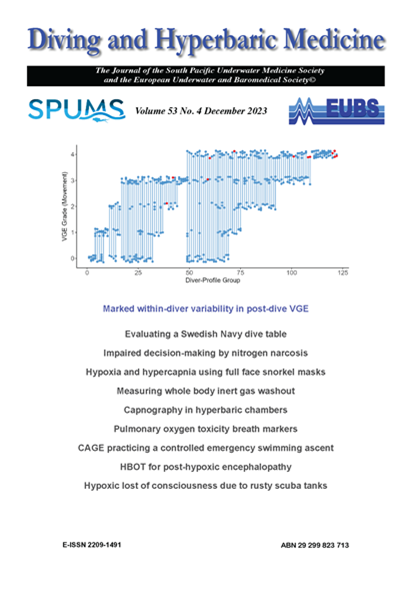
Within-diver variability in venous gas emboli (VGE) following repeated dives
David J Doolette1,2, F Gregory Murphy1
1 Navy Experimental Diving Unit, Panama City, Florida, USA
2 Department of Anaesthesiology, University of Auckland, New Zealand
Corresponding author: Associate Professor David J Doolette, Navy Experimental Diving Unit, Panama City, Florida, USA
ORCiD: 0000-0001-9027-3536
Keywords
Bubbles; Decompression sickness; Diving; Echocardiography; Risk
Abstract
(Doolette DJ, Murphy FG. Within-diver variability in venous gas emboli (VGE) following repeated dives. Diving and Hyperbaric Medicine. 2023 December 20;53(4):333−339. doi: 10.28920/dhm53.4.333-339. PMID: 38091593. PMCID: PMC10944664.)
Introduction: Venous gas emboli (VGE) are widely used as a surrogate endpoint instead of decompression sickness (DCS) in studies of decompression procedures. Peak post-dive VGE grades vary widely following repeated identical dives but little is known about how much of the variability in VGE grades is proportioned between-diver and within-diver.
Methods: A retrospective analysis of 834 man-dives on six dive profiles with post-dive VGE measurements were conducted under controlled laboratory conditions. Among these data, 151 divers did repeated dives on the same profile on two to nine occasions separated by at least one week (total of 693 man-dives). Data were analysed for between- and within-diver variability in peak post-dive VGE grades using mixed-effect models with diver as the random variable and associated intraclass correlation coefficients.
Results: Most divers produced a wide range of VGE grades after repeated dives on the same profile. The intraclass correlation coefficient (repeatability) was 0.33 indicating that 33% of the variability in VGE grades is between-diver variability; correspondingly, 67% of variability in VGE grades is within-diver variability. DCS cases were associated with an individual diver’s highest VGE grades and not with their lower VGE grades.
Conclusions: These data demonstrate large within-diver variability in VGE grades following repeated dives on the same dive profile and suggest there is substantial within-diver variability in susceptibility to DCS. Post-dive VGE grades are not useful for evaluating decompression practice for individual divers.
Copyright: This article is the copyright of the authors who grant Diving and Hyperbaric Medicine a non-exclusive licence to publish the article in electronic and other forms.
Publication Type: Original article
Diving Hyperb Med. 2023 December 20;53(4):340−344. doi: 10.28920/dhm53.4.340-344. PMID: 38091594. PMCID: PMC10944665.
Pulmonary oxygen toxicity breath markers after heliox diving to 81 metres
Feiko JM de Jong1,2, Paul Brinkman3, Thijs T Wingelaar1,2, Pieter-Jan AM van Ooij1,3, Robert A van Hulst2
1 Royal Netherlands Navy Diving and Submarine Medical Centre, 1780 CA, Den Helder, The Netherlands
2 Department of Anesthesiology, Amsterdam University Medical Center, location AMC, 1100 DD, Amsterdam, The Netherlands
3 Department of Pulmonology, Amsterdam University Medical Center, location AMC, 1100 DD, Amsterdam, The Netherlands
Corresponding author: Feiko JM de Jong, Royal Netherlands Navy Diving and Submarine Medical Centre, Rijkszee-en, Marinehaven, Postbus 10.000, 1780 CA, Den Helder, The Netherlands
ORCiD: 0009-0008-9804-8307
Keywords
Diving research; Helium; Military diving; Unit pulmonary toxic dose; Volatile organic compounds
Abstract
(de Jong FJM, Brinkman P, Wingelaar TT, van Ooij PJAM, van Hulst RA. Pulmonary oxygen toxicity breath markers after heliox diving to 81 metres. Diving and Hyperbaric Medicine. 2023 December 20;53(4):340−344. doi: 10.28920/dhm53.4.340-344. PMID: 38091594. PMCID: PMC10944665.)
Pulmonary oxygen toxicity (POT), an adverse reaction to an elevated partial pressure of oxygen in the lungs, can develop as a result of prolonged hyperbaric hyperoxic conditions. Initially starting with tracheal discomfort, it results in pulmonary symptoms and ultimately lung fibrosis. Previous studies identified several volatile organic compounds (VOCs) in exhaled breath indicative of POT after various wet and dry hyperbaric hypoxic exposures, predominantly in laboratory settings. This study examined VOCs after exposures to 81 metres of seawater by three navy divers during operational heliox diving. Univariate testing did not yield significant results. However, targeted multivariate analysis of POT-associated VOCs identified significant (P = 0.004) changes of dodecane, tetradecane, octane, methylcyclohexane, and butyl acetate during the 4 h post-dive sampling period. No airway symptoms or discomfort were reported. This study demonstrates that breath sampling can be performed in the field, and VOCs indicative of oxygen toxicity are exhaled without clinical symptoms of POT, strengthening the belief that POT develops on a subclinical-to-symptomatic spectrum. However, this study was performed during an actual diving operation and therefore various confounders were introduced, which were excluded in previous laboratory studies. Future studies could focus on optimising sampling protocols for field use to ensure uniformity and reproducibility, and on establishing dose-response relationships.
Copyright: This article is the copyright of the authors who grant Diving and Hyperbaric Medicine a non-exclusive licence to publish the article in electronic and other forms.
Publication Type: Short communication
Diving Hyperb Med. 2023 December 20;53(4):345−350. doi: 10.28920/dhm53.4.345-350. PMID: 38091595. PMCID: PMC10944668.
Cerebral arterial gas embolism (CAGE) during open water scuba certification training whilst practising a controlled emergency swimming ascent
Neil Banham1, Elisabete da Silva1, John Lippmann2
1 Department of Hyperbaric Medicine, Fiona Stanley Hospital, Murdoch, Australia
2 Australasian Diving Safety Foundation, Melbourne, Australia
Corresponding author: Dr Neil Banham, Department of Hyperbaric Medicine, Fiona Stanley Hospital, 11 Warren Drive,
Murdoch WA 6150, Australia
Keywords
Case reports; CESA; Diving accidents; Emergency ascent; Pneumomediastinum; Pneumothorax; Pulmonary barotrauma
Abstract
(Banham N, da Silva E, Lippmann J. Cerebral arterial gas embolism (CAGE) during open water scuba certification training whilst practising a controlled emergency swimming ascent. Diving and Hyperbaric Medicine. 2023 December 20;53(4):345−350. doi: 10.28920/dhm53.4.345-350. PMID: 38091595. PMCID: PMC10944668.)
We report the case of a 23-year-old male novice diver who sustained cerebral arterial gas embolism (CAGE) during his open water certification training whilst practising a free ascent as part of the course. He developed immediate but transient neurological symptoms that had resolved on arrival to hospital. Radiological imaging of his chest showed small bilateral pneumothoraces, pneumopericardium and pneumomediastinum. In view of this he was treated with high flow normobaric oxygen rather than recompression, because of the risk of development of tension pneumothorax upon chamber decompression. There was no relapse of his neurological symptoms with this regimen. The utility and safety of free ascent training for recreational divers is discussed, as is whether a pneumothorax should be vented prior to recompression, as well as return to diving following pulmonary barotrauma.
Copyright: This article is the copyright of the authors who grant Diving and Hyperbaric Medicine a non-exclusive licence to publish the article in electronic and other forms.
Publication Type: Case report
Diving Hyperb Med. 2023 December 20;53(4):351−355. doi: 10.28920/dhm53.4.351-355. PMID: 38091596. PMCID: PMC10944663.
Hyperbaric oxygen treatment in delayed post-hypoxic encephalopathy following inhalation of liquefied petroleum gas: a case report
Kubra Canarslan Demir1, Burak Turgut1, Kubra Ozgok Kangal1, Taylan Zaman1, Kemal Şimşek1
1 Underwater and Hyperbaric Medicine, University of Health Sciences, Gulhane Training and Research Hospital, Ankara, Turkey
Corresponding author: Dr Kübra Canarslan Demir, SBÜ-Gülhane Eğitim ve Araştırma Hastanesi, Sualtı Hekimliği ve Hiperbarik Tıp Kliniği, Etlik/Ankara, Turkey
ORCiD: 0000-0001-6911-2375
Keywords
Brain; Dementia; Hyperbaric medicine; Neurology; Toxicity
Abstract
(Canarslan Demir K, Turgut B, Ozgok Kangal K, Zaman T, Şimşek K. Hyperbaric oxygen treatment in delayed posthypoxic encephalopathy following inhalation of liquefied petroleum gas: a case report. Diving and Hyperbaric Medicine. 2023 December 20;53(4):351−355. doi: 10.28920/dhm53.4.351-355. PMID: 38091596. PMCID: PMC10944663.)
Delayed post-hypoxic encephalopathy can occur after an episode of anoxia or hypoxia. Symptoms include apathy, confusion, and neurological deficits. We describe a 47-year-old male patient who inhaled gas from a kitchen stove liquid petroleum gas cylinder. He was diagnosed with hypoxic ischaemic encephalopathy 12 hours after his emergency department admission. He received six sessions of hyperbaric oxygen treatment (HBOT) and was discharged in a healthy state after six days. Fifteen days later, he experienced weakness, loss of appetite, forgetfulness, depression, balance problems, and inability to perform self-care. One week later, he developed urinary and fecal incontinence and was diagnosed with post-hypoxic encephalopathy. After 45 days from the onset of symptoms, he was referred to the Underwater and Hyperbaric Medicine Department for HBOT. The patient exhibited poor self-care and slow speech rate, as well as ataxic gait and dysdiadochokinesia. Hyperbaric oxygen was administered for twenty-four sessions, which significantly improved the patient’s neurological status with only hypoesthesia in the left hand remaining at the end of treatment. Hyperbaric oxygen has been reported as successful in treating some cases of delayed neurological sequelae following CO intoxication. It is possible that HBO therapy may also
be effective in delayed post-hypoxic encephalopathy from other causes. This may be achieved through mechanisms such as transfer of functional mitochondria to the injury site, remyelination of damaged neurons, angiogenesis and neurogenesis, production of anti-inflammatory cytokines, and balancing of inflammatory and anti-inflammatory cytokines.
Copyright: This article is the copyright of the authors who grant Diving and Hyperbaric Medicine a non-exclusive licence to publish the article in electronic and other forms.
Publication Type: Case report
Diving Hyperb Med. 2023 December 20;53(4):356−359. doi: 10.28920/dhm53.4.356-359. PMID: 38091597. PMCID: PMC10944661.
Hypoxic loss of consciousness in air diving: two cases of mixtures made hypoxic by oxidation of the scuba diving cylinder
Arnaud Druelle1, Lucille Daubresse1, Jean U Mullot2, Hélène Streit3, Pierre Louge4
1 Department of Hyperbaric Medicine, Military Teaching Hospital, Sainte-Anne, Toulon, France
2 Navy Laboratory for Analysis Surveillance and Expertise, 83000 Toulon, France
3 Medical Center of ATRIA, 90 000 BELFORT, France
4 Acute Medicine Department, Hyperbaric Medicine Unit, Geneva University Hospitals, rue Gabrielle-Perret-Gentil 4, 1205 Geneva, Switzerland
Corresponding author: Dr Arnaud Druelle, Department of Hyperbaric Medicine, Military Teaching Hospital, HIA Ste Anne, 2 boulevard Ste Anne, BP 600, 83800 Toulon CEDEX, France
Keywords
Case reports; Corrosion; Diving tank; Hypoxia; Oxygen consumption; Rust; Unconsciousness
Abstract
(Druelle A, Daubresse L, Mullot JU, Streit H, Louge P. Hypoxic loss of consciousness in air diving: two cases of mixtures made hypoxic by oxidation of the scuba diving cylinder. Diving and Hyperbaric Medicine. 2023 December 20;53(4):356−359. doi: 10.28920/dhm53.4.356-359. PMID: 38091597. PMCID: PMC10944661.)
Without an adequate supply of oxygen from the scuba apparatus, humans would not be able to dive. The air normally contained in a scuba tank is dry and free of toxic gases. The presence of liquid in the tank can cause corrosion and change the composition of the gas mixture. Various chemical reactions consume oxygen, making the mixture hypoxic. We report two cases of internal corrosion of a scuba cylinder rendering the respired gas profoundly hypoxic and causing immediate hypoxic loss of consciousness in divers.
Copyright: This article is the copyright of the authors who grant Diving and Hyperbaric Medicine a non-exclusive licence to publish the article in electronic and other forms.
Publication Type: Case report
Diving Hyperb Med. 2023 December 20;53(4):360. doi: 10.2980/dhm53.4.360. PMID: 38091598. PMCID: PMC10944660.
University of Auckland Postgraduate Diploma in Diving and Hyperbaric Medicine
Michael Davis
Corresponding address: PO Box 35, Tai Tapu 7645, New Zealand
Keywords
Diving medicine; Hyperbaric medicine; Education; Qualifications
Copyright: This article is the copyright of the author who grants Diving and Hyperbaric Medicine a non-exclusive licence to publish the article in electronic and other forms.
Publication Type: Letter to the Editor
- Super User
- Category: Information
- 3052
Click to download each article. This will download a PDF that is password protected from any changes, these individual article PDFs are not for public distribution and for society members personal use.
Copyright: These articles are the copyright of the authors who grant Diving and Hyperbaric Medicine a non-exclusive licence to publish the article in electronic and other forms.
- Super User
- Category: Information
- 13783
2024 March;54(1)
Diving Hyperb Med. 2024 31 March;54(1):2−8. doi: 10.28920/dhm54.1.2-8. PMID: 38507904. PMCID: PMC11227965.
Efficacy of searching in biomedical databases beyond MEDLINE in identifying randomised controlled trials on hyperbaric oxygen treatment
Hira Khan1, Mohammad Sindeed Islam2, Manvinder Kaur3, Joseph K Burns1,3, Cole Etherington1,3, Pierre-Marc Dion2, Sarah Alsayadi4, Sylvain Boet1,3,5,6
1 Clinical Epidemiology Program, Ottawa Hospital Research Institute, Ottawa, ON, Canada
2 Faculty of Medicine, University of Ottawa, Ottawa, ON, Canada
3 Department of Anesthesiology and Pain Medicine, The Ottawa Hospital, Ottawa, ON, Canada
4 Faculty of Science, University of Ottawa, Ottawa, ON, Canada
5 Department of Innovation in Medical Education, University of Ottawa, Ottawa, ON, Canada
6 Institut du Savoir Montfort, Ottawa, ON, Canada
Corresponding author: Dr Sylvain Boet, 1053 Carling Avenue, Ottawa, ON K1Y 4E9, ON, Canada
Keywords
Biomedical databases; Research methods; Systematic review
Abstract
(Khan K, Islam MS, Kaur M, Burns JK, Etherington C, Dion P-M, Alsayadi S, Boet S. Efficacy of searching in biomedical databases beyond MEDLINE in identifying randomised controlled trials on hyperbaric oxygen treatment. Diving and Hyperbaric Medicine. 2024 31 March;54(1):2−8. doi: 10.28920/dhm54.1.2-8. PMID: 38507904. PMCID: PMC11227965.)
Introduction: Literature searches are routinely used by researchers for conducting systematic reviews as well as by healthcare providers, and sometimes patients, to quickly guide their clinical decisions. Using more than one database is generally recommended but may not always be necessary for some fields. This study aimed to determine the added value of searching additional databases beyond MEDLINE when conducting a literature search of hyperbaric oxygen treatment (HBOT) randomised controlled trials (RCTs).
Methods: This study consisted of two phases: a scoping review of all RCTs in the field of HBOT, followed by a a statistical analysis of sensitivity, precision, ‘number needed to read’ (NNR) and ‘number unique’ included by individual biomedical databases. MEDLINE, Embase, Cochrane Central Register of Control Trials (CENTRAL), and Cumulated Index to Nursing and Allied Health Literature (CINAHL) were searched without date or language restrictions up to December 31, 2022. Screening and data extraction were conducted in duplicate by pairs of independent reviewers. RCTs were included if they involved human subjects and HBOT was offered either on its own or in combination with other treatments.
Results: Out of 5,840 different citations identified, 367 were included for analysis. CENTRAL was the most sensitive (87.2%) and had the most unique references (7.1%). MEDLINE had the highest precision (23.8%) and optimal NNR (four). Among included references, 14.2% were unique to a single database.
Conclusions: Systematic reviews of RCTs in HBOT should always utilise multiple databases, which at minimum include MEDLINE, Embase, CENTRAL and CINAHL.
Copyright: This article is the copyright of the authors who grant Diving and Hyperbaric Medicine a non-exclusive licence to publish the article in electronic and other forms.
Publication Type: Original article
Diving Hyperb Med. 2024 31 March;54(1):9−15. doi: 10.28920/dhm54.1.9-15. PMID:38507905. PMCID: PMC11227964.
Hyperbaric oxygen treatment for infants: retrospective analysis of 54 patients treated in two tertiary care centres
Kubra Ozgok Kangal1, Bengusu Mirasoglu2
1 Department of Underwater and Hyperbaric Medicine, University of Health Sciences, Gulhane Faculty of Medicine, Gulhane Research and Training Hospital, Ankara, Turkey
2 Department of Underwater and Hyperbaric Medicine, Istanbul University, Istanbul Faculty of Medicine, Istanbul, Turkey
Corresponding author: Associate Professor Kubra Ozgok Kangal, Gen. Dr. Tevfik Saglam Cad. SBÜ-Gülhane Eğitim ve Araştırma Hastanesi, Sualtı Hekimliği ve Hiperbarik Tıp Kliniği, Etlik/Ankara, Turkey
Keywords
Hyperbaric medicine; Neonate; Newborn; Premature
Abstract
(Ozgok Kangal K, Mirasoglu B. Hyperbaric oxygen treatment for infants: retrospective analysis of 54 patients treated in two tertiary care centres. Diving and Hyperbaric Medicine. 2024 31 March;54(1):9−15. doi: 10.28920/dhm54.1.9-15. PMID:38507905. PMCID: PMC11227964.)
Introduction: We aimed to analyse the outcomes of hyperbaric oxygen treatment (HBOT) and describe difficulties encountered in infants, a rare patient population in this therapeutic intervention, with limited scientific reports.
Methods: This was a retrospective analysis of patients 12 months old or younger who underwent HBOT in two different institutions. Demographic data, clinical presentation, HBOT indication, chamber type, oxygen delivery method, total number of treatments, outcome and complications were extracted from clinical records.
Results: There were 54 infants in our study. The patients’ median age was 3.5 (range 0–12) months. The major HBOT indication was acute carbon monoxide intoxication (n = 32). A total of 275 HBOT treatments were administered, mostly performed in multiplace chambers (n = 196, 71%). Only one patient (2%) required mechanical ventilation. Acute signs were fully resolved in the most patients (n = 40, 74%). No complications related to HBOT were reported.
Conclusions: This study suggests that HBOT may be a safe and effective treatment for infants. Paediatricians should consider HBOT when indicated in infants even for the preterm age group.
Copyright: This article is the copyright of the authors who grant Diving and Hyperbaric Medicine a non-exclusive licence to publish the article in electronic and other forms.
Publication Type: Original article
Diving Hyperb Med. 2024 31 March;54(1):16−22. doi: 10.28920/dhm54.1.16-22. PMID: 38507906. PMCID: PMC11227960.
Effect of hyperbaric oxygen treatment on ischaemia-reperfusion injury in rats detorsioned after experimental ovarian torsion
Eralp Bulutlar1, Ali Yilmaz2, Gizem Berfin Uluutku Bulutlar3, Yavuz Aslan4, Hale Nur Bozdağ5, Zafer Küçükodaci6
1 Zeynep Kamil Gynecology and Obstetrics Training and Research Hospital, İstanbul, Turkey
2 Kartal Lütfü Kırdar Training and Research Hospital İstanbul, Turkey
3 Haydarpaşa Numune Training and Research Hospital, İstanbul, Turkey
4 Sultan Abdulhamid Han Research and Training Hospital
5 VM Medical Park Maltepe Hastanesi, İstanbul , Turkey
6 Anadolu Sağlık Merkezi, Gebze, Kocaeli, Turkey
Corresponding author: Dr Eralp Bulutlar, Başakşehir Çam and Sakura City Hospital, Başakşehir Olimpiyat Bulvarı Yolu, 34480 Başakşehir, İstanbul, Turkey
ORCiD: 0000-0002-2246-4899
Keywords
Animal model; Antioxidants; Experimental; Hyperbaric research; Inflammation
Abstract
(Bulutlar E, Yilmaz A, Uluutku Bulutlar GB, Aslan Y, Bozdağ HN, Küçükodaci Z. Effect of hyperbaric oxygen treatment on ischaemia-reperfusion injury in rats detorsioned after experimental ovarian torsion. Diving and Hyperbaric Medicine. 2024 31 March;54(1):16−22. doi: 10.28920/dhm54.1.16-22. PMID: 38507906. PMCID: PMC11227960.)
Introduction: This study aimed to investigate whether hyperbaric oxygen treatment (HBOT) could ameliorate ischaemia-reperfusion injury in a rat model of ovarian torsion-detorsion.
Methods: Twenty-seven rats were divided among four groups: surgical sham rats (S) (n = 6) underwent identical anaesthesia and surgical incisions to other groups (n = 7 per group) but with no ovary intervention; torsion rats (T) underwent laparotomy, ovarian torsion, relaparotomy and sacrifice after three hours; torsion and detorsion rats (T/DT) underwent laparotomy, ovarian torsion (three hours), relaparotomy and detorsion, and sacrifice after one week; torsion, detorsion, hyperbaric oxygen rats (T/DT/HBOT) underwent laparotomy, ovarian torsion, relaparotomy and detorsion, and sacrifice after one week during which HBOT was provided 21 times (100% oxygen at 600 kPa for 50 min). In all groups blood collection for markers of oxidative stress or related responses, and ovary collection for histology were performed after sacrifice.
Results: When the T/DT, and T/DT/HBOT groups were compared, 8-hydroxy-2′-deoxyguanosine (a marker of oxidative damage to DNA) and malondialdehyde (a product of lipid peroxidation) levels were lower in the T/DT/HBOT group. Anti-Mullerian hormone levels were higher in the T/DT/HBOT group compared to the T/DT group. In addition, oedema, vascular occlusion, neutrophilic infiltration and follicular cell damage were less in the T/DT/HBOT group
than in the T/DT group.
Conclusions: When biochemical and histopathological findings were evaluated together, HBOT appeared reduce ovarian ischaemia / reperfusion injury in this rat model of ovarian torsion-detorsion.
Copyright: This article is the copyright of the authors who grant Diving and Hyperbaric Medicine a non-exclusive licence to publish the article in electronic and other forms.
Publication Type: Original article
Diving Hyperb Med. 2024 31 March;54(1):23−38. doi: 10.28920/dhm54.1.23-38. PMID: 38507907. PMCID: PMC11065503.
Review of saturation decompression procedures used in commercial diving
Jean-Pierre Imbert1, Lyubisa Matity2, Jean-Yves Massimelli3, Philip Bryson4
1 Divetech, 1543 chemin des vignasses, 06410 Biot, France
2 Hyperbaric and Tissue Viability Unit, Gozo General Hospital, Malta
3 CHU de Nice, Hôpital Pasteur, 30 avenue de la voie romaine, 06001 Nice, France
4 International SOS, Forest Grove House, Foresterhill Road, Aberdeen, AB25 2ZP, UK
Corresponding author: Jean Pierre Imbert, Divetech, 1543 ch des vignasses 0641Biot, France
Keywords
Decompression tables; Occupational diving; Saturation diving
Abstract
(Imbert J-P, Matity L, Massimelli J-Y, Bryson P. Review of saturation decompression procedures used in commercial diving. Diving and Hyperbaric Medicine. 2024 31 March;54(1):23−38. doi: 10.28920/dhm54.1.23-38. PMID: 38507907. PMCID: PMC11065503.)
Introduction: This is a review of commercial heliox saturation decompression procedures. The scope does not include compression, storage depth or bell excursion dive procedures. The objectives are to: identify the sources of the procedures; trace their evolution; describe the current practice; and detect relevant trends.
Methods: Eleven international commercial diving companies provided their diving manuals for review under a confidentiality agreement.
Results: Modern commercial diving saturation procedures are derived from a small number of original procedures (United States Navy, Comex, and NORSOK). In the absence of relevant scientific studies since the late 80’s, the companies have empirically adapted these procedures according to their needs and experience. Such adaptation has caused differences in decompression rates shallower than 60 msw, decompression rest stops and the decision to decompress linearly or stepwise. Nevertheless, the decompression procedures present a remarkable homogeneity in chamber PO2 and daily decompression rates when deeper than 60 msw. The companies have also developed common rules of good practice; no final decompression should start with an initial ascending excursion; a minimum hold is required before starting a final decompression after an excursion dive. Recommendation is made for the divers to exercise during decompression.
Conclusions: We observed a trend towards harmonisation within the companies that enforce international procedures, and, between companies through cooperation inside the committees of the industry associations.
Copyright: This article is the copyright of the authors who grant Diving and Hyperbaric Medicine a non-exclusive licence to publish the article in electronic and other forms.
Publication Type: Original article
Full article available here.
Diving Hyperb Med. 2024 31 March;54(1):39−46. doi: 10.28920/dhm54.1.39-46. PMID: 38507908. PMCID: PMC11227959.
Chain of events analysis in diving accidents treated by the Royal Netherlands Navy 1966–2023
Benjamin L Turner1, Pieter-Jan AM van Ooij1,2, Thijs T Wingelaar1,3, Rob A van Hulst3, Edwin L Endert1, Paul Clarijs1, Rigo Hoencamp4,5,6
1 Royal Netherlands Navy Diving and Submarine Medical Centre, Den Helder, The Netherlands
2 Department of Respiratory Medicine, Amsterdam UMC, Location AMC, University of Amsterdam, Amsterdam, The Netherlands
3 Department of Anesthesiology, Amsterdam UMC, Location AMC, University of Amsterdam, Amsterdam, The Netherlands
4 Department of Surgery, Alrijne Hospital, Leiderdorp, the Netherlands
5 Trauma Research Unit, Department of Trauma Surgery, Erasmus MC, University Medical Center Rotterdam, Rotterdam, the Netherlands
6 Defence Healthcare Organization, Ministry of Defence, Utrecht, the Netherlands
Corresponding author: Mr Benjamin L Turner, Royal Netherlands Navy Diving and Submarine Medical Centre, Den Helder, The Netherlands
ORCiD: 0009-0004-6606-9788
Keywords
Arterial gas embolism; Decompression sickness; Incidents; Risk factors; Safety; Underwater hazards
Abstract
(Turner BL, van Ooij P-JAM, Wingelaar TT, van Hulst RA, Endert EL, Clarijs P, Hoencamp R. Chain of events analysis in diving accidents treated by the Royal Netherlands Navy 1966-2023. Diving and Hyperbaric Medicine. 2024 31 March;54(1):39−46. doi: 10.28920/dhm54.1.39-46. PMID: 38507908. PMCID: PMC11227959.)
Introduction: Diving injuries are influenced by a multitude of factors. Literature analysing the full chain of events in diving accidents influencing the occurrence of diving injuries is limited. A previously published ‘chain of events analysis’ (CEA) framework consists of five steps that may sequentially lead to a diving fatality. This study applied four of these steps to predominately non-lethal diving injuries and aims to determine the causes of diving injuries sustained by divers treated by the Diving Medical Centre of the Royal Netherlands Navy.
Methods: This retrospective cohort study was performed on diving injuries treated by the Diving Medical Centre between 1966 and 2023. Baseline characteristics and information pertinent to all four steps of the reduced CEA model were extracted and recorded in a database.
Results: A total of 288 cases met the inclusion criteria. In 111 cases, all four steps of the CEA model could be applied. Predisposing factors were identified in 261 (90%) cases, triggers in 142 (49%), disabling agents in 195 (68%), and 228 (79%) contained a (possible-) disabling condition. The sustained diving injury led to a fatality in seven cases (2%). The most frequent predisposing factor was health conditions (58%). Exertion (19%), primary diver errors (18%), and faulty equipment (17%) were the most frequently identified triggers. The ascent was the most frequent disabling agent (52%).
Conclusions: The CEA framework was found to be a valuable tool in this analysis. Health factors present before diving were identified as the most frequent predisposing factors. Arterial gas emboli were the most lethal injury mechanism.
Copyright: This article is the copyright of the authors who grant Diving and Hyperbaric Medicine a non-exclusive licence to publish the article in electronic and other forms.
Publication Type: Original article
Diving Hyperb Med. 2024 31 March;54(1):47−56. doi: 10.28920/dhm54.1.47-56. PMID: 38507909.
Reported outcome measures in necrotising soft tissue infections: a systematic review
Jonathan Wackett1, Bridget Devaney2,3,4, Raymond Chau5, Joshua Ho5, Nicholas King5, Jasleen Grewal1, Joshua Armstrong6, Biswadev Mitra2,4
1 Department of Medicine, Alfred Health, Melbourne, Australia
2 Emergency and Trauma Centre, Alfred Health, Melbourne, Australia
3 Department of Intensive Care and Hyperbaric Medicine, Alfred Health, Melbourne, Australia
4 Department of Epidemiology and Preventative Medicine, Monash University, Melbourne, Australia
5 Monash Health, Melbourne, Australia
6 Barwon Health, Geelong, Australia
Corresponding author: Dr Bridget Devaney, Head of Hyperbaric Medicine, Alfred Health, 55 Commercial Road, Melbourne, VIC 3004, Australia
ORCiD: 0000-0001-6521-418X
Keywords
Fournier’s gangrene; Gas gangrene; Hyperbaric oxygen treatment; Intensive care medicine; Systematic review
Abstract
(Wackett J, Devaney B, Chau R, Ho J, King N, Grewal J, Armstrong J, Mitra B. Reported outcome measures in necrotising soft tissue infections: a systematic review. Diving and Hyperbaric Medicine. 2024 31 March;54(1):47−56. doi: 10.28920/dhm54.1.47-56. PMID: 38507909. PMCID: PMC11371474.)
Introduction: There are inconsistencies in outcome reporting for patients with necrotising soft tissue infections (NSTI). The aim of this study was to evaluate reported outcome measures in NSTI literature that could inform a core outcome set (COS) such as could be used in a study of hyperbaric oxygen in this indication.
Methods: A systematic review of all NSTI literature identified from Cochrane, Ovid MEDLINE and Scopus databases as well as grey literature sources OpenGrey and the New York Academy of Medicine databases which met inclusion criteria and were published between 2010 and 2020 was performed. Studies were included if they reported on > 5 cases and presented clinical endpoints, patient related outcomes, or resource utilisation in NSTI patients. Studies did not have to include intervention. Two independent researchers then extracted reported outcome measures. Similar outcomes were grouped and classified into domains to produce a structured inventory. An attempt was made to identify trends in outcome measures over time and by study design.
Results: Three hundred and seventy-five studies were identified and included a total of 311 outcome measures. Forty eight percent (150/311) of outcome measures were reported by two or more studies. The four most frequently reported outcome measures were mortality without time specified, length of hospital stay, amputation performed, and number of debridements, reported in 298 (79.5%), 260 (69.3%), 156 (41.6%) and 151 (40.3%) studies respectively. Mortality outcomes were reported in 23 different ways. Randomised controlled trials (RCTs) were more likely to report 28-day mortality or 90-day mortality. The second most frequent amputation related outcome was level of amputation, reported in 7.5% (28/375) of studies. The most commonly reported patient-centred outcome was the SF-36 which was reported in 1.6% (6/375) of all studies and in 2/10 RCTs.
Conclusions: There was wide variance in outcome measures in NSTI studies, further highlighting the need for a COS.
Copyright: This article is the copyright of the authors who grant Diving and Hyperbaric Medicine a non-exclusive licence to publish the article in electronic and other forms.
Publication Type: Review article
Diving Hyperb Med. 2024 31 March;54(1):57−60. doi: 10.28920/dhm54.1.57-60. PMID: 38507910. PMCID: PMC11227961.
Equipoise: an important ethical consideration when contemplating participation in a randomised controlled trial of hyperbaric oxygen treatment in necrotising soft tissue infections
Bridget Devaney1,2,3
1 Emergency and Trauma Centre, Alfred Health, Melbourne, Australia
2 Department of Intensive Care and Hyperbaric Medicine, Alfred Health, Melbourne, Australia
3 Department of Epidemiology and Preventative Medicine, Monash University, Melbourne, Australia
Corresponding author: Dr Bridget Devaney, Head of Hyperbaric Medicine, Alfred Health, 55 Commercial Road, Melbourne, VIC 3004, Australia
ORCiD: 0000-0001-6521-418X
Keywords
Clinical trials; Ethics; Hyperbaric research
Abstract
(Devaney B. Equipoise: an important ethical consideration when contemplating participation in a randomised controlled trial of hyperbaric oxygen treatment in necrotising soft tissue infections. Diving and Hyperbaric Medicine. 2024 31 March;54(1):57−60. doi: 10.28920/dhm54.1.57-60. PMID: 38507910. PMCID: PMC11227961.)
A proposal for a large, multi-centre, randomised controlled trial investigating the role of hyperbaric oxygen treatment (HBOT) in necrotising soft tissue infections (NSTI) has led to much discussion locally and internationally about whether participation is ethical for a centre where stakeholders already consider HBOT standard practice. This article systematically addresses the concept of clinical equipoise specific to the role of HBOT in NSTI, and presents a series of considerations to be taken into account by key stakeholders at potential participating sites.
Copyright: This article is the copyright of the author who grants Diving and Hyperbaric Medicine a non-exclusive licence to publish the article in electronic and other forms.
Publication Type: World as it is
Diving Hyperb Med. 2024 31 March;54(1):61−64. doi: 10.28920/dhm54.1.61-64. PMID: 38507911. PMCID: PMC11227966.
Secondary deterioration in a patient with cerebral and coronary arterial gas embolism after brief symptom resolution: a case report
Ryota Tsushima1, Kosuke Mori2, Shohei Imaki1
1 Yokohama Municipal Citizen’s Hospital 1-1, Mitsuzawanishi-chou, Kanagawa-ku, Yokohama-city, Kanagawa-ken 221-0855, Japan
2 Yokohama Minami Kyosai Hospital 1-21-1, Mutsurahigashi, Kanazawa-ku, Yokohama- city, Kanagawa-ken 236-0037, Japan
Corresponding author: Dr Ryota Tsushima, Yokohama Municipal Citizen’s Hospital 1-1, Mitsuzawanishi-chou, Kanagawa-ku, Yokohama-city, Kanagawa-ken 221-0855, Japan
Keywords
Air embolism; Case reports; Hyperbaric oxygen treatment
Abstract
(Tsushima R, Mori K, Imaki S. Secondary deterioration in a patient with cerebral and coronary arterial gas embolism after brief symptom resolution: a case report. Diving and Hyperbaric Medicine. 2024 31 March;54(1):61−64. doi: 10.28920/dhm54.1.61-64. PMID: 38507911. PMCID: PMC11227966.)
Introduction: Hyperbaric oxygen treatment (HBOT) is recommended for arterial gas embolism (AGE) with severe symptoms. However, once symptoms subside, there may be a dilemma to treat or not.
Case presentation: A 71-year-old man was noted to have a mass shadow in his left lung, and a transbronchial biopsy was performed with sedation. Flumazenil was intravenously administered at the end of the procedure. However, the patient remained comatose and developed bradycardia, hypotension, and ST-segment elevation in lead II. Although the ST changes spontaneously resolved, the patient had prolonged disorientation. Whole- body computed tomography revealed several black rounded lucencies in the left ventricle and brain, confirming AGE. The patient received oxygen and remained supine. His neurological symptoms gradually improved but worsened again, necessitating HBOT. HBOT was performed seven times, after which neurological symptoms resolved almost completely.
Conclusions: AGE can secondarily deteriorate after symptoms have subsided. We recommend that HBOT be performed promptly once severe symptoms appear, even if they resolve spontaneously.
Copyright: This article is the copyright of the authors who grant Diving and Hyperbaric Medicine a non-exclusive licence to publish the article in electronic and other forms.
Publication Type: Case report
Diving Hyperb Med. 2024 31 March;54(1):65−68. doi: 10.28920/dhm54.1.65-68. PMID: 38507912. PMCID: PMC11227963.
Hyperbaric oxygen for the treatment of carbon monoxide-induced delayed neurological sequelae: a case report and review of the literature
Zebedee KR Wong1, Colin KA Teo1, James WM Kwek1, Soo Joang Kim2, Hooi Geok See3
1 Navy Medical Service, Republic of Singapore Navy, Singapore
2 Hyperbaric and Diving Medicine Centre, Singapore General Hospital, Singapore
3 Division of Anaesthesiology and Perioperative Medicine, Singapore General Hospital, Singapore
Corresponding author: Dr Zebedee KR Wong, Navy Medical Service, Republic of Singapore Navy, Singapore
ORCiD: 0009-0000-0081-3915
Keywords
Hyperbaric medicine; Morbidity; Pain; Neurology; Psychology; Radiological imaging; Toxicity
Abstract
(Wong ZKR, Teo CKA, Kwek JWM, Kim SJ, See HG. Hyperbaric oxygen for the treatment of carbon monoxide-induced delayed neurological sequelae: a case report and review of the literature. Diving and Hyperbaric Medicine. 2024 31 March;54(1):65−68. doi: 10.28920/dhm54.1.65-68. PMID: 38507912. PMCID: PMC11227963.)
Introduction: Hyperbaric oxygen treatment (HBOT) remains a recognised treatment for acute carbon monoxide (CO) poisoning, but the utility of HBOT in treating CO-induced delayed neurological sequelae (DNS) is not yet established.
Case description: A 26-year old woman presented with reduced consciousness secondary to CO exposure from burning charcoal. She underwent a single session of HBOT with US Navy Treatment Table 5 within six hours of presentation, with full neurological recovery. Eight weeks later, she represented with progressive, debilitating neurological symptoms mimicking Parkinsonism. Magnetic resonance imaging of her brain demonstrated changes consistent with hypoxic ischaemic encephalopathy. The patient underwent 20 sessions of HBOT at 203 kPa (2 atmospheres absolute) for 115 minutes, and received intravenous methylprednisolone 1 g per day for three days. The patient’s neurological symptoms completely resolved, and she returned to full-time professional work with no further recurrence.
Discussion: Delayed neurological sequelae is a well-described complication of CO poisoning. In this case, the patient’s debilitating neurocognitive symptoms resolved following HBOT. Existing literature on treatment of CO-induced DNS with HBOT consists mainly of small-scale studies and case reports, many of which similarly suggest that HBOT is effective in treating this complication. However, a large, randomised trial is required to adequately determine the effectiveness of HBOT in the treatment of CO-induced DNS, and an optimal treatment protocol.
Copyright: This article is the copyright of Case report
Diving Hyperb Med. 2024 31 March;54(1):69−72. doi: 10.28920/dhm54.1.69-72. PMID: 38507913. PMCID: PMC11065502.
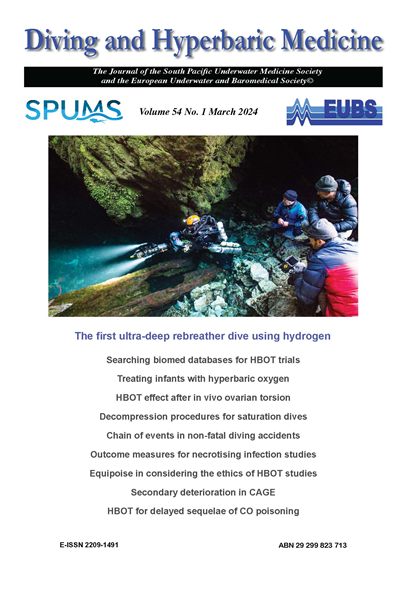
The first deep rebreather dive using hydrogen: case report
Richard J Harris1, Craig J Challen1, Simon J Mitchell1,2,3,4
1 Technical diver, Wetmules Dive Team
2 Department of Anaesthesiology, School of Medicine, University of Auckland, Auckland, New Zealand
3 Department of Anaesthesia, Auckland City Hospital, Auckland, New Zealand
4 Slark Hyperbaric Unit, North Shore Hospital, Auckland, New Zealand
Corresponding author: Professor Simon Mitchell, Department of Anaesthesiology, School of Medicine, University of Auckland, Private Bag 92019, Auckland 1142, New Zealand
ORCiD: 0000-0002-5149-6371
Keywords
Helihydrox; High pressure neurological syndrome; HPNS; Hydreliox; Hydrox; Technical diving; Trimix
Abstract
(Harris RJ, Challen CJ, Mitchell SJ. The first deep rebreather dive using hydrogen: case report. Diving and Hyperbaric Medicine. 2024 31 March;54(1):69−72. doi: 10.28920/dhm54.1.69-72. PMID: 38507913. PMCID: PMC11065502.)
Bounce diving with rapid descents to very deep depths may provoke the high-pressure neurological syndrome (HPNS). The strategy of including small fractions of nitrogen in the respired gas to produce an anti-HPNS narcotic effect increases the gas density which may exceed recommended guidelines. In 2020 the ‘Wetmules’ dive team explored the Pearse Resurgence cave (New Zealand) to 245 m breathing trimix (approximately 4% oxygen, 91% helium and 5% nitrogen). Despite the presence of nitrogen, one diver experienced HPNS tremors beyond 200 m. The use of hydrogen (a light yet slightly narcotic gas) has been suggested as a solution to this problem but there are concerns, including the potential for ignition and explosion of hydrogen-containing gases, and accelerated heat loss. In February 2023 a single dive to 230 m was conducted in the Pearse Resurgence to experience hydrogen as a breathing gas in a deep bounce dive. Using an electronic closed-circuit rebreather, helihydrox (approximately 3% oxygen, 59% helium and 38% hydrogen) was breathed between 200 and 230 m. This was associated with amelioration of HPNS symptoms in the vulnerable diver and no obvious adverse effects. The use of hydrogen is a potential means of progressing deeper with effective HPNS amelioration while maintaining respired gas density within advised guidelines.
Copyright: This article is the copyright of the authors who grant Diving and Hyperbaric Medicine a non-exclusive licence to publish the article in electronic and other forms.
Publication Type: Case report
Full article available here.
Diving Hyperb Med. 2024 March 31;54(1):73−74. doi: 10.28920/dhm54.1.73-74. PMID: 38507914.
Time to shock people
Gerard Laden1, Bruce Mathew1, Ananthakrishnan Ananthasayanam1,2
1 Clinical Hyperbaric Facility, Hull and East Riding Hospital, Anlaby, UK
2 Department of Surgery, Hull University Teaching Hospitals, NHS Trust, Hull, UK
Corresponding author: Mr Gerard Laden, Clinical Hyperbaric Facility, Hull and East Riding Hospital, Anlaby, UK
ORCiD: 0009-0008-0820-8291
Keywords
Cardiac; CPR, Defibrillation; First aid; Resuscitation
Copyright: This article is the copyright of the authors who grant Diving and Hyperbaric Medicine a non-exclusive licence to publish the article in electronic and other forms.
Publication Type: Letter to the Editor
Diving Hyperb Med. 2024 March 31;54(1):74−75. doi: 10.28920/dhm54.1.74-75. PMID: 38507915. PMCID: PMC11227962.
Response to Laden et al.
Andrew Tabner1,2, Graham Johnson1,2, Philip Bryson3 on behalf of the authorship team
1 Emergency Department, Royal Derby Hospital, Uttoxeter Road, Derby, UK, DE22 3NE
2 University of Nottingham Medical School, Queen’s Medical Centre, Nottingham, UK, NG7 2UH
3 TAC Healthcare, Wellheads Crescent, Aberdeen, Scotland AB21 7GA
Corresponding author: Dr Andrew Tabner, Emergency Department, Royal Derby Hospital, Uttoxeter Road, Derby, UK, DE22 3NE
Keywords
Resuscitation; Defibrillation; Mechanical CPR; Cardiovascular; Letters (to the Editor)
Copyright: This article is the copyright of the authors who grant Diving and Hyperbaric Medicine a non-exclusive licence to publish the article in electronic and other forms.
Publication Type: Letter to the Editor
- Super User
- Category: Information
- 4492
Click to download each article. This will download a PDF that is password protected from any changes, these individual article PDFs are not for public distribution and for society members personal use.
Copyright: These articles are the copyright of the authors who grant Diving and Hyperbaric Medicine a non-exclusive licence to publish the article in electronic and other forms.
- Super User
- Category: Information
- 9837
2024 June;54(2)
Diving Hyperb Med. 2024 30 June;54(2):86−91. doi: 10.28920/dhm54.2.86-91. PMID: 38870949.
Formulating policies and procedures for managing diving related deaths: a whole of state engagement from frontline and hospital services in Tasmania
Elizabeth J Elliott1, Karl Price1, Bernard Peters2
1 Diving and Hyperbaric Medicine Unit, Royal Hobart Hospital, Hobart, Tasmania, Australia
2 Tasmania Police Marine and Rescue Services, Tasmania, Australia
Corresponding author: Dr Elizabeth Elliott, Royal Hobart Hospital, Liverpool St, Hobart, Tasmania 7000, Australia
ORCiD: 0009-0005-3679-621X
Keywords
Autopsy findings, Diving deaths, Diving incidents, Diving medicine, Forensic pathology
Abstract
(Elliott EJ, Price K, Peters B. Formulating policies and procedures for managing diving related deaths: a whole of state engagement from frontline and hospital services in Tasmania. Diving and Hyperbaric Medicine. 2024 30 June;54(2):86−91. doi: 10.28920/dhm54.2.86-91. PMID: 38870949.)
Introduction: Tasmania is a small island state off the southern edge of Australia where a comparatively high proportion of the 558,000 population partake in recreational or occupational diving. While diving is a relatively safe sport and occupation, Tasmania has a significantly higher diving death rate per head of population than other States in Australia (four times the national diving mortality rate).
Methods: Three compressed gas diving deaths occurred in seven months between 2021–2022 prompting a review of the statewide approach for the immediate response of personnel to diving-related deaths. The review engaged first responders including the Police Marine and Rescue Service, hospital-based departments including the Department of Hyperbaric and Diving Medicine, and the mortuary and coroner’s office.
Results: An aide-mémoire for all craft groups, digitalised checklists for first responders (irrespective of diving knowledge), and a single-paged algorithm to highlight inter-agency communication pathways in the event of a diving death were designed to enhance current practices and collaboration.
Conclusions: If used, these aids for managing diving related deaths should ensure that time-critical information is appropriately captured and stored to optimise information provided for the coronial investigation.
Copyright: This article is the copyright of the authors who grant Diving and Hyperbaric Medicine a non-exclusive licence to publish the article in electronic and other forms.
Publication Type: Original article
Diving Hyperb Med. 2024 30 June;54(2):92−96. doi: 10.28920/dhm54.2.92-96. PMID: 38870950.
The use of hyperbaric oxygen for avascular necrosis of the femoral head and femoral condyle: a single centre’s experience over 30 years
John RB Currie1, Ian C Gawthrope1, Neil D Banham1
1 Department of Hyperbaric Medicine, Fiona Stanley Hospital, Perth, Australia
Corresponding author: Dr John Currie, Department of Hyperbaric Medicine, Fiona Stanley Hospital, 102-118 Murdoch Drive, Murdoch WA 6150, Australia
ORCiD: 0009-0009-0086-4953
Keywords
Bone healing; Bone necrosis; Dysbaric osteonecrosis; Hyperbaric research; Inflammation; Orthopaedics; Treatment
Abstract
(Currie JRB, Gawthrope IC, Banham ND. The use of hyperbaric oxygen for avascular necrosis of the femoral head and femoral condyle: a single centre’s experience over 30 years. Diving and Hyperbaric Medicine. 2024 30 June;54(2):92−96. doi: 10.28920/dhm54.2.92-96. PMID: 38870950.)
Introduction: Avascular necrosis (AVN) is a rare progressive degenerative disease leading to bone and joint destruction. Patients often require surgical intervention. Femoral AVN is the most common anatomical location. Hyperbaric oxygen treatment (HBOT) has been shown to be effective in AVN. We present data collected from one centre over a 30-year period and compare the results with other published data.
Methods: A retrospective chart review of all patients receiving HBOT for AVN at Fremantle and Fiona Stanley Hospitals since 1989 was performed. The primary outcome was radiological appearance using the Steinberg score, with secondary outcomes being subjective improvement, the need for joint replacement surgery and rates of complications.
Results: Twenty-one joints in 14 patients (14 femoral heads and seven femoral condyles) were treated with HBOT since 1989. Two patients were excluded. Within the femoral head group, nine of the 14 joints (64%) had stable or improved magnetic resonance imaging (MRI) scans post treatment and at six months (minimum); 10 joints (71%) had good outcomes subjectively, three joints required surgical intervention, and three patients developed mild aural barotrauma. Within the femoral condyle group, all five joints had stable or improved post-treatment MRI scans (four had visible improvement in oedema and/or chondral stability), four joints reported good outcomes subjectively, none of the patients required surgical intervention (follow-up > six months).
Conclusions: This single centre retrospective study observed prevention of disease progression in femoral AVN with the use of HBOT, comparable to other published studies. This adds to the body of evidence that HBOT may have a significant role in the treatment of femoral AVN.
Copyright: This article is the copyright of the authors who grant Diving and Hyperbaric Medicine a non-exclusive licence to publish the article in electronic and other forms.
Publication Type: Original article
Diving Hyperb Med. 2024 30 June;54(2):97−104. doi: 10.28920/dhm54.2.97-104. PMID:38870951.
Survey comparing the treatment of central retinal artery occlusion with hyperbaric oxygen in Australia and New Zealand with the recommended guidelines as outlined by the Undersea and Hyperbaric Medical Society
William Emmerton1, Neil D Banham2, Ian C Gawthrope2
1 Department of Anaesthesia and Hyperbaric Medicine, Royal Adelaide Hospital, Adelaide, Australia
2 Department of Hyperbaric Medicine, Fiona Stanley Hospital, Perth, Australia
Corresponding author: Dr William Emmerton, Department of Anaesthesia and Hyperbaric Medicine, Royal Adelaide Hospital, Port Road, Adelaide, SA 5000, Australia
ORCiD: 0009-0007-0996-0728
Keywords
Blindness, sudden; Hyperbaric oxygen treatment; Hypoxia; Medical conditions and problems; Ophthalmology; Questionnaire; Vision
Abstract
(Emmerton W, Banham ND, Gawthrope IC. Survey comparing the treatment of central retinal artery occlusion with hyperbaric oxygen in Australia and New Zealand with the recommended guidelines as outlined by the Undersea and Hyperbaric Medical Society. Diving and Hyperbaric Medicine. 2024 30 June;54(2):97−104. doi: 10.28920/dhm54.2.97-104. PMID: 38870951.)
Introduction: Central retinal artery occlusion (CRAO) presents suddenly causing painless loss of vision that is often significant. Meaningful improvement in vision occurs in only 8% of patients with spontaneous reperfusion. Hyperbaric oxygen treatment (HBOT) is considered to be of benefit if commenced before retinal infarction occurs. The Undersea and Hyperbaric Medical Society (UHMS) guidelines on the management of CRAO were last amended in 2019. This survey questioned Australian and New Zealand (ANZ) hyperbaric medicine units (HMUs) about the incidence of CRAO cases referred and compared their subsequent management against the UHMS guidelines.
Methods: An anonymous survey via SurveyMonkey® was sent to all 12 ANZ HMUs that treat emergency indications, allowing for multiple choice and free text answers regarding their management of CRAO.
Results: One-hundred and forty-six cases of CRAO were treated in ANZ HMUs over the last five years. Most (101/146) cases (69%) were initially treated at a pressure of 284 kPa. This was the area of greatest difference noted in CRAO management between the UHMS guidelines and ANZ practice.
Conclusions: Few ANZ HMUs strictly followed the UHMS guidelines. We suggest a more simplified management protocol as used by the majority of ANZ HMUs.
Copyright: This article is the copyright of the authors who grant Diving and Hyperbaric Medicine a non-exclusive licence to publish the article in electronic and other forms.
Publication Type: Original article
Diving Hyperb Med. 2024 30 June;54(2):105−109. doi: 10.28920/dhm54.2.105-109. PMID: 38870952.
Clinical utility of dipstick urinalysis in assessing fitness to dive in military divers, submariners, and hyperbaric personnel
Arne Melessen1, Thijs T Wingelaar1, Pieter-Jan AM van Ooij1
1 Royal Netherlands Navy Diving and Submarine Medical Center, Den Helder, the Netherlands
Corresponding author: Dr Thijs Wingelaar, Royal Netherlands Navy Diving and Submarine Medical Center, Rijkszee and Marinehaven, 1780 CA Den Helder, the Netherlands
ORCiD: 0000-0001-7740-7392
Keywords
Diving; Fitness to dive; Haematuria; Screening; Urology
Abstract
(Melessen A, Wingelaar TT, van Ooij PJAM. Clinical utility of dipstick urinalysis in assessing fitness to dive in military divers, submariners, and hyperbaric personnel. Diving and Hyperbaric Medicine. 2024 30 June;54(2):105−109. doi: 10.28920/dhm54.2.105-109. PMID: 38870952.)
Introduction: Routine dipstick urinalysis is part of many dive medical assessment protocols. However, this has a significant chance of producing false-positive or false-negative results in asymptomatic and healthy individuals. Studies evaluating the value of urinalysis in dive medical assessments are limited.
Methods: All results from urinalysis as part of dive medical assessments of divers, submarines, and hyperbaric personnel of the Royal Netherlands Navy from 2013 to 2023 were included in this study. Additionally, any information regarding additional testing, referral, or test results concerning the aforementioned was collected.
Results: There were 5,899 assessments, resulting in 46 (0.8%) positive dipstick urinalysis results, predominantly microscopic haematuria. Females were significantly overrepresented, and revisions resulted in significantly more positive test results than initial assessments. Lastly, almost half of the cases were deemed fit to dive, while the other half were regarded as temporarily unfit. These cases required additional testing, and a urologist was consulted three times.
Conclusions: To our knowledge, this is the most extensive study evaluating urinalysis in dive medical assessments. In our military population, the incidence of positive test results is very low, and there have not been clinically relevant results over a period of 10 years. Therefore, routinely assessing urine in asymptomatic healthy military candidates is not cost-effective or efficacious. The authors advise taking a thorough history for fitness to dive assessments and only analysing urine when a clinical indication is present.
Copyright: This article is the copyright of the authors who grant Diving and Hyperbaric Medicine a non-exclusive licence to publish the article in electronic and other forms.
Publication Type: Original article
Diving Hyperb Med. 2024 30 June;54(2):110−119. doi: 10.28920/dhm54.2.110-119. PMID: 38870953.
Effects of CO2 on the occurrence of decompression sickness: review of the literature
Lucile Daubresse1, Nicolas Vallée2, Arnaud Druelle1, Olivier Castagna2, Régis Guieu3, Jean-Eric Blatteau1
1 Department of hyperbaric and diving medicine. Hôpital d’instruction des armées Sainte-Anne. Toulon armées, France
2 Resident operational underwater research team, Institut de recherche biomédicale des armées, Toulon armées, France
3 Center for cardiovascular and nutrition research, Aix-Marseille University, Marseille, France
Corresponding author: Professor Jean-Eric Blatteau, Department of hyperbaric and diving medicine (SMHEP). Hôpital d’instruction des armées Sainte-Anne. 83800 Toulon armées, France
Keywords
Bubbles; Carbogen; Carbon dioxide; Decompression illness; Diving; Hyperbaric; Hypercapnia; Hypobaric
Abstract
(Daubresse L, Vallée N, Druelle A, Castagna O, Guieu R, Blatteau J-E. Effects of CO2 on the occurrence of decompression sickness: review of the literature. Diving and Hyperbaric Medicine. 2024 30 June;54(2):110−119. doi: 10.28920/dhm54.2.110-119. PMID: 38870953.)
Introduction: Inhalation of high concentrations of carbon dioxide (CO2) at atmospheric pressure can be toxic with dose-dependent effects on the cardiorespiratory system or the central nervous system. Exposure to both hyperbaric and hypobaric environments can result in decompression sickness (DCS). The effects of CO2 on DCS are not well documented with conflicting results. The objective was to review the literature to clarify the effects of CO2 inhalation on DCS in the context of hypobaric or hyperbaric exposure.
Methods: The systematic review included experimental animal and human studies in hyper- and hypobaric conditions evaluating the effects of CO2 on bubble formation, denitrogenation or the occurrence of DCS. The search was based on MEDLINE and PubMed articles with no language or date restrictions and also included articles from the underwater and aviation medicine literature.
Results: Out of 43 articles, only 11 articles were retained and classified according to the criteria of hypo- or hyperbaric exposure, taking into account the duration of CO2 inhalation in relation to exposure and distinguishing experimental work from studies conducted in humans.
Conclusions: Before or during a stay in hypobaric conditions, exposure to high concentrations of CO2 favors bubble formation and the occurrence of DCS. In hyperbaric conditions, high CO2 concentrations increase the occurrence of DCS when exposure occurs during the bottom phase at maximum pressure, whereas beneficial effects are observed when exposure occurs during decompression. These opposite effects depending on the timing of exposure could be related to 1) the physical properties of CO2, a highly diffusible gas that can influence bubble formation, 2) vasomotor effects (vasodilation), and 3) anti-inflammatory effects (kinase-nuclear factor and heme oxygenase-1 pathways). The use of O2-CO2 breathing mixtures on the surface after diving may be an avenue worth exploring to prevent DCS.
Copyright: This article is the copyright of the authors who grant Diving and Hyperbaric Medicine a non-exclusive licence to publish the article in electronic and other forms.
Publication Type: Review article
Diving Hyperb Med. 2024 30 June;54(2):120−126. doi: 10.28920/dhm54.2.120-126. PMID: 38870954.
The role of routine cardiac investigations before hyperbaric oxygen treatment
Connor TA Brenna1,2, Marcus Salvatori1,3,4, Shawn Khan1, George Djaiani1,3,4, Simone Schiavo1,3,4, Rita Katznelson1,3,4
1 Department of Anesthesiology & Pain Medicine, University of Toronto, Toronto, Ontario, Canada
2 Department of Physiology, University of Toronto, Toronto, Ontario, Canada
3 Hyperbaric Medicine Unit, Toronto General Hospital, Toronto, Ontario, Canada
4 Department of Anesthesia and Pain Management, University Health Network, Toronto, Ontario, Canada
Corresponding author: Dr Rita Katznelson, Toronto General Hospital, 200 Elizabeth St, Toronto, ON M5G 2C4, Canada
Keywords
Cardiac complications; Echocardiography; Electrocardiography; Hyperbaric oxygen therapy; Risk assessment
Abstract
(Brenna CTA, Salvatori M, Khan S, Djaiani G, Schiavo S, Katznelson R. The role of routine cardiac investigations before hyperbaric oxygen treatment. Diving and Hyperbaric Medicine. 2024 30 June;54(2):120−126. doi: 10.28920/dhm54.2.120-126. PMID: 38870954.)
Cardiac complications are a rare but potentially serious consequence of hyperbaric oxygen treatment (HBOT), resulting from increased blood pressure and decreased heart rate and cardiac output associated with treatment. These physiologic changes are generally well-tolerated by patients without preexisting cardiac conditions, although those with known or undetected cardiac disease may be more vulnerable to treatment complications. Currently, there are no universally accepted guidelines for pre-HBOT cardiac screening to identify these patients at heightened risk, leading to variability in practice patterns. In the absence of HBOT-specific evidence, screening protocols might be adapted from the diving medicine community; however, given the important differences in physiological stressors, these may not be entirely applicable to patients undergoing HBOT. Traditional cardiac investigations such as electro- and echo-cardiograms are limited in their ability to detect relevant risk modifying states in the pre-HBOT patient, stymieing their cost-effectiveness as routine tests. In the absence of strong evidence to support routine cardiac investigation, we argue that a comprehensive history and physical exam – tailored to identify high-risk patients based on clinical parameters – may serve as a more practical screening tool. While certain unique patient groups such as those undergoing dialysis or with implanted cardiac devices may warrant specialised assessment, thorough evaluation may be sufficient to identify many patients unlikely to benefit from cardiac investigation in the pre-HBOT setting. A clinical decision-making tool based on suggested low-risk and high-risk features is offered to guide the use of targeted cardiac investigation prior to HBOT.
Copyright: This article is the copyright of the authors who grant Diving and Hyperbaric Medicine a non-exclusive licence to publish the article in electronic and other forms.
Publication Type: Review article
Diving Hyperb Med. 2024 30 June;54(2):127−132. doi: 10.28920/dhm54.2.127-132. PMID: 38870955.
Shunt-mediated decompression sickness in a compressed air worker with an atrial septal defect
Andrew P Colvin1, Ryan Hogg2, Peter T Wilmshurst3
1 Tunnelmed Services Ltd, Dunblane, United Kingdom
2 TRHA Ltd, Surlingham, United Kingdom
3 Royal Stoke University Hospital, Stoke on Trent, United Kingdom
Corresponding author: Dr Andrew Colvin, Tunnelmed Services Ltd, Rokeby House, 27 Doune Road, Dunblane, FK15 9AT, United Kingdom
Keywords
Bubbles; Compressed air work; Decompression sickness; Hyperbaric tunnel work; Migraine aura; Oxygen decompression; Persistent (patent) foramen ovale
Abstract
(Colvin AP, Hogg R, Wilmshurst PT. Shunt-mediated decompression sickness in a compressed air worker with an atrial septal defect. Diving and Hyperbaric Medicine. 2024 30 June;54(2):127−132. doi: 10.28920/dhm54.2.127-132. PMID: 38870955.)
We report a compressed air worker who had diffuse cutaneous decompression sickness with pain in his left shoulder and visual disturbance characteristic of migraine aura after only his third hyperbaric exposure. The maximum pressure was 253 kPa gauge with oxygen decompression using the Swanscombe Oxygen Decompression Table. He was found to have a very large right-to-left shunt across a 9 mm atrial septal defect. He had transcatheter closure of the defect but had some residual shunting with release of a Valsalva manoeuvre. Thirty-two other tunnel workers undertook the same pressure profile and activities in the same working conditions during the maintenance of a tunnel boring machine for a total of 233 similar exposures and were unaffected. As far as we are aware this is the first report of shunt-mediated decompression sickness in a hyperbaric tunnel worker in the United Kingdom and the second case reported worldwide. These cases suggest that shunt-mediated decompression sickness should be considered to be an occupational risk in modern compressed air working. A right-to-left shunt in a compressed air worker should be managed in accordance with established clinical guidance for divers.
Copyright: This article is the copyright of the authors who grant Diving and Hyperbaric Medicine a non-exclusive licence to publish the article in electronic and other forms.
Publication Type: Case report
Diving Hyperb Med. 2024 30 June;54(2):133−136. doi: 10.28920/dhm54.2.133-136. PMID: 38870956.
Hyperbaric oxygen treatment in bilateral orchiopexy and post-circumcision haematoma in a thrombocytopenic patient with Noonan syndrome
Dilşad Dereli1, Selahattin Çakiroğlu2, Ayse Aydan Köse3, Baran Tokar1
1 Pediatric Urology, Eskişehir Osmangazi University, Turkey
2 Department of Underwater Medicine and Hyperbaric Medicine, Eskişehir Yunusemre State Hospital, Turkey
3 Plastic and Reconstructive Surgery, Eskişehir Osmangazi University, Turkey
Corresponding author: Dr Dilşad Dereli, Pediatric Urology, Eskişehir Osmangazi University, Turkey
Keywords
Case reports; Children; Haematology; Hyperbaric oxygenation; Injuries; Surgery
Abstract
(Dereli D, Çakiroğlu S, Köse AA, Tokar B. Hyperbaric oxygen treatment in bilateral orchiopexy and post-circumcision haematoma in a thrombocytopenic patient with Noonan syndrome. Diving and Hyperbaric Medicine. 2024 30 June;54(2):133−136. doi: 10.28920/dhm54.2.133-136. PMID: 38870956.)
Hyperbaric oxygen treatment (HBOT) can be utilised for necrotising soft tissue infections, clostridial myonecrosis (gas gangrene), crush injuries, acute traumatic ischaemia, delayed wound healing, and compromised skin grafts. Our case was a 17-month-old male patient with Noonan syndrome, idiopathic thrombocytopenic purpura, and bilateral undescended testicles. Haematoma and oedema developed in the scrotum and penis the day after bilateral orchiopexy and circumcision. Ischaemic appearances were observed on the penile and scrotal skin on the second postoperative day. Enoxaparin sodium and fresh frozen plasma were started on the recommendation of haematology. Hyperbaric oxygen treatment was initiated considering the possibility of tissue necrosis. We observed rapid healing within five days. We present this case to emphasise that HBOT may be considered as an additional treatment option in patients with similar conditions. To our knowledge, no similar cases have been reported in the literature.
Copyright: This article is the copyright of the authors who grant Diving and Hyperbaric Medicine a non-exclusive licence to publish the article in electronic and other forms.
Publication Type: Case report
Diving Hyperb Med. 2024 30 June;54(2):137−139. doi: 10.28920/dhm54.2.137-139. PMID: 38870957.
Drinker driver flyer diver
Gerard Laden1, Bruce Mathew1
1 Clinical Hyperbaric Facility, Hull and East Riding Hospital, Anlaby, UK
Corresponding author: Gerard Laden. Clinical Hyperbaric Facility, Hull and East Riding Hospital, Anlaby, UK
ORCID: 0009-0008-0820-8291
Keywords
Diving; Inert gas; Narcosis; Nitrogen; Scuba
Abstract
(Laden G, Mathew B. Drinker driver flyer diver. Diving and Hyperbaric Medicine. 2024 30 June;54(2):137−139. doi: 10.28920/dhm54.2.137-139. PMID: 38870957.)
Blood alcohol concentrations above defined levels are detrimental to cognitive performance. Empirical and published evidence suggest that nitrogen narcosis is analogous to alcohol intoxication with both impairing prefrontal cortex function. Nitrogen narcosis is also known to have been a factor in fatal accidents. To examine the effects of nitrogen narcosis, a recent publication used the Iowa Gambling Task tool, to simulate dynamic real-life risky decision-making behaviour. If the reported outcomes are corroborated in larger rigorously designed studies it is likely to provide further evidence that divers may well experience the negative effects of a ‘narcotic agent’, even at relatively shallow depths. These deleterious effects may occur regardless of diving experience, aptitude or professional status. In 1872, English law made it an offence to be ‘drunk’ whilst in charge of horses, carriages, cattle and steam engines. Understanding the danger was easy, establishing who is ‘drunk’ in the eyes of the court required a legal definition. Driving above a ‘legal limit’ for alcohol was made illegal in the United Kingdom in 1967. The limit was set at 80 milligrams of alcohol per 100 millilitres of blood. It took just short of one hundred years to get from first introducing a restriction to specific activities, whilst under the influence of alcohol, to having a clear and well-defined enforceable law. The question surely is whether our modern society will tolerate another century before legally defining safe parameters for nitrogen narcosis?
Copyright: This article is the copyright of the authors who grant Diving and Hyperbaric Medicine a non-exclusive licence to publish the article in electronic and other forms.
Publication Type: World as it is