52 - 55

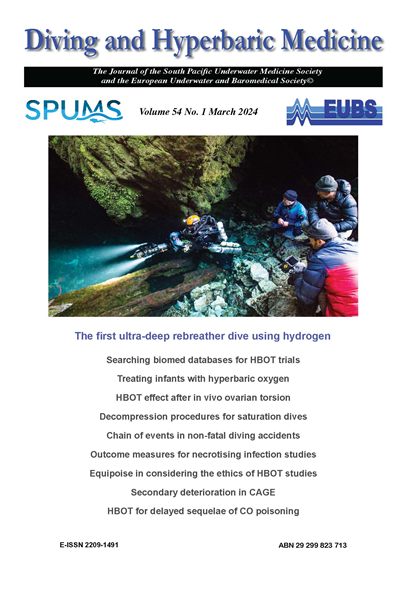

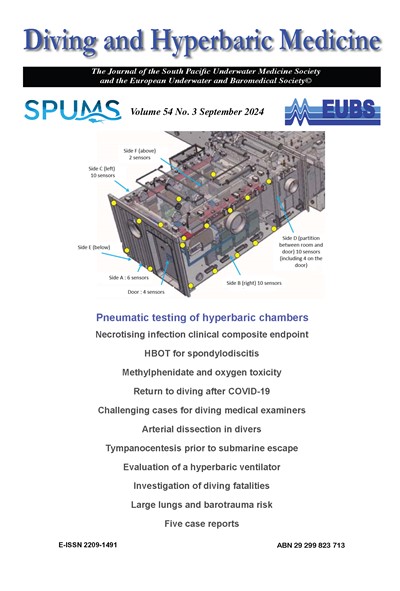
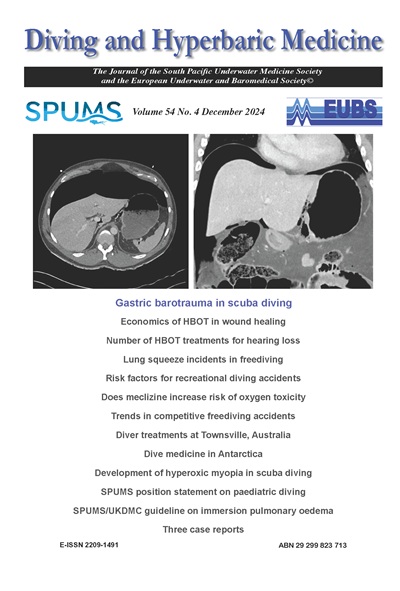
- Super User
- Category: Information
- 520
DHM now on PubMed Central (PMC)!
PMC is the most important medical scientific database in the public domain. This is retrospective to the March 2017 issue. PMC complies with our one-year embargo policy, articles from 2017 are available now. This markedly increases DHM’s visibility to the international medical and scientific online readership.
- Super User
- Category: Information
- 11000
Included in this page are policies governed and created by the Publishers.
| 02 April 2019 | ||
| September 2017 |
- Super User
- Category: Information
- 12236
- Super User
- Category: Information
- 15536
Diving and Hyperbaric Medicine (DHM) – Statement on principles of transparency (updated July 2024)
(Download a full copy of this document here)
1 Website.
The DHM website is at https://www.dhmjournal.com. All appropriate documentation relating to the principles of transparency and best practice in scholarly publishing as set out by the Directory of Open Access Journals (https://doaj.org/bestpractice) are provided in this document and/or elsewhere on the site. The aims and scope of the journal are set out in the opening paragraph of the Instructions for Authors.
2 Name of journal.
The Journal name, Diving and Hyperbaric Medicine, is unique and not one that could be confused with another journal or that might mislead potential authors and readers about the Journal's origin or association with other journals.
3 Peer review process.
All manuscripts submitted to DHM are subject to open peer review usually by a member of the Editorial Board and/or external reviewers. Usually at least two reviews are invited. Reviewer comments will be provided to authors with any recommendations for improvement before acceptance for publication, or if the article is rejected. DHM believes that a transparent review process is indicated in such a small specialty; reviewers are often able to identify the origin of manuscripts and, in the interests of fairness, the authors are therefore provided the names of reviewers of their articles. The review process typically takes about eight weeks to complete, but can be longer. If additional reviews are needed, this will prolong the process. Papers are generally scheduled for publication in order of final acceptance. The Editor retains the right to delay publication in the interests of the Journal.
4 Ownership and management.
DHM is jointly published by the South Pacific Underwater Medicine Society (SPUMS) and the European Underwater and Baromedical Society (EUBS).
SPUMS is incorporated in Victoria , Australia, A0020660B and DHM is registered with the National Library of Australia, ISSN 1833-3516, ABN 29 299 823 713, E-ISSN 2209-1491.
EUBS is a United Kingdom Registered Charity No. 264970.
5 Governing body.
The governing bodies of DHM are the respective Executive Committees (ExCom) of the SPUMS and the EUBS. The current members of the ExCom are listed on the society websites:
http://www.eubs.org/?page_id=47 and https://www.spums.au/index.php/home/executive-committee.
The ExCom are advised on specific matters at their request by a Journal Governance Committee (JGC), consisting of two members of each society, appointed periodically. The JGC is responsible in cooperation with the journal office and the SPUMS Treasurer in preparing an annual journal budget for the approval of the society ExCom.
The Purposes and Rules of SPUMS state as follows with regard to DHM:
"Publication of a scientific journal a Journal to be known as “Diving and Hyperbaric Medicine” (hereinafter called the “Journal”) or other such name as may be adopted by the Association in general meeting, shall be produced and distributed to all members of the Association. The Journal will be published jointly by the Association and the European Underwater and Baromedical Society (EUBS). Any change in name must be agreed jointly by the Association and EUBS.
Income from subscriptions to the Association shall be applied by the Committee for such publication via a separate journal bank account, according to an annual budget agreed to jointly by the Association and EUBS. The financial management and governance of the Journal will be arranged by mutual agreement between the Association and EUBS.
The Committees of the Association and EUBS shall appoint an Editor-in-Chief (hereinafter called the Editor) for terms of five years. The conditions of appointment of the Editor and the respective responsibilities of the Association, the EUBS and the Editor shall be by mutual agreement of the three parties and set out in a contract signed by the Presidents of the Association and EUBS and the appointed Editor.
The Editor, and an Editorial Board appointed by the Editor and the existing members of the Editorial Board, shall be responsible for all academic content of the Journal and its timely publication at least quarterly. Whilst the Editor shall be mindful of the views, if any, expressed by the majority of each Committee (of the Association and EUBS) as to editorial policy and publishing of material, the Editor is guaranteed full academic freedom by the Association.”
6 Editorial team/contact information. (https://www.dhmjournal.com/index.php/contact-us/editorial-board-profiles)
Editor-in-Chief
Professor Simon Mitchell MB ChB, PhD, DipOccMed, DipAdvDHM (ANZCA), FUHM, FANZCA
Department of Anaesthesiology, University of Auckland, Private Bag 92019, Auckland 1142, New Zealand
E-mail:
Submissions; login to: http://www.manuscriptmanager.net/dhm
European Editor
Lesley Blogg, PhD, SLB ConsultingLtd, United Kingdom
E-mail:
Editorial Manager and Administration
Nicky Telles, Editorial Manager/Web Developer
E-mail:
Submissions; login to: http://www.manuscriptmanager.net/dhm
Editorial Board
Associate Professor David Doolette, PhD
Research Physiologist, U.S. Navy Experimental Diving Unit and Associate Professor of Anaesthesiology, University of Auckland, New Zealand
Christopher. Edge MA,PhD,MBBS,AFOM,FRCA,FRSC,CChem,FRGS
Honorary Senior Lecturer, Department of Biophysics, Imperial College, London and Consultant Anaesthetist, Royal Berkshire Hospital, Reading
Associate Professor Ingrid Eftedal, siv.ing. PhD
Norwegian University of Science and Technology
Peter Germonpré, MD
Centre for Hyperbaric Oxygen Therapy, Belgian Military Hospital, Brussels, Belgium
Associate Professor Jacek Kot, MD, PhD
Medical University of Gdansk, Poland
Professor Claus-Martin Muth, MD, PhD, Dip DHM (GTUeM)
Department of Anesthesiology, Ulm University Medical School, Germany
Associate Professor Neal W Pollock, PhD
Department of Kinesiology, Université Laval, and Research Chair, Service de médecine hyperbare, Centre de médecine de plongée du Québec, Québec
Associate Professor Monica Rocco, MD
Department of Intensive Care and Hyperbaric Medicine, University of Rome “La Sapienza”, Italy
Martin Sayer, BSc(hons),PhD,MAE,FSUT
NERC National Facility for Scientific Diving and West Scotland Centre for Diving and Hyperbaric Medicine
Chris Sames BSc,MBChB,MD,DipA&EMed,DipOccMed,FRNZCGP
Clinical Director, Hyperbaric Unit, Te Whatu Ora, Health New Zealand
Professor Erika Schagatay, MSc, PhD
Environmental Physiology Group, Mid Sweden University, Sundsvall, Sweden
Professor Robert van Hulst, MD,PhD
Academic Medical Centre, Amsterdam , The Netherlands
7 Copyright. (extract from copyright form signed by first authors of all articles).
“Manuscripts must be offered exclusively to DHM, unless clearly authenticated copyright exemption accompanies the manuscript. Authors must agree to accept the standard conditions of publication. These grant DHM a non-exclusive licence to publish the article in electronic form and/or in other media; also granting the right to sublicense third parties to exercise all or any of these rights. DHM agrees that in publishing the article(s) and exercising this non-exclusive publishing sub-licence, the author(s) will always be acknowledged as the copyright owner(s) of the article.
Articles are embargoed for one year from the date of publication, after which they will be free to access. If authors wish their article to be free to access immediately upon publication, then a fee (determined by the publishers, EUBS and SPUMS) will be charged for its release. Authors may place their publication on their own institutional website using the ‘restricted distribution’ pdf version provided but not elsewhere during the first year following publication. Thereafter, the non-watermarked pdf may be used ad lib.”
8 Author fees. (https://www.dhmjournal.com/index.php/homepage/dhm-publishers-policies).
One-year embargo
Articles in DHM are embargoed for one year. During that time only registered members of EUBS and SPUMS have access to the journal or specific papers within the journal. The only information in the public domain during that time is the Abstract on MEDLINE and as widely distributed by Crossref under the article’s DOI number.
The article may also be placed on author’s institution's library site for internal and individual educational/research use only. Two pdf versions of the paper will be sent to the first author, one password protected as embargoed for one year to use initially and the other a 'clean' version which the author may do with as the authors wish thereafter.
Immediate release into the public domain
No fees are charged for publication in DHM. However, articles for publication in DHM are embargoed for 12 months. If immediate release is requested by authors then there is a charge for this, set by the publishers.
If authors require immediate release of their article then a fee of AUD2,000 applies, which must be paid to DHM before release. Released articles will be placed in the public domain on the DHM, EUBS and SPUMS websites and may be distributed freely by the authors. The article will also appear in full in PubMed Central about two months after publication. If authors require immediate release, please forward to the SPUMS Treasurer (
Authors are strongly advised to allow for such publishing expenses in their research budgets. Many government organisations and academic institutions now require that research publications are ‘open access’ (for instance, all European Union-funded projects).
Exceptions to this policy
Exceptions to this policy whereby articles shall be ‘open access’ at the time of publication are as follows:
(1) Guidelines/standards/recommendations/reviews/position statements and other such documents produced either jointly or separately by SPUMS/EUBS based on structured workshops or through targeted group activity.
(2) Consensus documents which have resulted from activities where there has been representation and significant intellectual input from either or both of the publishing societies.
Note that all submissions to DHM are subject to peer review before they are accepted for publication, irrespective of their nature.
9 Process for identification of and dealing with allegations of research misconduct.
Publishers and Editors shall take reasonable steps to identify and prevent the publication of papers where research misconduct has occurred, including plagiarism, citation manipulation, and data falsification/fabrication, among others. In no case shall a journal or its editors encourage such misconduct, or knowingly allow such misconduct to take place. In the event that a journal’s publisher or editors are made aware of any allegation of research misconduct relating to a published article in their journal, the publisher or editor shall follow COPE’s guidelines (or equivalent) in dealing with allegations.
10 Publication ethics and conflicts of interest.
DHM requirements for authorship and ethical approval of submitted studies are set out in the Mandatory Submission Form and the Instructions for Authors.
DHM editorial policy for the eight standards and four levels of the Transparency and Openness Promotion (TOP) Guidelines
Citation standard: DHM encourages citation of data in guidelines to authors with clear rules and examples (level 1).
Data transparency: Article states whether data are available and, if so, where to access them (level 1).
Analytic methods (code) transparency: Article states whether code is available and, if so, where to access them (level 1). (It was unclear to most EB members what “code” referred to in the TOP guidelines)
Research materials transparency: Article states whether materials are available and, if so, where to access them (level 1). (little application in the field of diving and hyperbaric medicine)
Design and analysis transparency: DHM articulates design transparency standards (level 1).
Preregistration of studies: DHM encourages preregistration of studies and provides link in article to preregistration if it exists (level 1).
Preregistration of analysis plans: DHM encourages pre-analysis plans and provides link in article to any registered analysis plan, if it exists (level 1).
Replication: DHM encourages submission of replication studies (level 1).
DHM has clear policies on handling potential conflicts of interest of editors, authors, and reviewers and these policies are stated on the journal website. These policies are as recommended by the World Association of Medical Editors (WAME):
“Conflict of interest exists when a participant in the publication process (author, peer reviewer or editor) has a competing interest that could unduly influence (or be reasonably seen to do so) his or her responsibilities in the publication process (submission of manuscripts, peer review, editorial decisions, and communication between authors, reviewers and editors).”
In the fields of diving and hyperbaric medicine, such conflicts are mainly based on financial ties, academic commitments, personal relationships or institutional affiliations.
Conflicts of interest should be declared by the corresponding author of a paper on the DHM “Mandatory Submission Form”. When a paper is accepted for publication, any authors for whom a conflict has been listed is required to submit a completed ICMJE form available on the ICMJE website at: http://www.icmje.org/coi_disclosure.pdf.
All conflicts or a declaration of no conflicts will appear at the end of the published article.
It is not possible to specify what conflict situations might result in a manuscript not being considered, as this would be dealt with on a case-by-case basis.
Post-publication options for discussion may take the form of letters to the Editor. Errata, corrections and retractions are handled using the guidelines and flow charts of the Committee on Publication Ethics (COPE) https://publicationethics.org/.
11 Publishing schedule.
DHM is published quarterly at the end of March, June, September and December of each calendar year. Occasionally DHM will publish a supplement issue alongside the quarterly issue.
12 Access.
DHM is available to readers by subscription to one or other of the learned societies, EUBS or SPUMS. Details of membership (which includes subscription to DHM) are available on the respective society websites. Once articles cease their first year embargo access is freely available on the journal website.
13 Archiving.
DHM’s plan for electronic backup and preservation of access to the journal contents includes display of each entire issue on the journal website, URL: https://www.dhmjournal.com and in the German Diving and Hyperbaric Medical Society database (accessible only to SPUMS and EUBS members). In addition, Abstracts of articles are deposited with Crossref. All back issues of DHM are available including individual articles, and full issues out of embargo are available on the DHM website. https://www.dhmjournal.com/index.php/full-journals-embargoed/full-journals.
14 Revenue sources.
DHM's revenue is generated primarily through membership subscriptions to our affiliated learned societies, EUBS and SPUMS. Additional income is obtained from limited article sales on the DHM website and from author-requested Immediate Release articles. We receive only minimal revenue from advertising and reprint services.
15 Advertising. (https://www.dhmjournal.com/index.php/homepage/dhm-publishers-policies)
The advertising policy for DHM is provided on the journal website, including what types of adverts will be considered, who makes decisions regarding accepting adverts, etc. Display is at random.
16 Direct marketing.
Any direct marketing activities, including solicitation of manuscripts that are conducted on behalf of the journal, will be appropriate, well targeted and unobtrusive.
- Super User
- Category: Information
- 13280
The first Newsletter published by SPUMS was in May 1971. Over the next several years the content had expanded such that for the first issue in 1975 (and somewhat 'tongue-in-cheek'!) this became the "South Pacific Underwater Medicine Society Journal. 1975 January-March;Vol. 5 No. 1".